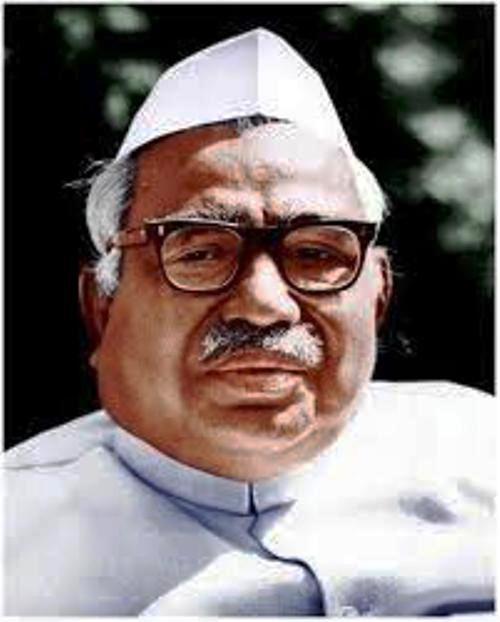
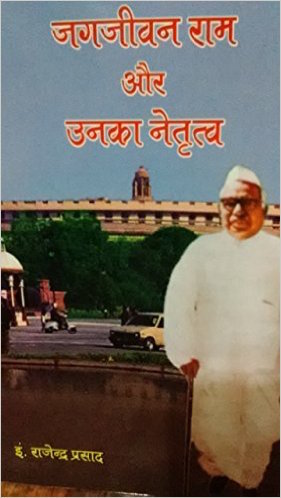
Many books have been written on the life and the struggles of former deputy prime minister and freedom fighter Babu Jagjivan Ram. However, Rajendra Prasad’s book on Babuji, Jagjivan Ram Aur Unka Netratva, stands out in more ways than one. The writer has not confined himself to portraying the positive aspects of Jagjivan Ram’s life and works; he has made an honest and objective assessment of the negatives as well. Rajendra Prasad was very close to Babuji and worked with him. The popular perception of Babuji, his personal life, political struggle, key speeches and many hitherto untouched facets of his personality – all form part of the book.
Divided into 24 chapters, the book, starting with Jagjivan Ram’s birth and primary education, goes on to describe his entry into politics, his contributions as an MP and as a minister, important incidents of his life, his funeral procession and even the tributes paid to him. The foreword to the book has been written by Dr Razi Ahmed, secretary, Gandhi Museum, Patna. Dr Razi writes, “Babuji’s life was full of struggles but he achieved a lot of success too. He had to grapple with the bitter truths of Bihar’s societal texture… Jagjivan Ram was a brilliant politician, he cannot be confined to the narrow circle of Dalits.” In the preface, Rajendra Prasad says, “A man of multidimensional talents, Babuji was a polyglot and a thinker. He worked for the awakening of all sections of society … Babuji influenced the social, economic and political life of the country for nearly five decades.”
Referring to his parliamentary and ministerial life, Rajendra Prasad notes that Jagjivan Ram served as minister for 31 years in the Cabinets of four prime ministers. He represented the Sasaram parliamentary constituency, Bihar, in the Central Legislative Assembly, Constituent Assembly and in the first eight Lok Sabhas. He was the youngest minister in the interim government. When he was sworn in on 2 September 1946, he was only 38. As union minister, he held the portfolios of Communications, Railways, Transport, Labour, Employment and Rehabilitation, Food, Agriculture, Irrigation, Cooperatives and Defence from 1952 to 1979. As a minister, he took many decisions that turned out to be milestones for the country.
On many occasions, he came tantalizingly close to becoming the prime minister but every time the circumstances were against him, though he did become the deputy prime minister. Rajendra Prasad says that he does not have an iota of doubt that had Babuji not been a member of the Scheduled Castes, he would have become prime minister. The stigma of the caste he was born into always came between him and the prime ministership. The author says that Babuji’s long innings as a parliamentarian and a minister and his steady rise made many envious of him, and he became the victim of a conspiracy. But Jagjivan Ram did fulfil Dr Ambedkar’s dream of Dalits partnering in the governance and administration of the country.
Disappearing legacy
Jagjivan Ram founded many institutions aimed at aiding the SCs and weaker sections of society but after his passing away, these institutions either collapsed or were turned into personal fiefdoms by his kin. Jagjivan Vidya Bhawan (New Delhi), Ravidas Memorial (Rajghat, Kashi), Jagjivan Sewa Ashram (Sasaram), Bharatiya Dalit Sahitya Academy and many other institutions are in poor condition. Even his memorial in his ancestral village, Chandwa, is mired in controversies. Rajendra Prasad says that Jagjivan Ram was a visionary who thought ahead of his times. Babuji believed that knowledge was power and that is why he laid the foundation stones of and inaugurated many institutions of learning. But it is sad that his legacy is not being taken forward.
Second edition in six months
The first edition of Jagjivan Ram Aur Unka Netratva came out in February 2015 and was sold out within a couple of months. The revised second edition came out in July 2015. An IIT alumnus, Rajendra Prasad presently works for the Bihar government. He has written more than a dozen books, with this biography being the latest.
(Published in the April 2016 issue of the FORWARD Press magazine)