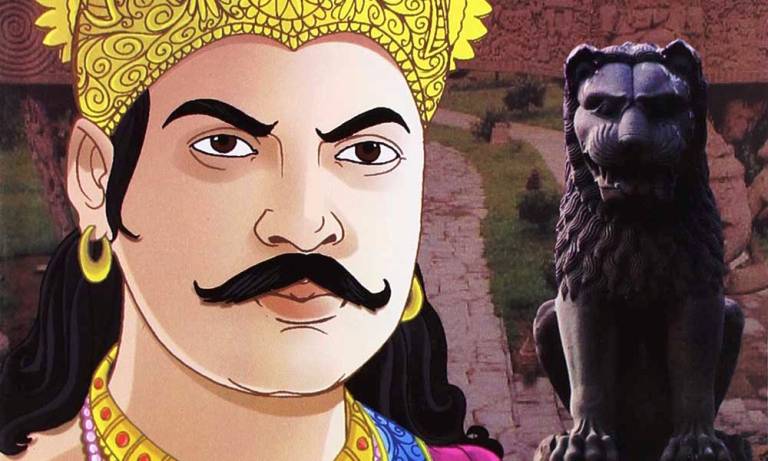
The history known so far suggests that it was the Mauryan rulers who began the tradition of celebrating birthdays in India. Quoting Strabo (Amesia, 64BC-19AD), Bhagwatsharan Upadhyay writes, “Chandragupta Maurya used to mount grand celebrations on his birthday every year [Brihhatar Bharat pp35-36].”h
Similarly, Emperor Ashoka also celebrated his birthday. Historians believe that he also started the tradition of releasing prisoners on his birthday (Pracheen Bharat Ka Rajnaitik Evam Sanskritik Itihaas p321).
There are reasons to believe that the day of Ashtami held a special significance for Ashoka. The slaughter of oxen, goats, sheep, pigs and other animals was banned on the eight day of every lunar fortnight (Patliputra Kee Katha p152).
The annual festival of Patliputra, which has been described in great detail by Chinese traveller Fa-Hien, was celebrated on Chaitra Shukla Ashtami. Fa-Hien writes that a procession of 20 huge, well-decorated chariots was taken out every year on the eighth day of the second month of the year. (Pracheen Bharat Ka Ithihas, B.D. Mahajan, p463).
Many historians have wrongly interpreted the date of the annual festival mentioned by Fa-Hien. On the basis of the present lunar calendar – in which Baisakh is the second month of the year – they have concluded that this date pertains to the month of Baisakh.
Fa-Hien had come to India around 1600 years ago in the Guptan era. At that time, Phalgun was the first month of the year. This can be verified from the report of the Calendar Reform Committee (1955), which says that the festivals that were celebrated 1400 years ago in particular seasons, have retreated by 23 days. Today, spring equinox takes place in Chaitra. Hence, Chaitra Shukla Pratipada is celebrated as the New Year’s Day. The time of Spring Equinox goes back by 20: 24.28 minutes every year. That is why in the age of Fa-Hien, the first month of the year was Phalgun and Chaitra was the second month.
Thus the annual festival Fa-Hien talks about in his travelogue is the Ashokashtami celebrated on Chaitra Shukla Ashtami. Krityaratnavali, Kurmapuran and Vrat Parichay describe celebrations of Ashokashtami in detail. (Puranakosh p36).
kIn Puranic sources, the link between the Ashok tree and Ashokashtami is well documented. Let us refer to Buddhist treatise Divyavadan to understand this link. It says that Ashoka liked the Ashok tree because the similarity in names. Or, just recall Hazari Prasad Dwivedi’s Chanwardharini Yakshini, which stands in the Mathura museum, holding a sapling of Ashok.
This proves that the annual Ashokaashtami (This year 14th April) festival, celebrated on Chaitra Shukla Ashtami was the birthday of Ashoka, which the mythologists have assiduously linked with only the Ashok tree, disassociating it from the Emperor.
Published in the February 2016 issue of the Forward Press magazine
Forward Press also publishes books on Bahujan issues. Forward Press Books sheds light on the widespread problems as well as the finer aspects of the Bahujan (Dalit, OBC, Adivasi, Nomadic, Pasmanda) community’s literature, culture, society and culture. Contact us for a list of FP Books’ titles and to order. Mobile: +919968527911, Email: info@forwardmagazine.in)