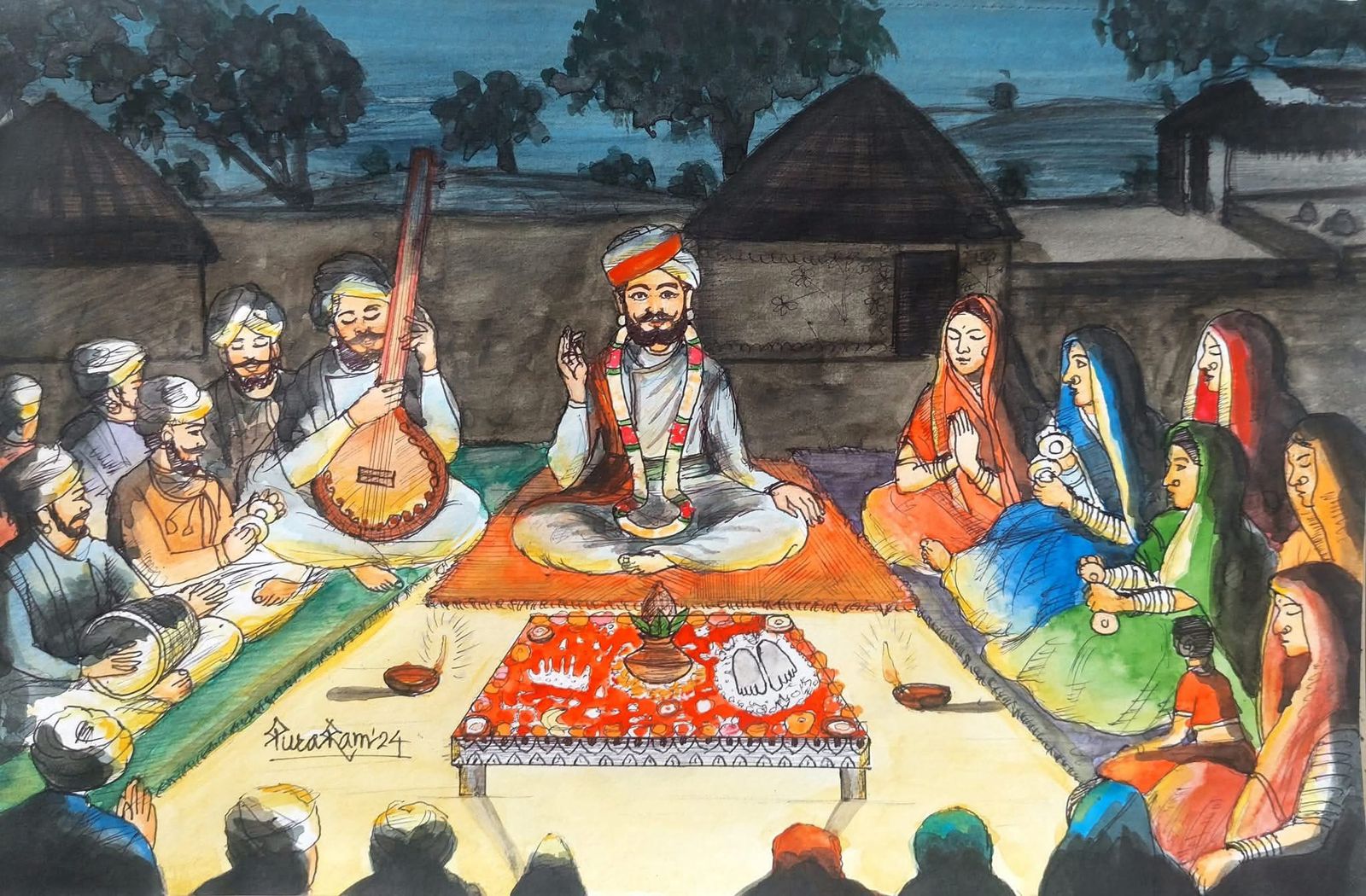
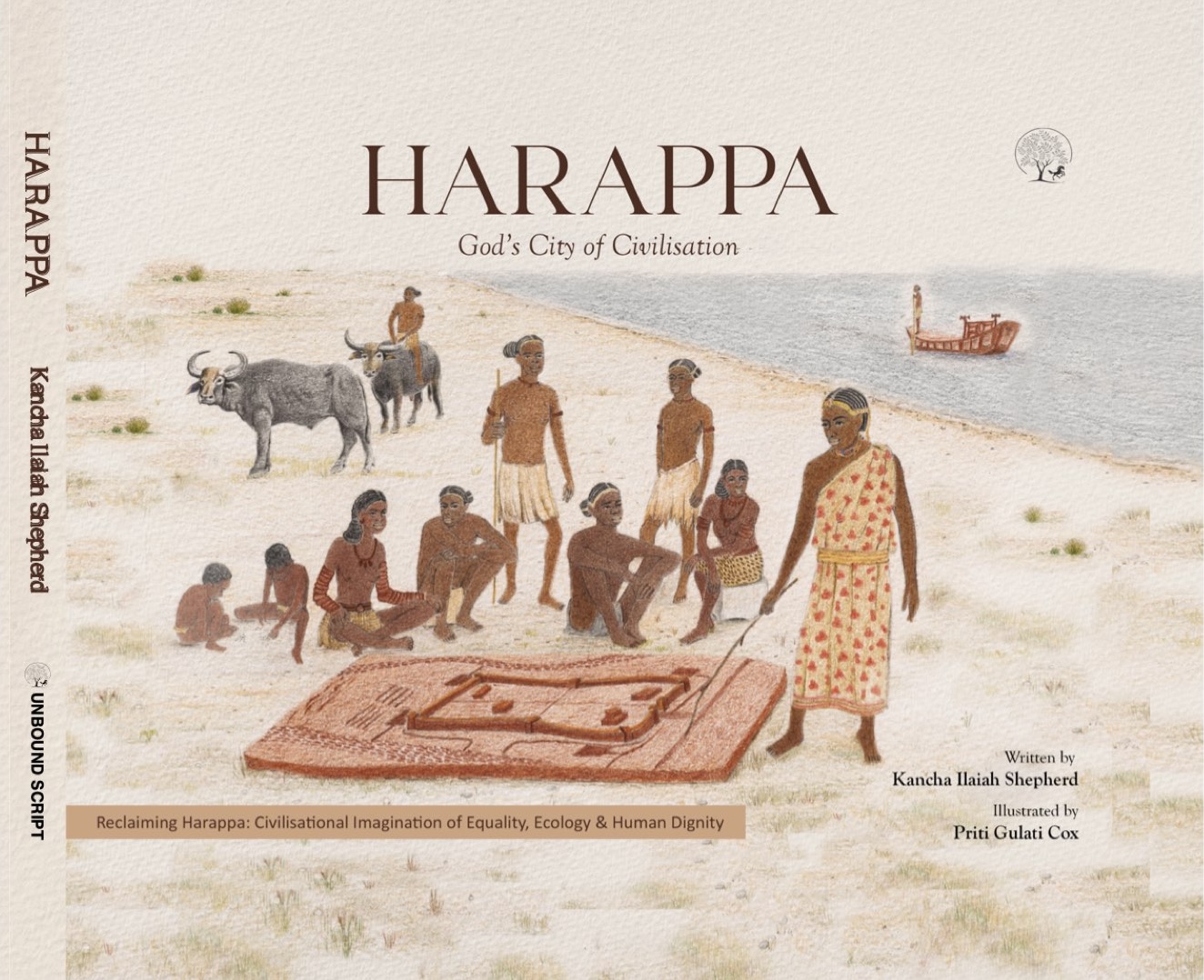
My just-released novel Harappa: God’s City of Civilisation, published by Unbound Script, New Delhi, with magnificent illustrations by Priti Gulati Cox is an unusual experiment in the literary history of India. Critic Satya Sagar described it as a counter myth and product of courageous imagination. We have in the guise of history only purely mythical Brahminic Sanskrit literature, texts starting with Rigveda followed by Ramayana, Mahabharata and so on. There is no historical source of production, animal economy and collective culture and even what they call civilization. Ramayana and Mahabharata were woven around characters of Brahmin and Kshatriya heroes, ascetics and some women.
My novel, on the other hand, draws on the world’s oldest city – Harappa – that existed around 3000 BCE in the Sindhu river basin. Excavations, DNA studies, reading and rereading of archaeological artefacts by scholars from India and abroad have proved that there was a city with this name and it had a civilizational, cultural and economic strength that was unmatched globally at the time.
India as a nation today can be proud of its civilizational roots in Harappa. The protagonist of my novel is Harappa as the one who builds the world’s greatest city of his time, with the assistance of his wife Maisamma after Harappa himself domesticates the buffalo. Maisamma builds the world’s first water tank. They gradually transform Jambhu Dwipa, a village named after Harappa’s father into a massive city Harappa. He becomes the first king of that city state. The story goes on till some foreigners arrive.
Harappa was the ancient historical city, not Ayodhya
Harappa was the first major global city. In many aspects it was different from the ancient cities of Egypt, Israel, Greece and Rome. Harappa had many special civilizational strengths that other ancient cities did not. From houses built with bricks and sustainable wood to canals, the connection with the present Indian village and town with agrarian life is apparent.
Harappa laid the foundation for the advancement of knowledge of humans and has left behind information about their living environment, animal economy, productivity, science, engineering almost 1500 years before Aryan (Brahmin, Kshatriya and Bania) migration or invasion took place. It was much later that the rest of the world reached that level of civilizational advancement.
In contrast, the town we know of as Ayodhya, the capital of Dasharatha, the father of Rama – now what the Hindutvawadis call Rama Rajya – seems to be a city of much later period. It seems that most of the so-called ancient cities and other locations that bear names from the texts of Ramayana or Mahabharata were named after those names first appeared in those texts. Harappa, on the other hand, is the oldest historical name of a place. I am of the opinion that the city could have been named after its builder, Harappa. The practice of naming villages and cities after people has been a historical practice in India. My belief has been reinforced by the fact that there are hundreds of such names that end with the suffix “appa” in South India. Harappan troops who migrated to the south may have taken these names with them.
Ayodhya and Dwaraka
Neither Ayodhya named in Ramayana nor Dwaraka named in Mahabharata have proven excavational evidence of having been ancient cities. Some excavations were done in Ayodhya after a court order in the context of the Babri Masjid dispute and a report was prepared by the Archaeological Survey of India saying that there are some relics of ancient constructions in that place dating to 700-300 BCE. However, it did not have strong evidence in terms of artefacts. Not much evidence was found about Ayodhya’s economy, animals, technology and so on. Even if we go by that report, Ayodhya came into existence much later than Harappa. Obviously it was built almost 800 to 1000 years after the Aryan Brahmin migration took place. There has not been a single scholarly study on those findings from the Ayodhya excavation unlike in the case of Harappa. The descriptions of the characters, their dress codes, the palaces they lived in, the ornaments they used and the chariots they rode in Ramayana give the impression that they were very modern. How did those kings and their women get such clothes and ornaments? If that was an ancient civilizational life, how could they use such dresses, ornaments, houses and vehicles. Of course, their idea of Krita Yuga is very recent and imaginary with absolutely no evidence. Both Ramayana and Mahabharata are novels written with purely imagined figures. The Indian Shudra/Dalit/Adivasis should not trust any book written by Brahmin/Ksatriya/Vaisya writers because they wrote only about themselves. They never even recognized the existence of the productive forces of India – Shudra/Dalit/Adivasis – let alone their antecedence. This is where my novel Harappa becomes very important for the future generations of India. Even the Brahmin Brahmin/Bania/Ksatriya youth have to realize that the Sanskrit literature, which did not deal with the lives and contribution of productive masses, has no value for the nation. The Indian youth have to reconstruct the Indian past from the Harappa city civilization onwards to acquire a respectable stature in the global knowledge systems. Reading mere Brahmin/Ksatriya life as ancient parampara of the nation will lead to a clash of cultures among Indian castes. Unity among all castes becomes possible only when you go to the casteless society of Harappan times.
The true story of an ancient civilization and its people lies in Harappa, not in Ayodhya or Dwaraka.
My novel
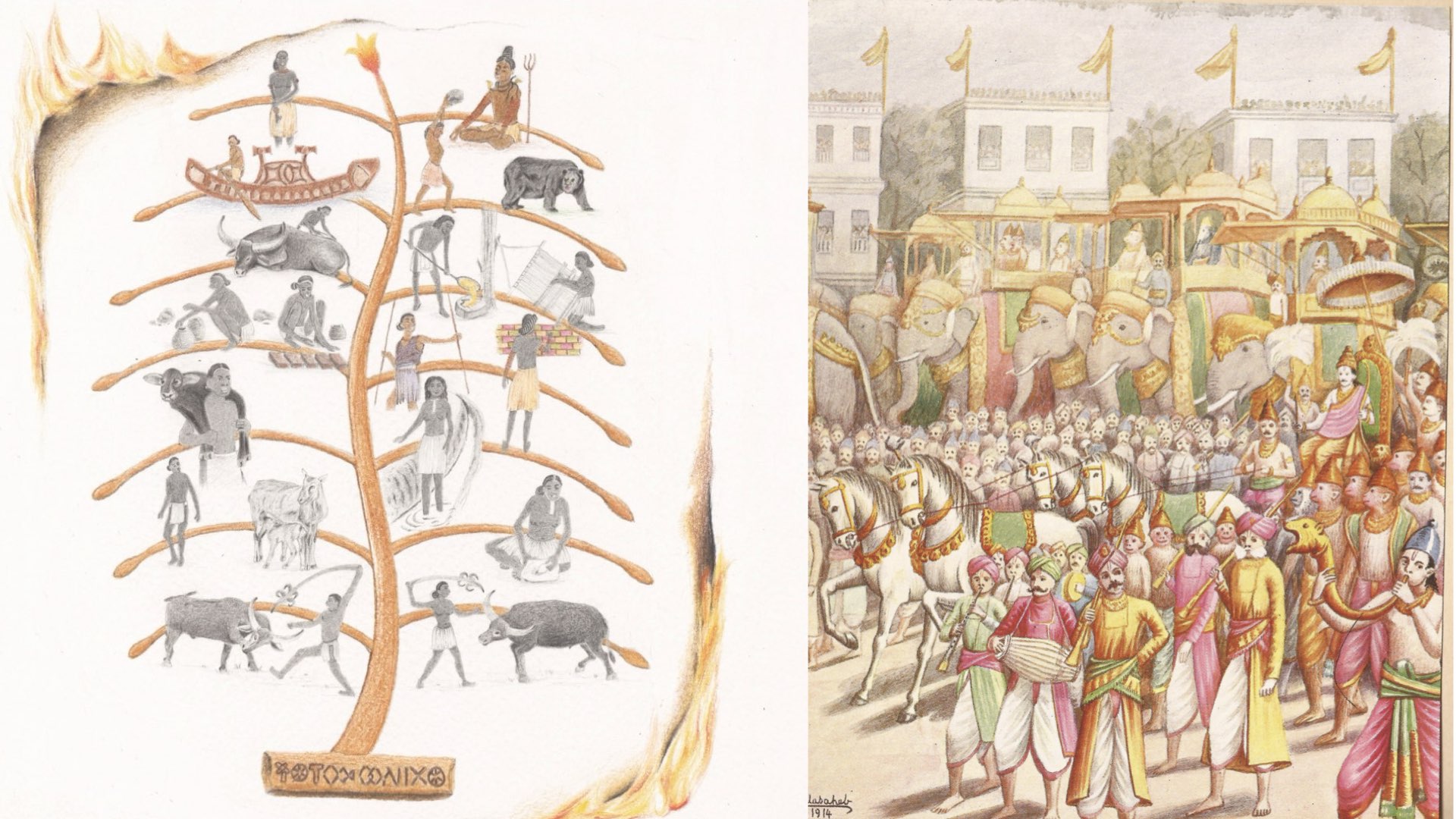
Harappa: God’s City of Civilisation shows the evolutionary process of human society, economy, relations between humans and animals, technology and science in India’s antiquity. The book Ramayana, on the other hand, does not show the kind of animal economy the Ayodhya kingdom had starting with the rule of Dasharatha. Even a work of fiction will have to show the nature of agriculture, animals, artisan production and usage of technology in those times. Ramayana only deals with the Ksatriya royalty and Brahmin ascetics. How did society survive without food producers at that time? Who were producing food, supplying meat and milk products to Ksatriya rulers and Brahmin ascetics? Naturally when there were Ksatriya kings and Brahmin ascetics, there would have been Shudra food producers, based on the varna-based division. In that social system, Ksatriya kings and Brahmin ascetics never got involved in food production. A story of ancient India would have to show ancient values, lifestyles, artefacts, technology. If a narrative claims to be ancient, yet features lifestyles and technologies that are more recent, the writer’s maturity will be called to question. Even a novel has to be located within a time frame. If Ramayana was written by a person called Valmiki the text has to give an indication of the time frame in which lived and the social, economic, cultural environment that existed in those times. Ramayana does not tell us anything about the lives of the people who sustained that society. My novel tells about the masses who built this nation’s early civilization from which India of today evolved.
Harappa shows the ancient evolutionary character of society that was learning things gradually and collectively. The production process is a collective labour process. So is war. Ramayana tells about how Vanaras helped Rama in the war against Ravana. His victory was a collective effort. In fact food production, house construction, making productive tools and weapons for war need a more organized long-term collective effort. Ramayana does not tell anything about that fundamental process in Ayodhya or the life in nearby villages.
Any spiritual or social text will have to deal with masses of that time. They may be slaves or masters. But Ramayana and Mahabharat dealt only with the Ksatriyas and Brahmins who constituted the ruling class and the religious heads. Such books do not reflect India and the Indian people. When Ksatriya rulers are projected as gods and goddesses the very idea of religion itself gets distorted. Once the idea of God is caste-centered, that divine agency remains completely alienated from the productive masses on whom humanity depends for survival. My novel runs contrary to the narrative in the Ramayana and Mahabharata and is set hundreds of years before even their fictional time frame of Krita Yuga and Dwapara Yuga.
Domestication of animals and birds
So far no social science book or a work of fiction has dealt with the process of how human beings could domesticate sheep, goats and more importantly one of the most ferocious wild animals, the water buffalo. Nobody has given an account even of when and how the chicken was domesticated. Domestication of animals and birds was a scientific process and involved studying the psychology of animals and birds. My novel deals with this struggle of Harappa, his father Jambhav and his mother Sindh to domesticate the buffalo, sheep, goat and chicken. While Jambhav domesticated sheep and goat Harappa himself domesticated buffalo. His mother’s efforts to domesticate chicken and how she laid the foundations of the milk and curd (yogurt) economy has been graphically explained. Generally, writers presume that these animals were around to be used by humans. But before they were domesticated humans had to hunt and eat. After animal domestication human lifestyle underwent a sea change as the meat and milk economy became the home and village economy. Without the domestication of animals and birds humans could not have sedentary village economies and without such economies no city could have come into existence. Harappa: God’s City of Civilisation is a creative depiction of this process.
How I realized that Harappa was a man’s name
Most villages and cities in India even today are named after the man or woman who played a key role in settling that village or city. It is a known fact that cities and towns are the result of expansion of villages. In ancient and medieval times, cities were never planned and built like Chandigarh in modern India. Nowhere in the world were cities a one-time building project. A city is formed by the continuous expansion of a village.
There are a number of names in South India that end with “appa”. There are also godheads like Ayyappa, Beerappa, Ramappa and so on. The Ayyappa temple of Kerala is well known. Beerappa is the god of the shepherd communities across South India, more pronouncedly in Maharashtra among Dhangar community and among Kuruma/Kuruba communities in Telangana, Andhra Pradesh and Karnataka. A Beerappa temple can be seen in every village where these caste communities live. The Ramappa temple is located in north Telangana, near the town of Mulugu.
There are hundreds of personal and family names suffixed with “appa” in South India – Bangarappa, Veerappa, Mallappa and so on, apart from those are named after deities like Ayyappa, Beerappa and Ramappa. There are several villages with names that end with the word “Appa”. It is this socio-anthropological cultural environment of South India that got me thinking that Harappa would have been the name of a man in ancient India, after whom the historical city was named.
The process of writing this novel began with a sociological understanding of this similarity in names as well as the discovery by archaeologists and historians that Harappa shared many similarities with South India – people’s skin colour, their agricultural tools, housing patterns and so on.
The name Harappa does not figure in any Aryan Sanskrit books or names of people of Aryan heritage even today.
A village settles and advances only when there is a well developed animal economy, agriculture and artisanal craftsmanship. The people can develop all kinds of tools in the village only when there is a reliable supply of food available and they don’t have to hunt and fish everyday for survival.
In my novel the village Jambhu Dwipa comes into existence with the domestication of sheep, goat, chicken, dog by Harappa’s father Jambhav and mother Sindh. Jambhav’s father and mother were Mahisha and Pocha. Mahisha and Pocha were the first known couple who lived depending on nature and under trees and caves, but from Jambhav and Sindh onwards animal and chicken domestication paved the way for artisanship and the settling of a village. That was great advancement.
The idea of God
The idea of God has been presented in the book as a process of new thinking and imagination. The people of Jumbhu Dwipa were also forming new ideas about life.
The idea of God was abstract at the beginning. Then some people wanted to introduce idol worship. However, Harappa strongly opposes the idea of projecting humans as gods and goddesses. But in the process, Harappa becomes the king of the city state. Then another person, Adidevudu, claims that he has some speculative, foreseeing powers and predicts aliens arriving and destroying his city state. Harappa begins to take him seriously. Adidevudu thus became the first human being to be accepted as equivalent to God.
My view is that those indigenous (Mulavasi) people of India, by the time they built the city of Harappa and that great civilization, had a well developed idea of God in two contending forms – abstract God and human God. Over a period of time the idea of human God took the form of an idol. Adidevudu represents that divine cultural stream.
This novel is in fact going to establish that mythological books like Ramayana and Mahabharata were written to bring society under the complete control of Brahmin writers and priests with the assistance of Ksatriya rulers. Both these castes became anti-production and gradually turned against productive science, technology and advancement. Those adults and children who read Harappa: God’s City of Civilisation will realize that India’s ancient roots lie in Harappa.
Forward Press also publishes books on Bahujan issues. Forward Press Books sheds light on the widespread problems as well as the finer aspects of Bahujan (Dalit, OBC, Adivasi, Nomadic, Pasmanda) society, culture, literature and politics. Contact us for a list of FP Books’ titles and to order. Mobile: +917827427311, Email: info@forwardmagazine.in