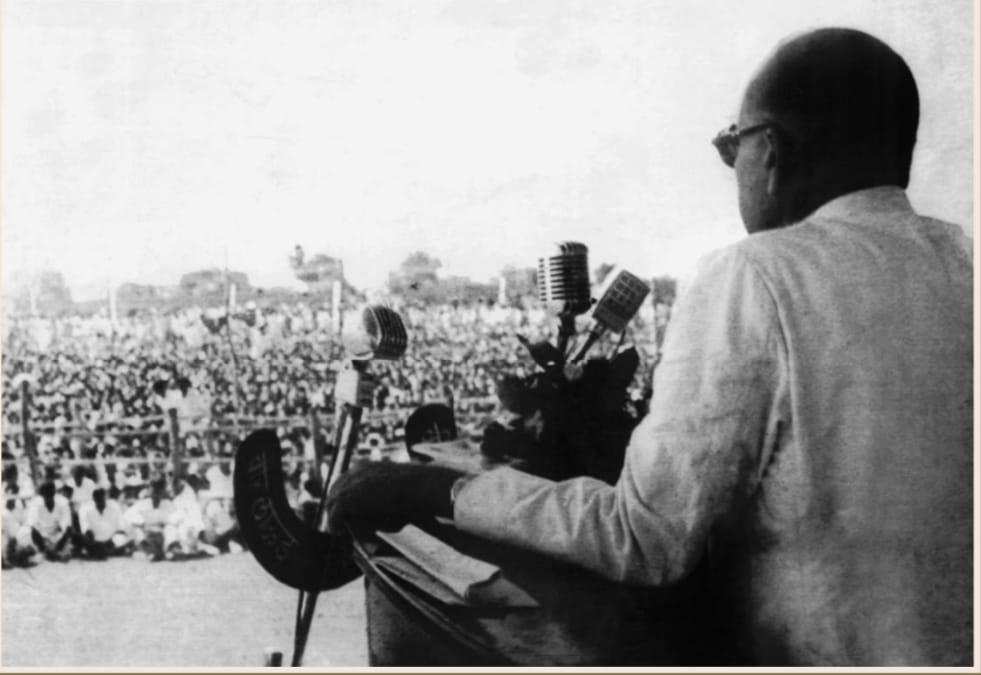
Jotirao Phule’s birth anniversary should be celebrated as Teacher’s Day
It is baffling why Dr Sarvepalli Radhakrishnan’s birthday has been recognized as Teacher’s Day. What qualities of his prompted the Congress government of the day to take this step? What made it glorify Radhakrishnan as an educationist, when he was actually a hypocrite and a staunch casteist? He made no contribution to the development of education in India. Indeed, most of his recommendations as the president of University Education Commission, after his appointment in 1948, were downright backward, regressive in nature. Regarding women’s education, he observed that women and men are equal but they have different domains, hence women’s education should be such that she becomes an ideal mother and an ideal housewife[1]. This gives us an idea of his standards as an educationist.
How interesting that we blame the Rashtriya Swayamsevak Sangh (RSS) and the Bharatiya Janata Party (BJP) for spreading the brahmanical culture even though the credit for its establishment goes to the Congress. Fascinated by the Vedas and Upanishads and the Varna system, it foisted on the country a staunch supporter of Hindutva as an educationist. How can someone who considers the Varna system as the ideal support universal education? No Hindu ruler can be given credit for universalization of education. The British alone made that possible. Had they not opened up education to the public, would Jotirao have been educated? It was after he received an education from the Scottish Mission School that he understood its importance, and along with Savitribai set up schools for Bahujans and women. Given this history, if there is anybody in India whose birthday should be celebrated as Teacher’s Day it is the great hero of the Bahujans, Jotirao Phule. How can Sarvepalli Radhakrishnan usurp Phule’s credentials?
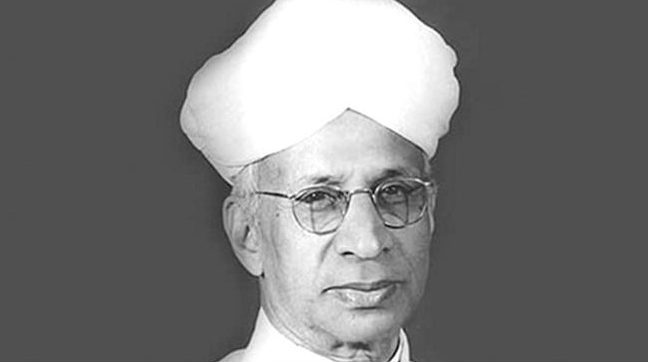
Sarvepalli Radhakrishnan is hailed as a great philosopher of India. In reality, he was a religious preacher, not a philosopher. In a very systematic way, he established himself as the last philosopher in the tradition of Adi Shankaracharya. Like Shankaracharya, Radhakrishnan also upheld the condemnable rules enunciated in the Manusmriti. He observed that the Manusmriti is basically a religious text, a compilation of moral values, and that it re-established the glory of customs and traditions at a time when they were being undermined[2]. He rued that with the loosening of traditional values the power of orthodoxy – which recognizes Vedic yagyas and considers Varna (determination of caste based on birth) as the will of God – also had waned. Therefore, he said, acquisition of knowledge is the duty of the Brahman; Kshatriya must protect the weak; business and agriculture is the responsibility of the Vaishya; and Shudra is duty-bound to serve others[3].
It is not the RSS alone that is enamoured by Radhakrishnan’s knowledge of Hinduism. Surprisingly, even the Supreme Court, in a judgment relating to R.Y. Prabhu and P.K. Kunde on 11 December 1995, based its decision on a line from Radhakrishnan’s book Indian Philosophy that says Hinduism is a way of life and a tolerant religion. No decision can be impartial or just unless Dr Ambedkar’s views are taken into account. Dharamvir Bharati[6] has aptly commented on this case: “But while pronouncing the judgment, the honorable Supreme Court has not taken into account what renowned scholar Rahul Sankrityayan has written: That Dr Radhakrishnan is an orthodox ‘religious preacher’.”[7]
That Radhakrishnan was a great philosopher is merely a mischievous propaganda. He was a Brahman writer who injected Hindutva into Indian philosophy, particularly Veda-Vedanta into Buddhist philosophy. Sankrityayan wrote that only a Hindu writer like Radhakrishnan[10] could make the irresponsibly audacious claim that Buddha was Dhyana and Prarthana Margi and believer in the supreme power[11]. Dr Ambedkar, in his essay “Krishna and Gita”, has also vehemently attacked the opinion that Gita was written before Buddha[12]. Dr Ambedkar has proved with evidence that Gita was written to thwart the “counter revolution of Buddhism”[13].
While Radhakrishnan observes that in India God created man and the success of its culture and civilization lies in its illiberal liberalism, Sankrityayan counters by asking how the Indian culture and civilization managed to declare a third of Hindus untouchable. “How did it prevent caste unity by ascribing caste discrimination to the system that emanated from Brahma’s mouth? … All this is due to illiberal liberalism and therefore man is the creation of God in India … We know that devotees and philosophers like Sir Radhakrishnan have so thoroughly misrepresented India for centuries that it is now more dead than alive.”[15]
In the same book, Rahul Sankrityayan writes, “People like Sir Radhakrishnan are acting as feeders to exploitation in India and doing what scientists like Sir Arthur Eddington have done to protect the interest of the clergy class of England.”
There can be no justification for remembering a staunch casteist and an ardent Hindu – in other words, a Brahmanvadi – like Radhakrishnan as an educationist[16].
Reference:
[1] Dr Sitaram Jaiswal, Bharatiya Shiksha ka Itihaas, 1981, Prakashan Kendra, Sitapur Road, Lucknow, Page 259
[2] It is hinting at the period of Buddha. Clearly, Manusmriti was created after the period of Buddha
[3] Sarvepalli Radhakrishnan, Bharatiya Darshan (Hindi translation of Indian Philosophy), Volume 1, 2004, Rajpal & Sons, Delhi, Page 422
[4] Dr Babasaheb Ambedkar, Writing and Speeches, Volume I, 1989, Government of Maharashtra, Mumbai, Page 66
[5] Dr Babasaheb Ambedkar, Jati Ka Vinash (Hindi translation of Annihilation of Caste), trans Rajkishore, 2018, Forward Press, New Delhi, Page 96
[6] Dharamvir Bharati, Dalit Bharatiyata Banam Nyaypalika me Dwij Tatva, 1996, Page 6
[7] Rahul Sankrityayan, Darshan Digdarshan, 1944, Preface, Page 5
[8] Sarvepalli Radhakrishnan, History of Philosophy, Volume I, Page 2 (Hindi translation by Nandkishore Gobhil, Volume 1, 2004, page 18)
[9] Rahul Sankrityayan, Darshan Digdarshan, 1998, Preface
[10] Sarvepalli Radhakrishnan, Indian Philosophy, Volume 1, First Edition, Page 355
[11] Rahul Sankrityayan, Darshan Digdarshan, Page 408
[12] Dr Babasaheb Ambedkar Writing and Speeches, Volume 3, 1987, Chapter 13
[13] Ibid, page 369
[14] Rahul Sankrityayan, Vaigyanik Bhautikwad 1981, Lokbharti, Allahbad, Page 64-65.
[15]Ibid, 80-81
[16] Ibid, 85
Translation: Parmanand Baiga; copy-editing: Anil
Forward Press also publishes books on Bahujan issues. Forward Press Books sheds light on the widespread problems as well as the finer aspects of Bahujan (Dalit, OBC, Adivasi, Nomadic, Pasmanda) society, culture, literature and politics. Contact us for a list of FP Books’ titles and to order. Mobile: +917827427311, Email: info@forwardmagazine.in)
The titles from Forward Press Books are also available on Kindle and these e-books cost less than their print versions. Browse and buy:
The Case for Bahujan Literature
Dalit Panthers: An Authoritative History