(The month of April has a special significance for the Dalitbahujan. The nation celebrates the birth anniversary of Jotirao Phule on April 11 and of Dr Ambedkar on April 14 with great fervour and enthusiasm. Phule was born on 11 April 1827. Thus, 11 April 2026 marks the beginning of his 200th birth anniversary. FORWARD Press is publishing a series of articles on Phule and his ideology to mark the occasion. Here is one by Dr Rajendra Mundhe.)
The life and works of Mahatma Jotirao Phule – the harbinger of a social revolution in India – represent a momentous endeavour to re-establish the values of equality, justice and human dignity in Indian society. He was no drawing-room intellectual. He built a social movement by implementing his ideas on the ground. He initiated education for women, set up schools for the Shudras and the Atishudras, worked for the welfare of the widows and established ‘Balhatya Pratibandhak Griha’ (Home for Prevention of Infanticide). He challenged socio-religious hegemony through his Satyashodhak Samaj. All these were different dimensions of his work. Emancipation of humanity was central to his thinking. He was against any kind of discrimination on the basis of religion, caste or gender.
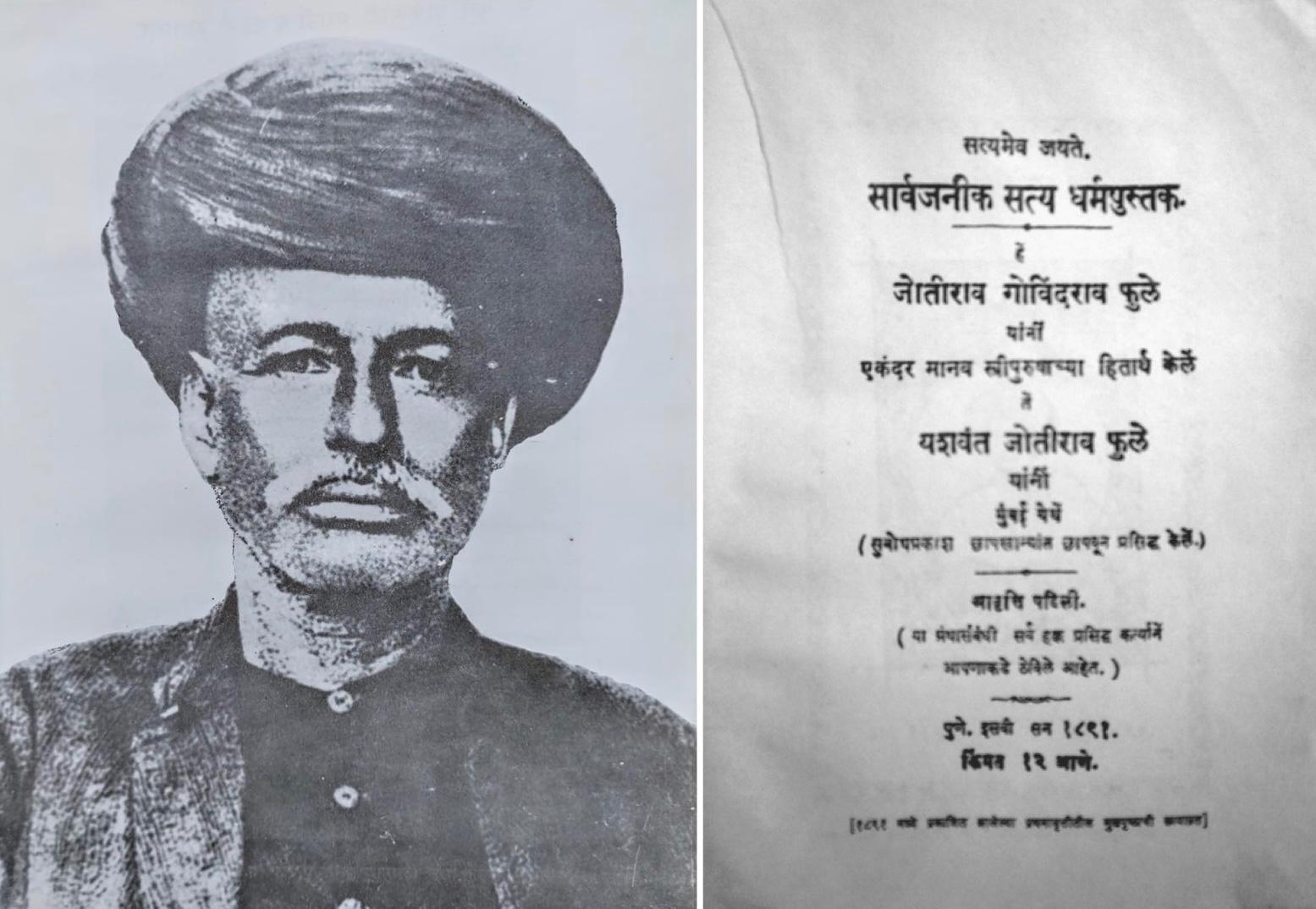
His book Sarvajanik Satyadharma represents the zenith of his philosophical musings. He proposes a new religion which will have no place for priests, scriptures and caste. Truth, morality and universal humanism would be its foundations. ‘Satyadharma’ is basically a moral-social order which accords the highest importance to equality and brotherhood. Phule’s ideas went beyond social reform. They constituted a universal humanistic philosophy.
Phule’s literature was an extension of his ideological struggle. For him, literature was not only an aesthetic endeavour, but a tool for social change. His writings span a wide range of genres. They include plays, powadas (ballads describing valour of warriors), essays and “akhandnatmak kavya” (poetry). Tritiya Ratna, written in 1855, is considered the first modern social play in Marathi. It is a theatrical depiction of issues like blind faith, priestly dominance and lack of education among women.
Similarly, his powada Chattrapati Shivajiraje Bhosle Yancha presents the life of Chhatrapati Shivaji Maharaj from the Bahujan perspective and differs starkly from the traditional depiction of the Maratha warrior in history. Gulamgiri and Shetkanyacha Asud logically analyze social and economic exploitation. Phule’s works, despite spanning many genres, have a singular objective – raising social consciousness and awareness.
His experimentation with poetry also deserves a mention. Inspired by the “abhang” poetry of Sant Tukaram, he crafted a new Marathi poetic form called “akhand”. It is characterized by a consistent flow of thoughts and social messaging. He refashioned abangs – a form of devotional poetry – into a vehicle for spreading social consciousness. “Akhand” is not just a genre of poetry. It is a powerful ideological tool that challenges the established socio-religious notions.
Ironically, despite the wide sweep of his literary works and his originality, the critics of mainstream Marathi literature did not accept Phule as a litterateur for a long time. And that had little to do with literary canons. Social and historical factors were behind it. The first of them was casteist bias. At the time, literary discourse was the exclusive preserve of the upper castes. It had its own set of cultural and linguistic criteria. Phule’s writing sought to break this straitjacket. His language was direct and aggressive and close to the lingo of the common man. He prioritized truth and logic over ornamentation and classicism. Hence, his writings were slotted as activist, rather than literary.
The second reason was the Shudra perspective. Phule himself came from a Shudra community and raised his voice in favour of the Shudras and the Atishudras. The anger, the outrage and the resistance that were palpable in his writings made the contemporary Savarna critics uneasy. Hence, his literary works were either ignored or marginalized.
Thirdly, Phule challenged the traditional concept of literature. For him, literature was not only about aesthetics; it was a tool for ushering in social justice. This was in sharp contrast with the then prevalent notion that literature is something to be enjoyed and savoured. His writings were evaluated on traditional standards, which could not have fully appreciated his contribution.
A deeper analysis would reveal that Phule was ignored not owing to literary reasons but because his ideas did not gel with the contemporary social and ideological milieu. Now that the definition of literature stands widened and the marginalized voices are being accepted and heard, Phule’s works are being reevaluated.
The fact is that Phule’s oeuvre has a unique place in Marathi literature. It is eternal. It seeks to address the basic issues confronting humanity and is far ahead of its times. It enunciates the struggle, the pain, the dreams and the resistance of the Bahujan at different levels. His writings not only give voice to the exploited class but also affords it a solid ideological basis.
Thus, Mahatma Jotirao Phule’s writings complement his ideas. His writings infuse life into his ideas and his ideas are the soul of his writings. Projecting him just as a social reformer or only as a writer would only diminish his contribution and his personality. He was a thinker whose writings showed the way to social change. His literary works are like beacons, illuminating the path to social justice.
(Translated from the original Hindi by Amrish Herdenia)
Forward Press also publishes books on Bahujan issues. Forward Press Books sheds light on the widespread problems as well as the finer aspects of Bahujan (Dalit, OBC, Adivasi, Nomadic, Pasmanda) society, culture, literature and politics. Contact us for a list of FP Books’ titles and to order. Mobile: +917827427311, Email: info@forwardmagazine.in