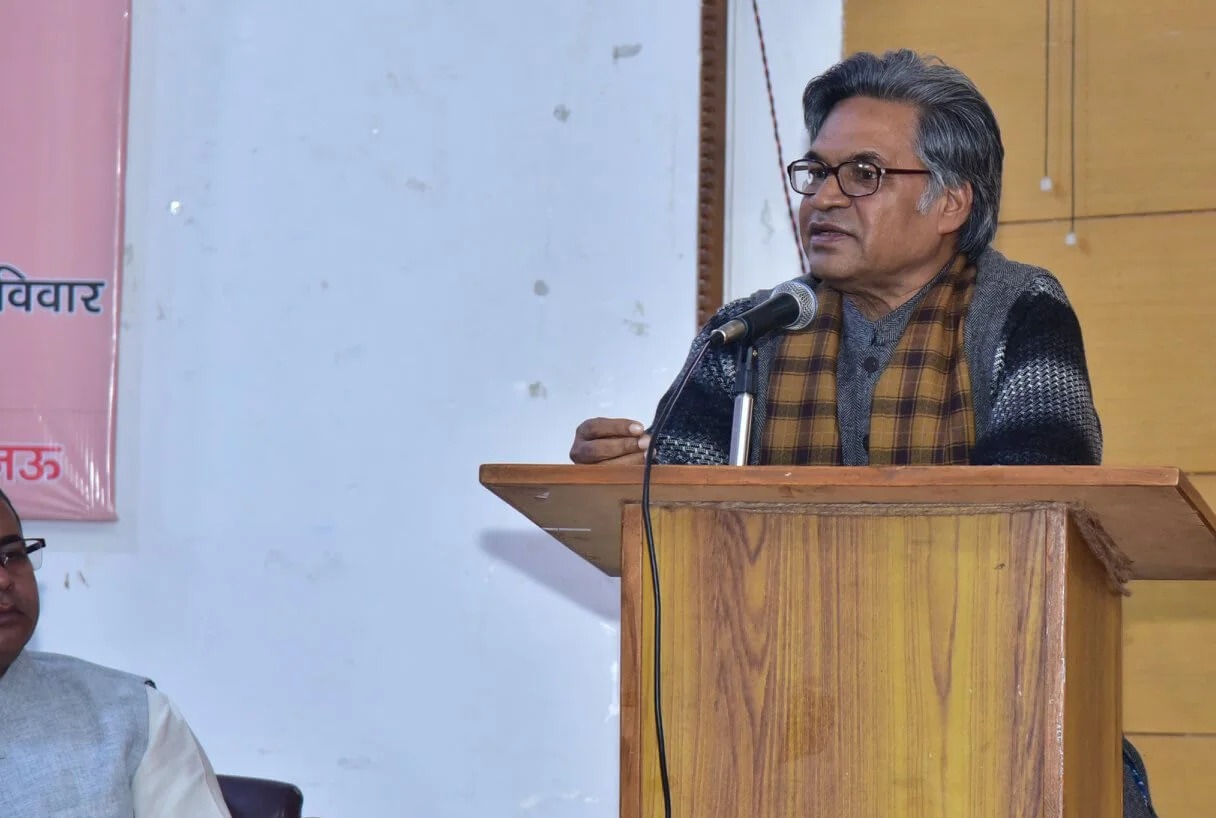
No one could have imagined that Virendra Yadav would depart so suddenly. After his passing on 16 January 2026, well-known journalist Urmilesh shared an old article by Yadav on his Facebook page. Reading it made me think. And here is what I wrote:
“I don’t like using brahmanical similes and idioms but borrowing one, I would like to say that Virendra Yadav, like Neelkanth (A name for Lord Shiva who drank the poison during the churning of the ocean to save the world) absorbed all the digressions and all the indecencies of the leading Savarna figures of progressive organizations. They had turned these organizations into citadels of the Savarnas. But Yadav’s forthrightness and brilliance saved these organizations and progressive individuals from ignominy. Virendra Yadav was committed to the organizations but when the insider Savarna brotherhood launched vulgar attacks on him, the masters of the organizations never stood by him. Despite all this, his personality bloomed and his stature grew – higher than even the president of the organization. That was because despite his serious ailments, instead of confining himself to literary pursuits, he continued countering fascist campaigns with logical and principled rebuttals. However, it would become more difficult when a Savarna protégé of the leaders of the three progressive writers’ associations began batting for the fascists. Even as the old and young of the organizations would swoon to his tunes, Virendra Yadav would dig out vintage facts and logically present them, reflecting his unwavering commitment and intellect. And the shrewd batter would not know how he got clean-bowled. Amid all this, Virendra Yadav was writing for newspapers and magazines – both on his own as well as at the bidding of the editors. When Forward Press published Shudra Vidroh: Taki Ban Sake Atmanirbhar Bharat, the Hindi translation of Kancha Ilaiah Shepherd’s Shudra Rebellion, [‘Samayantar’ magazine editor] Pankaj Bisht asked me who would read the book and write about it at short notice. I advised him to talk to Virendra Yadav. “He won’t say no to you,” I told Bisht. He did that and the piece arrived within the expected time frame. And this happened many times – including in Yogendra Yadav’s ‘Nirmal Prem’ episode. He had no time to rest. So much to do, so many responsibilities, so much stress and such was the atmosphere – he died fighting.”
While it is acceptable to be swept away by emotions and resort to exaggeration while writing or speaking about a just-departed personality, what Virendra Yadav had to endure on Facebook over the past few years makes my post an understatement. In 2021, he was honoured with the Shamsher Samman. Given his scholarship and his prolific contribution, he would have only lent prestige to any award or honour. But the resentment and the bitterness of the Savarna camp came to the fore thanks to Ajay Tiwari. This declared leftist’s fulminations took the form of petty and tasteless comments on Yadav including that he was a casteist. Despite the ignominy Tiwari had earned for himself by his notorious exploits, the kind of backing his post received from writers including Rajesh Joshi, profusely exposed the hollowness of Savarna progressivism. Barring some very mild dissensions, couched in a very roundabout language, the Savarna progressive biggies and their organizations did not protest. A disappointed Yadav wrote in one of his posts, ‘The Hindi literary community is shameless enough to prop up a person held guilty of sexual misconduct by a High Court and dismissed from the services of a university. Does the character of a writer have no bearing on him being conferred with literary honours?’”
At the time, shedding the compulsions of decency, I wrote in my acerbic comment that “It won’t be forgotten that amid the attack of Rajesh Joshi gang and the silence of the Savarna literary caucus, only journalist Urmilesh felt the need to write an article. There were some sporadic voices of protest but even they did not rise from the echelons of the exalted literary circles.”
This hadn’t happened for the first time. On 22 July 2020, Virendra Yadav wrote, “Two decades ago, when I wrote an article on ‘Dr Ramvilas Sharma’s literary criticism’ in a special issue of Aalochna, a Hindi professor, who was a devotee of Ramvilas ji, gave me the titles ‘Ahir Kul Bhushan’ and the ‘Aghori disciple of Namvar Singh’s Shav Sadhak Mandali’ [those who perform Tantric rituals sitting on a corpse], a dog and so on. Another devotee of Ramvilas, reacting to my article on 1857 (mutiny), bracketed me with Rajendra Yadav, announcing a class of ‘Yadav intellectuals’. He also accused me of tarnishing the sacrifices made by the Yadavs in the war. Another intellectual of Ramvilas ji’s caucus called me names in his book because of my caste. Later, he came out with an explanation that a writer had added those portions to the book during proofreading and also expressed regrets.”
Yadav’s social background did not allow him to keep quiet on issues related to social injustice, especially when they concerned caste. He realized that, “One cannot understand writers like Premchand, Renu, Nagarjun and Jagdish Chandra by shutting one’s eyes to caste-based exploitation in India. It needs to be said that this is the age of backlash by the Savarnas, perched, as they are, at the summit of the social power structure. It is not without reason that the likes of Perumal Murugan, Kancha Ilaiah and Anand Teltumbde are being besieged.”
Dazzled by famed authors right from Tulsidas to Ramvilas Sharma, Nirmal Verma, Agyeya Ashok Vajpayee, Vinod Kumar Shukla and others, and given their Savarna values and urges, members of progressive organizations would often begin parroting brahmanical ideas. But at every such occasion, Virendra Yadav would come up with solid facts and irrefutable arguments and with extreme patience, seek to correct the flawed narrative. In other words, he singlehandedly managed to redeem the prestige of the progressive organizations. Whenever bogus debates were used to further a conspiracy, readers seeking truth turned to his Facebook page, hoping to acquaint themselves with the real facts.
Namvar Singh, the patriarch of the Progressive Writers’ Association (PWA, or Pragatisheel Lekhak Sangh), gave a horrendous speech against reservations at the diamond jubilee celebrations of PWA in Lucknow in October 2011. One particularly obnoxious sentence from his speech read, “Thanks to reservations, the Dalits have become well-to-do, but Brahmin and Thakur boys have been reduced to beggary.” Virendra Yadav was one of the leading voices that rose in protest. But that did not curb Namvar’s such tendencies and the Savarnas of all the three organizations continued to hold him in high esteem. His communal and fascist shenanigans continued till his death. While Savarna progressives like Ashutosh Kumar of Jan Sanskriti Manch speaking for his patron Namvar Singh was natural, it was disappointing that Virendra Yadav could never throw off this yoke.
The fact is that to maintain its hegemony, the Savarna leadership has been placing such responsibilities on the shoulders of outstanding progressives from the deprived communities, calling them “strategic assignments”. They persuade Shudras, Dalits and Muslims to defend their retrograde ancestors using ruses like “image of the organization”, “the need of the hour”, “broader outlook”, “image of the organization” and “resisting negativism”. Factual errors in a book on Namvar Singh, which was based on another book edited by his own son, was presented as a conspiracy in true RSS style in a post written by Vishwanath Tripathi and shared on Yadav’s Facebook page. For no apparent reason, the statement made a startling claim that Namvar Singh fought against RSS all his life. In the debate that followed, his insistence that Namvar Singh was against casteism sounded patently pathetic. In any case, Namvar Singh was not known for being just a casteist. He had played an extraordinary role in protecting and preserving the domination of the Savarnas in the Hindi academic world, throwing all norms, rules and morals to the wind. That is the reason Savarna Marxists defend him in unison and are more than willing to sacrifice their ideology for this purpose.
Clearly, the social location of Namvar Singh and Vishwanath Tripathi was very different from that of Virendra Yadav. This applies to the Singh-Tripathi acolytes on the one hand and the progressive individuals genuinely believing in secular values and the Bahujan on the other hand, too. While vehemently opposing Virendra Yadav’s implicit endorsement of Viswanath Tripathi’s post, I realized how difficult it is for a Bahujan to express himself freely without dissociating himself from a leadership adamantly holding on to hegemonistic ideas and traditions. Yadav did not run after positions and awards. He never wished to take centre stage at festivals and events. He only wanted the dignity of the organization to remain intact. The way an RSS thinker was associated with the People’s Literature Festival (PLF) – held in Jaipur as a counter to the corporate circus there on the pretext of a literature festival – must not have been to the liking of Yadav but his training, his sense of discipline and his desire not to hurt the image of the organization did not allow him to articulate his views openly. Although there was no organizational whip vis-à-vis the “Sangat” series by Hindwi, despite being well aware of the communal and anti-left nature of the YouTube video interview series, like other progressive writers, he, too, got pulled into it.
When those who celebrated the demolition of Babri Mosque began finding a place in the columns of Tadbhav magazine there were slight murmurs of protest. But Virendra Yadav kept the company of the progressive Savarnas who chose to keep quiet. This was unfortunate, and even hurtful, because Yadav was considered very close to Tadbhav and its editor, Akhilesh.
As fascist attacks turned fierce and fiercer, writers increasingly turned opportunists even at the cost of secular values. But Yadav took a firm stand vis-a-vis festivals that were basically joint ventures of the corporate and fascist forces. Over the past seven-eight years, he struck many cautionary notes on this issue. On 11 February 2019, he wrote:
“We take part in literary events but forget about the muzzling of freedom of expression. We do not identify the forces that got [Narendra] Dabholkar, [Govind] Pansare, [M.M.] Kalburgi and Gauri Lankesh killed. We do not remember who were the people who whipped up violence against Perumal Murugan’s novel and went right up to the Supreme Court to get it banned; who were those who did not allow the staging of Mahashweta Devi’s play and screening of Anand Patwardhan’s film; who were the people who impeded Kancha Ilaiah’s freedom of expression; who were the people who built up pressure to withdraw invitation to 92-year-old author Nayantara Sehgal. If this is our situation, then let us be clear that we consider our poetry, our novels and our stories as mere performances. As we stand on the stage, we should remember those who were branded urban naxals and thrown behind bars just because they said or wrote something. We should remember the likes of Teltumbde, who may face arrest anytime. We should also remember all those who branded the writers joining the ‘Award Wapsi’ campaign as traitors to the nation. History will remember or forget us depending on whether at this critical juncture, we are willing partners in the unholy alliance of power or we add our voice to the chorus of resistance. I wish we could keep away from joining the procession of Domaji Ustad. It was not without reason that Premchand said that literature is the lamp that marches ahead of politics, it doesn’t follow in its wake.”
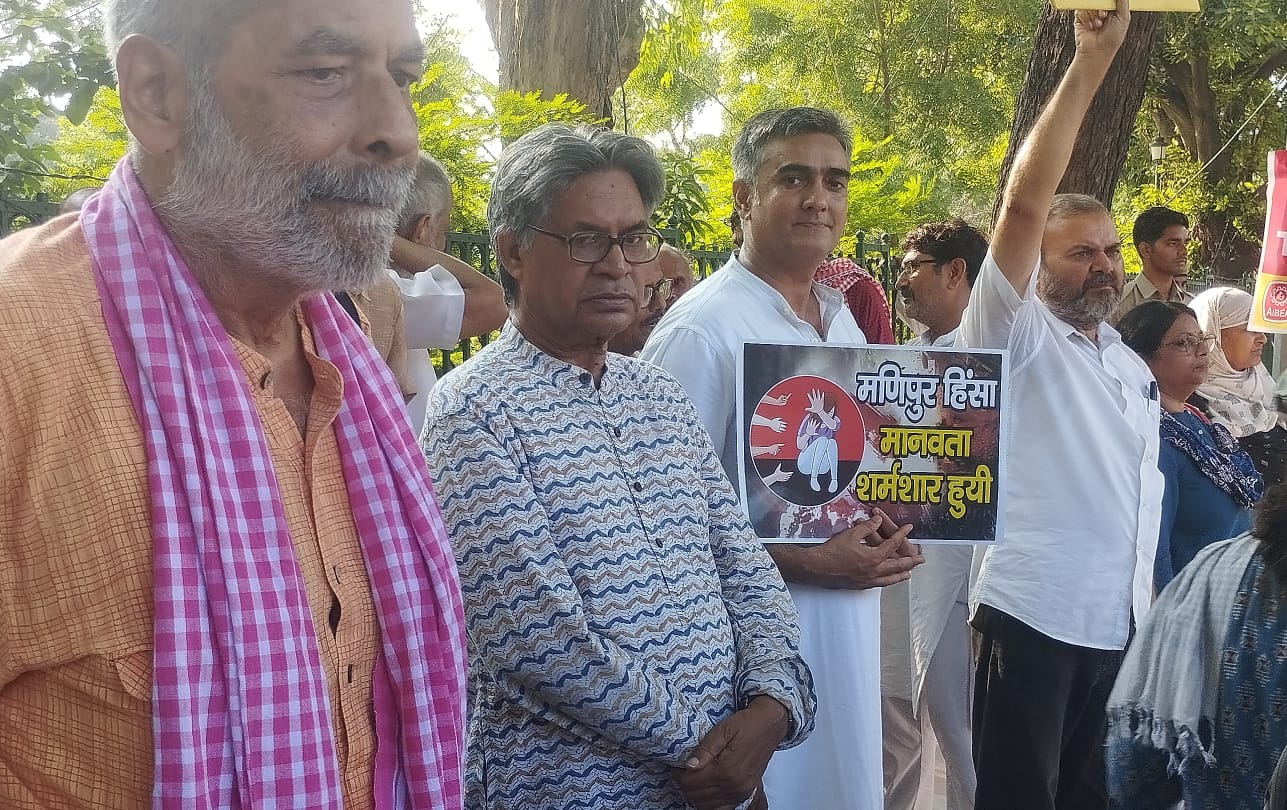
On umpteen occasions, a leftist poet or critic, keen to keep up with the times, jumped onto the other side of the fence and began berating the entire progressive tradition, including Premchand. But the progressive youth and seniors played second fiddle to them, egged on by their caste loyalties. But on all such occasions, Yadav was busy countering the attacks and articulating the responsibilities of the progressive organizations. He could and did realize that it was time to break the chains of courtesy and soft-talk and expose the truth in all its nakedness. It was at the instance of Yadav and other litterateurs like him that at the Chandigarh session of the PWA in October 2024, a resolution was adopted calling for a boycott of sham festivals. But despite that, the name of Naresh Saxena, the chief of the Uttar Pradesh unit of PWA, figured prominently in the posters of one such festival. Virendra Yadav protested publicly and Saxena posted his resignation on Facebook. But many prominent names from the progressive Savarna camp began underlining Saxena’s commitment on social media. The top leadership of the PWA bowed to this Savarna officebearer and went by his wish to urge Virendra Yadav to delete his post. This was extremely humiliating for Yadav and also disappointing for a person who stuck to his values. But Virendra Yadav kept quiet. Some time ago, I referred to the incident in reaction to one of his posts so as to make it public. But Yadav had nothing to say, except swearing by his commitment.
Virendra Yadav’s heart was riddled with barbs hurled by his ‘own’ people. But he kept fighting for secular-progressive ideas. He could have easily immersed himself in writing, ensconced in his living room. But he relentlessly took on fascist ideology – right from the streets to social media to the columns of newspapers and magazines.
Instead of trying to wriggle into the good books of the powerful and his critics, he won a place for himself in the hearts of the people by his concerns and his struggles. In Lucknow, Katyayani could not hold back her tears when the news of his passing reached her. It was as if the person whose going “changed the weather and left the city desolate” was smiling through the tears of his ideological comrades. Rooprekha Verma recalled the fighter who was always by her side. And Ranjit Verma remembered his stand on the attacks on Premchand – a stand which was the outcome of his extraordinary learning. Dalit writers underlined his significance, notwithstanding his take on ‘Kafan’ and many other differences they had with each other. Kanwal Bharti said that despite all their differences, his mere presence on the platform made one feel much stronger.
Anyone would have envied his stature as a writer. But sadly, an attempt was made to belittle his stature (because of his caste?) in a poster issued jointly by Swaraj Vidyapeeth, Janwadi Lekhak Sangh and Jan Sanskriti Manch. The poster carried a big photograph of Gyanranjan with a smaller one of Virendra Yadav, similar to the common political posters carrying the photographs of prime minister and chief minister in strikingly different sizes. When there were protests, some top writers defended the decision and even tried to embarrass thinker-activists like Siddharth Ramu who opposed it. After coming up with some eminently laughable arguments, a new poster was issued. But the question that lingered was whether Virendra Yadav’s stature was in any way lower that of Gyanranjan or any other Savarna messiah. Celebrity writers like Gyanranjan and Vinod Kumar Shukla passed away around the same time as Yadav. Vinod Kumar Shukla was in the dock for having accepted the Jnanpith Award, which had also been conferred on Rambhadracharya, and for cozying up to the BJP government. Virendra Singh took a clear stand on the issue but most of the progressive Savarna writers unashamedly tried to defend Shukla with innumerable ifs and buts. Virendra Yadav didn’t carry such stains. Unlike Gyanranjan, his progressivism was not tainted by the backing of institutions like Gita Press and neither did he need stratagems like the felicitation ceremony at Banda to hide it. The fact is that after the poster controversy, the progressive Savarna must have discovered that many of their leading stars were so hollow.
Had writers like Virendra Yadav been in command of the organizations of progressive writers and had they been given a free hand, these organizations would have been very different from what they are today.
(Translated from the original Hindi by Amrish Herdenia)