“Lost treasures are rarely gone forever, and are merely waiting for someone curious enough to seek them…” – Anonymous
(This is my fifth article in a series on the many events in Dr Ambedkar’s life that had been forgotten, erased, neglected, and perhaps even thought to be lost if not unknown. The only way to salvage any information, however small, about them was to go back and dig into the archives, conduct fresh investigations and find better primary sources that are dispassionate, and sometimes quite unrelated to him. I strongly believe that there is still a great deal to be found out and written about Dr Ambedkar. This short article is about a speech that he delivered in Chatham House and a few details of the speeches and lectures he was scheduled to deliver in the UK, US and Canada in the early 1930s coinciding with the Round Table Conferences.)
The period around the three Round Table Conferences in London that Dr Ambedkar attended, showed us an aspect of his advocacy which no tomes have been able to grasp, let alone this article. Contemporary biographers and other writers are still grappling with the material that Dr Ambedkar and our people could preserve, to understand the impact it has had on the course taken by Indian politics so far and its future. It is a shame that most of them have only reduced it to a battle between Gandhi and him, and ignored how he brought a constitutional spirit to the whole narrative. Talk about missing the woods for the trees! This is mainly due to the dominant Savarna worldview that remains as myopic as ever and full of vested interests.
Although the First Round Table Conference, the first of the series of meetings that were to discuss constitutional reforms and future government for India, began in mid-November of 1930, demands for making Dr Ambedkar an invitee were made almost a year earlier, and that too at a place of monumental importance: the site of Battle of Koregaon (fought on 1 January 1818) in Pune[1]. For Dr Ambedkar, this meant returning to the West and using the opportunity to advocate for our cause. We are only starting to uncover some hitherto unknown events and aspects pertaining to these trips – the elaborate cables sent back to India from the ship he sailed on and the various discussions and debates that ensued on the ship, even before it landed in London. The events I will talk about in this article are those that did not make it to the cables.
Chatham House, UK (November 1931)
Chatham House, also known as the Royal Institute of International Affairs, is one of the foremost institutes involved in global diplomacy and foreign policy. It is a stone’s throw away from St James’s Palace, in London, where the deliberations of the Round Table Conferences were taking place. Chatham House was the residence of British Prime Ministers before it was converted to an institute in 1923. The institute was the originator of the very popular “Chatham House Rule”, now adopted by premier think tanks like Council for Foreign Relations, Carnegie Endowment For Peace, Munich Security Conference[2], and Brookings Institution[3], which in its aim of fostering a safe space and trusted environment, restricted its members, in a way that in “any use made of information received at any meeting … the speaker’s name shall not be quoted nor the fact mentioned that the information was obtained at a meeting of the Institute”.
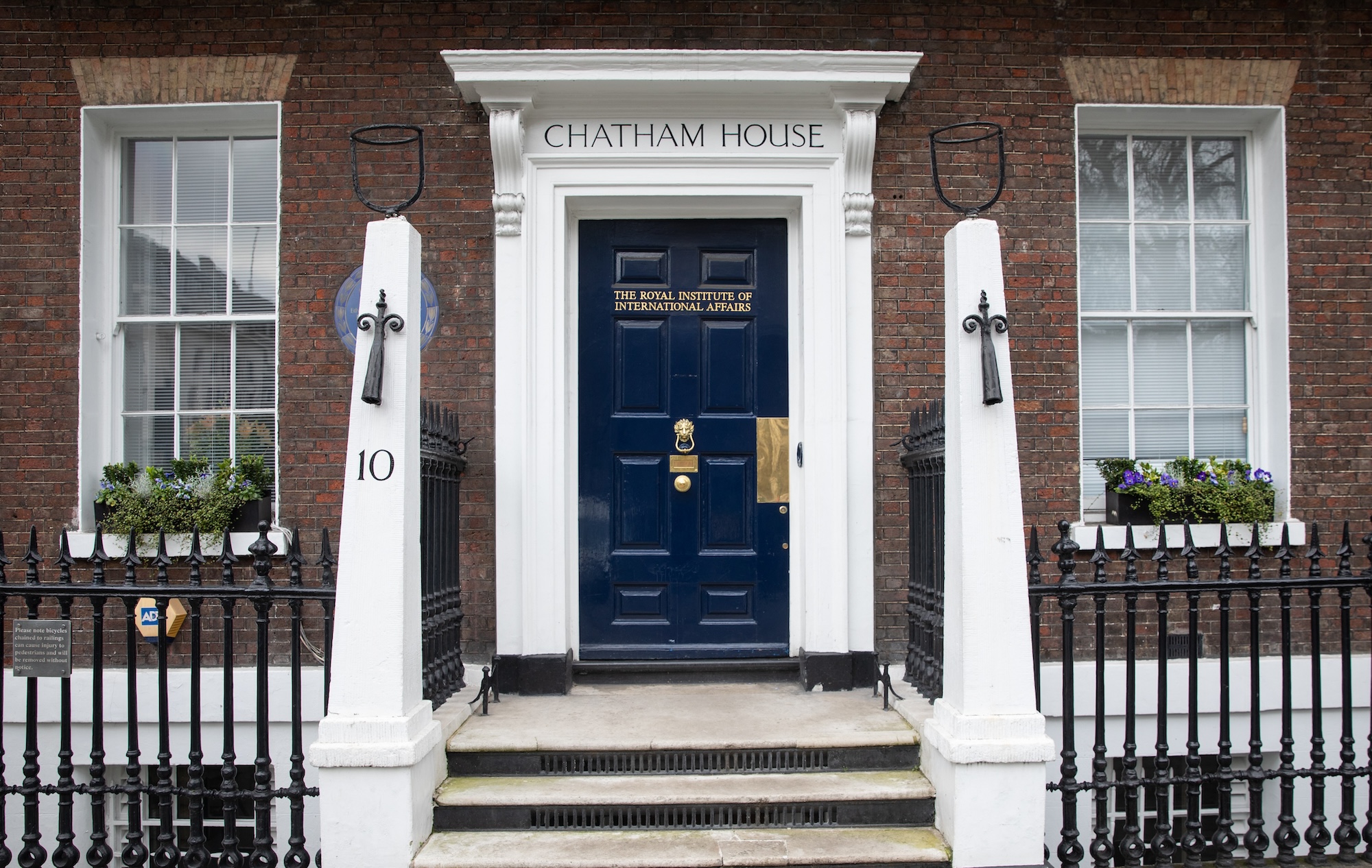
Courtesy: Chatham House[4]
Naturally, many invitees to the Round Table Conferences such as Dr Ambedkar, Sir Hubert Carr (British representative), Sir Muhammad Shafi (Muslim representative) Sardar Ujjal Singh (Sikh representative) and Gandhi were invited to address Chatham House on various topics and in various formats[5]. While Gandhi jumped on the bandwagon to speak on the “Future of India”,[6] Dr Ambedkar and his co-speakers adopted a more cautious and nuanced view and spoke on “The Problem of Indian Minorities”. While the transcript of Gandhi’s speech was published in International Affairs, a publication of the institute, the speeches on the Indian minorities remained buried in the archives.
On 10 November 1931, Dr Ambedkar, Sir Hubert Carr, Sir Muhammad Shafi, and Sardar Ujjal Singh spoke on the plight of Indian minorities. I would like to dwell on those speeches here. In order to remain within the scope of our subject, I will limit myself to the portion where Dr Ambedkar made his case for “a great body of Indians who were not recognised in the Hindu fold, a community which had the greatest possible claims upon those responsible for Indian constitutional growth”. It is here, in what appears to be a 15-minute speech (perhaps the full hour was to be shared between the four speakers) that Dr Ambedkar brilliantly spelt out the many aspects of the lived experience of the treatment of the one-sixth population of then India at the hands of caste Hindus.
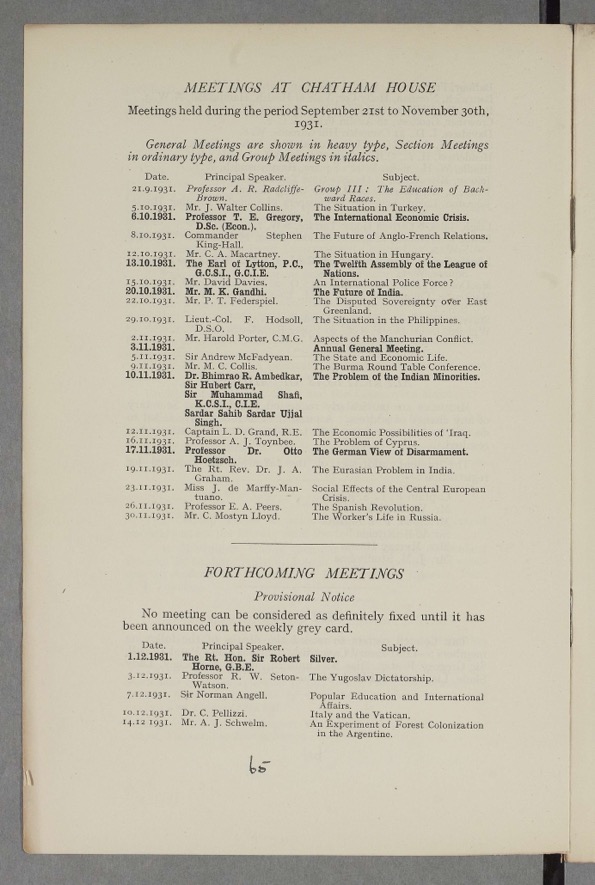
Dr Ambedkar mentioned in the Chatham House lecture schedule. Courtesy: National Library of Australia
Dr Ambedkar speech at Chatham House, 10 November 1931 by fpbooks
Courtesy: National Library of Australia holding Chatham House Archives via Gale[7]
At the beginning of the speech Dr Ambedkar put the population of the Depressed Classes at 43.5 million, who he argued should be treated as distinct from the Hindus for political purposes. He clarified that this number, sourced from the Simon Commission, was obtained from a limited administrative geography. He said that if the entire population were counted, they would not fall short of 60 million, the equivalent of Germany’s population, and larger than France’s and Great Britain’s population.
My dear friend Dr S.P.V.A. Sairam drew my attention to some writings of Babasaheb that dealt exclusively with this point. The format of the speech didn’t allow him to explain all the trouble he had to go through to get a correct estimate of the population of the Untouchables. While the Census of 1911 had employed the correct tests to distinguish Untouchables from the rest, and was upheld by four different committees time and again, those were suddenly challenged by the caste Hindus in a submission to the Lothian Committee (post 1932). As a member of the Indian Franchise Committee Ambedkar had to face witness after witness from provincial governments denying the existence of Untouchables, which they had admitted to in previous censuses. This change in stance was because the Untouchables had become politically conscious, demanding representation for themselves separate from the Hindus. The Hindus not only employed incorrect tests, by homogenizing the criteria, but also tried to fit other classes into the Depressed Classes despite this term being strictly used for Untouchables. Spreading rumours among untouchable communities to have them refrain from being counted as such was next in their playbook. Meanwhile, the Mohammedans would not challenge the Hindus because they couldn’t risk presence of castes among themselves, noted by the Census administration, being exposed by the Hindus; while the Backward Classes wanted to take the easy way out by being included in the Depressed Classes instead of demanding separate representation for themselves[8].
Coming back to the speech, he then proceeded to point out why the term Depressed Classes had to be coined: “to hide the shame that is inherent in the expression ‘Untouchables’. Either the Hindus felt ashamed of it, or the officials who had to deal with the destiny of these people felt ashamed of calling a human being, as good as anybody else, by this wretched, humiliating and contemptuous name”. He then touched on the uniqueness of untouchability, which has “no parallel in either modern or ancient history. It is a system which is unequalled by any other social system that we know of.” He then observed that while we read history of slavery and serfdom across many countries, a social system based on untouchability is nowhere to be found except in India, which meant that men are not categorized on economic or intellectual basis, but as holy and unholy, where if the unholy touches the holy, the latter becomes polluted and needs purification! This part of the speech offered a sneak peek into his views that he would later expand into a set of brilliant essays, comparing Untouchability with the social structure of Ancient Rome (plebeians, slaves, etc), the heart of the Roman Empire; and with the class system prevalent in English society during the Middle Ages; as well as dwelling on the history of Jews in the Middle Ages, the miseries of the African slaves brought into Asia, Europe and the Americas, where they were preferred to the Native Indians for physical labour[9].
He then dropped a rather anthropological term, “dichotomous division”, to describe a characteristic of Hindu society that had led to no contact between the two groups from birth until death. That no matter how many sins a Touchable may commit, how degraded or evil he may be in his character, he will remain a Touchable, while an Untouchable, in spite of his intellectual accomplishments, moral superiority, or economic status, will remain an Untouchable until his death. He then pointed out the rigidity of the caste system, and prohibition of endosmosis, unlike in the class system where “a percolation of the lower classes into the higher classes changes its character and personnel.”
He then drew attention to the matter, probably in the context of secular constitutional reforms being discussed at Round Table Conferences, that the problem of untouchability was not merely a religious and social problem but a civic problem, affecting the “civic rights of the subject of the State”[10], that “travels out of the doors and affects public relationships”.
As mentioned earlier, he drew on the lived experiences of our people to point out how, unlike in the UK to which the audience belonged, “… in India, although the road is built out of public funds … the Depressed Classes would not be allowed to use the road … you may build a well out of a public money but all the same the Depressed Classes will not be allowed to go there for their water…you may build a school out of a public funds but the Depressed Classes will not have the right to go there…” He added that even transportation and salons were out of bounds, thus driving home the point that it was also a civic problem. I can imagine the members of the audience who had neither been worked in India nor visited it, being dumbfounded hearing about this way of life normalized by the caste Hindus for centuries.
He then proceeded to explain that Hindus would soon replace the British as the rulers of the land and hence the Depressed Classes sought certain political protections, fully aware that the centuries-old hostility, with “excisive attitude” towards the “elevation and welfare of the Depressed Classes” would not go away overnight.
He went on to impress upon them that the Hindu society genuinely believed in their superiority to the Depressed Classes and strove to preserve and reify this belief as a special code of ethics – it would not even tolerate them wearing a dress that is not customary to them, or being denied a salaam that they felt entitled to. Dr Ambedkar gave many examples of the petty-mindedness of the Hindus that did not wish to see “… depressed class man … aspire to any equality of status with the upper classes”. He mentioned clashes that had occurred because a member of the depressed classes walked through a village wearing socks – that was perceived as an insult – or because his wedding ceremony happened to be as grand as an upper-caste wedding.
He then drew attention to the fact that in this communal conflict, the Depressed Classes were weak against the “decisive attitude of domination” held by the huge majority, owing to the fact that they were not concentrated in a certain part of India, but scattered across, living on the fringes of villages, totally cut off from others living in the villages proper. And that, in every struggle, “you have the solid mass of the Hindu community banded together and against it the scattered body of small groups of people.”
Dr Ambedkar spoke of how the Depressed Classes are economically a dependent class. Few have land or jobs. They are barred from public service and certain trades because of their untouchability or their polluting touch. He then drew a parallel between their exploitation and the subjugation of the peoples of Ireland.[11] He said the Depressed Classes face complete boycott any time they do something that “displeases the caste people and appears in their eyes as an irregular act not consistent with social life”, thus bringing them to their knees and the “whole economic life of the community to a standstill”.
Furthermore, he pointed out how the offices, in charge of the law and order, are “entirely manned by the Hindus”, who “take sides with the higher and not with the lower classes” in disputes, many of which lead to murders, properties being destroyed, and houses being burnt.
Dr Ambedkar thus delineated the civic aspect of untouchability. He was fully convinced that unless the Depressed Classes got adequate political protection, they could not consent to be placed under the rule of the Hindu majority that held tremendous religious and economic power, and owned arms. He concluded by saying that all classes of Indian society must be represented in Indian democracy: “You cannot apply the principle of territorial democracy to a society which does not recognise territorial evaluations, but which recognises religious and social evaluations. If you apply the principle of territorial representation without any modification to an organic society of this sort, I have not the slightest doubt that instead of producing political democracy you will produce a mockery of democracy. We do not want to block the political progress of the country. We do not say that Indians are not strong enough to control the destiny of the country ourselves; we do not say wait for another period. What we say is that if, under the present circumstances such as they are, you do transfer power, then the conditions of that transfer must be such that they will create a true and real democracy in India.”[12]
Birmingham Town Hall, UK (January 1931)
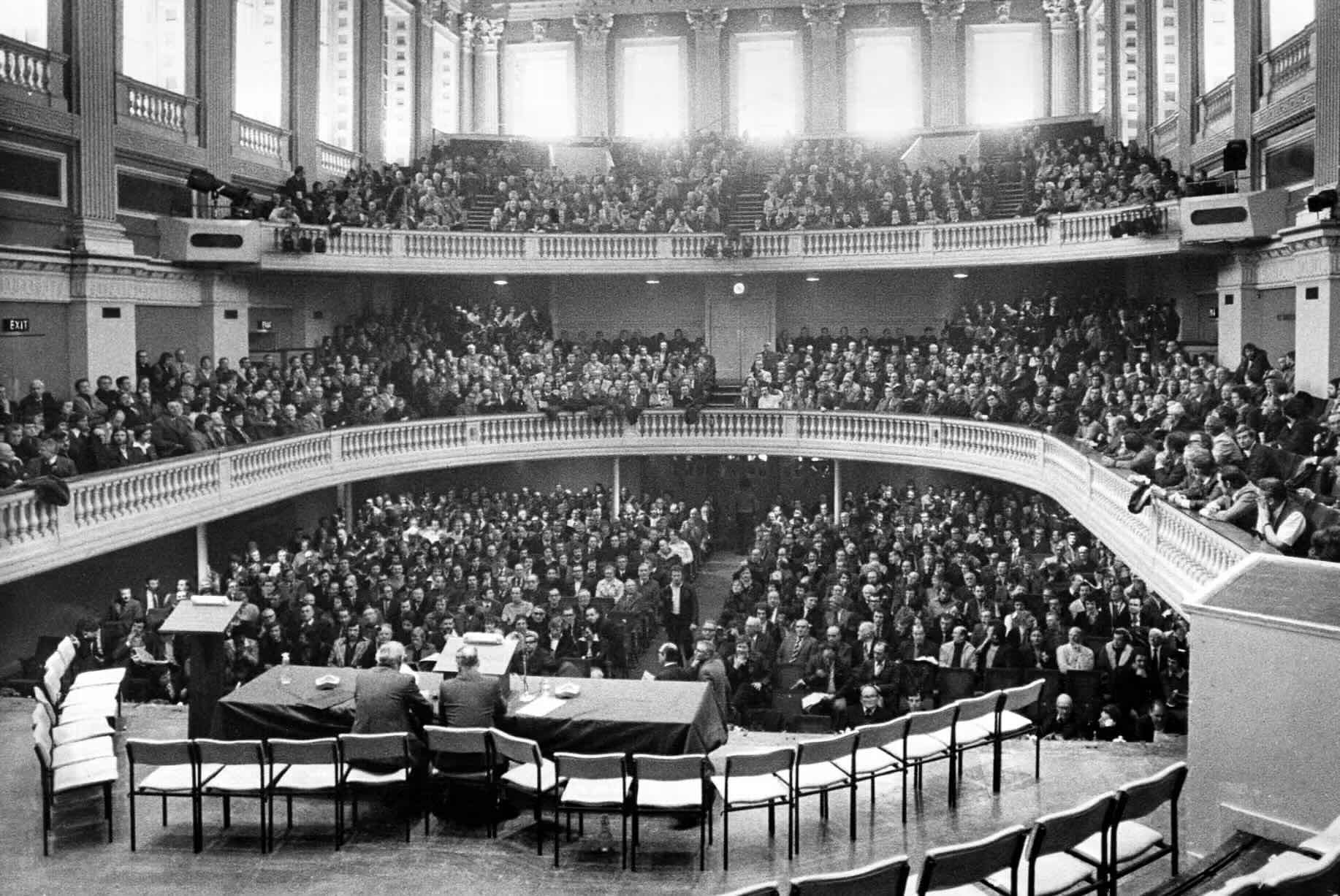
Interior of Town Hall. Courtesy: Birmingham Mail. Representative image from the 1940s; not from the actual event.
Amidst a terrific and enthusiastic send-off by more than ten thousand people belonging to the Depressed Classes who had assembled at the maidan near the Damodar Thackersey Hall in Bombay, Dr Ambedkar announced that he would present their case to the British government and that he was also not against Swaraj (if it came with political safeguards). He then announced that their old journal would be revived and renamed Janta. He proceeded to reveal his plans to “extend his stay in England to carry out another object he had in view… to go to Russia, Germany, America and Japan, and carry on propaganda on behalf of the Depressed Classes… he promised, if possible, he would place their problem even before the League of Nations”[13]. Thereafter, he left for England on the evening of 4 October 1930[14] aboard the P&O steamer Viceroy of India (earlier known as Taj Mahal), along with 21 other members. On the ship that sailed via Aden[15] and Suez[16] (where he visited the Pyramids), Dr Ambedkar participated in several informal discussions with members such as Sir A. P. Patro, Sir Prabhashanker Pattani, Mr Rushbrook Williams “on the measure of surrender or delegation of the States’ powers to the federal body and the future relations towards British India”.[17] They reached London by either 24th or 25th October. It was on this trip that he was invited to lunch by Mr Ramsay MacDonald, Ms Ishbel MacDonald, Mr S. Rowan Aitken, H. H. The Maharaja and Maharani of Baroda, Mr and Mrs Jinnah and others.[18]
He was still in London, as his letters sent to Bhaurao Gaikwad show[19], when The Birmingham Gazette ran an advertisement for a free-of-charge public meeting that was to be held in the neoclassical and Roman Forum-style Town Hall in Birmingham (not far from London) at 7 pm on Monday, 12 January 1931, in support of the demand for Indian Independence. The event was organized by the Birmingham Council for Indian Freedom in association with the Commonwealth of India League. The speakers included Dr Ambedkar as a delegate to the Round Table Conference representing the Indian Depressed Classes, along with Mrs Despard[20], Mrs Brijlal Nehru (a cousin of Jawaharlal Nehru), Dr K. T. Paul (representing Indian Christians at Round Table Conference), Mr A. Fenner Brockway (Member of Parliament)[21] while Mr Horace G. Alexander[22] was to chair the meeting. He would have made it to the Town Hall and spoken as scheduled, because there is no reason to believe otherwise. Unfortunately, the speech is yet to be found, and possibly lost, unless someone can find its traces in the speeches of the other speakers in the archives. It is hard, if not impossible, to reconstruct what he might have said, and what lessons he may have cited from history as was his usual style. He would have surely asked for India’s freedom from British rule but with all the necessary political safeguards for its minorities.
Newspaper notice for Ambedkar’s speech at Birmingham Town Hall, 12 January 1931 by fpbooks
Courtesy: Birmingham Gazette, 10 January 1931, p 2
Mount Vernon Public School, US (December 1932)
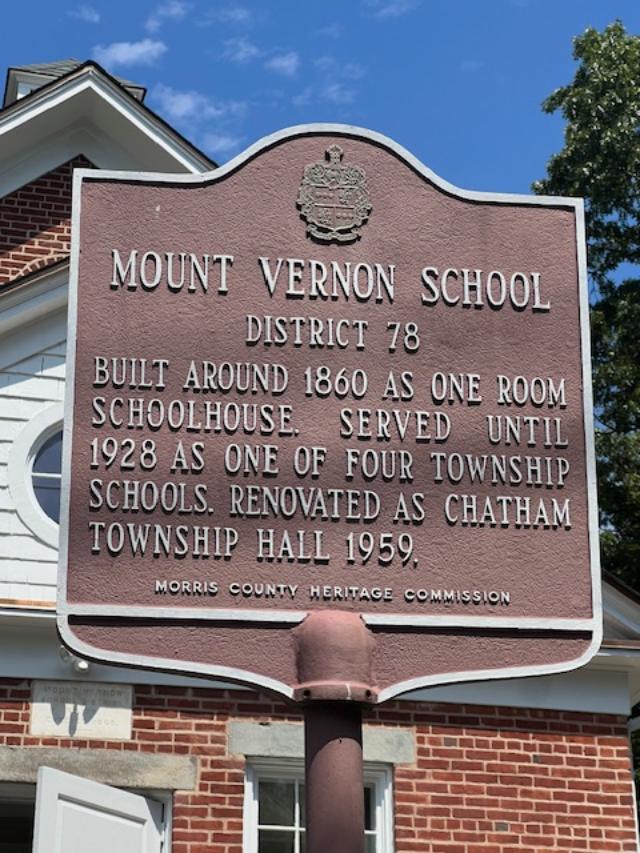
Historical signboard of the Mount Vernon School. Courtesy: Visiting A Museum[23]
The British government announced the Communal Award providing for separate electorates for the Depressed Classes. Dr Ambedkar had fought tooth and nail for this provision. Little did the world know how Gandhi would overreact to preserve the interests of his class. Dr Ambedkar lamented that Mr Gandhi, who had never sat on a fast-unto-death for India’s freedom, was ready to fast to death against the grant of special representation to the Depressed Classes. Dr Ambedkar noted that Gandhi accepted separate electorates for other minorities and also got them to reject separate electorates for the most oppressed of Indian society, namely the Depressed Classes!
On 24 September 1932, the day Gandhi’s political team signed the Poona Pact with Dr Ambedkar, a notice appeared in many of the papers in New York, such as the one reproduced below. It announced that Dr Ambedkar would be speaking at an evening lecture, which was a part of the 15-lecture series of the Fall & Winter study course, at Mount Vernon Public School organized by the Mount Vernon Public School Teacher Association in New York. It was to begin in less than two weeks on 4 October 1932 and Dr Ambedkar was scheduled to speak on 13 December 1932, on the topic “India”. The local newspaper The Daily Argus that carried this notice, was to announce two books that were recommended as readings for the lecture a few days before each lecture. Whether Dr Ambedkar responded to their request by recommending two books for preparing the students and other attendees for his lecture is not known.
Mount Vernon was no ordinary school. Some of the brightest minds participated in the lecture series held there. Dutch-American historian Hendrik van Loon was to open the lecture series with his talk on the topic, “To Have Or To Be”, arguing that personal fulfilment comes through developing one’s character rather than accumulating possessions.[24] He was to be followed by Princeton scholar Edward Kemmerer (who helped design US Federal Reserve and also contributed to framing economics policies from South American countries to Central Europe) and Columbia-educated intellectuals as John Erskine (American educator to speak on “New Directions in Education”), William T. Foster (another American educator to speak on “Men, Money, and Machines”), Paul Chih-Meng (a diplomat who ran China Institute in America was to speak on “The Far East”). Other speakers were also either seasoned diplomats or economists from different Universities or institutions.
The only venue today that fits this description of Mount Vernon Public School is the now locally popular “Red Brick Schoolhouse Museum” in Vernon, an hour’s drive from Manhattan, New York.[25] That leaves us with a few unanswered questions: Why did Dr Ambedkar choose this place to deliver a lecture? Was it suggested to him by someone from Columbia University given that some of the speakers were, indeed, from the university? If so, who? Unfortunately, I do not have answers for these yet.
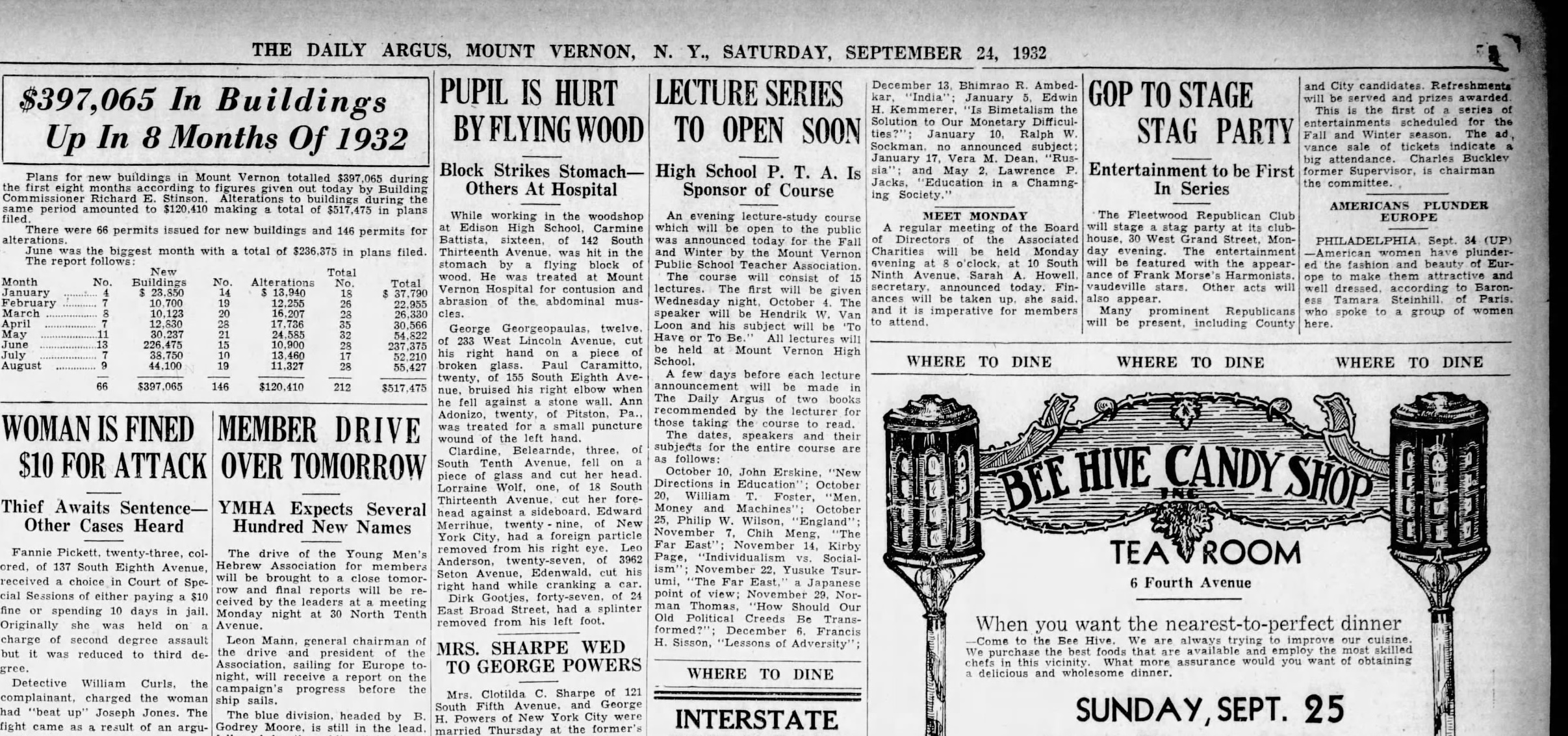
Courtesy: The Daily Argus, Mount Vernon, NY, 24 September 1932, p 3
A week after this announcement, the newspaper carried a notice on 1 October 1932, spelling out Dr Ambedkar’s topic as “The Present Day Problems of India”. Unfortunately, the notice still did not have the recommended readings for the lecture. Perhaps, the correspondence with the request for readings never reached Dr Ambedkar. It may have been sent to his Parel address in Bombay, from where he must have initiated the communication before leaving for London.
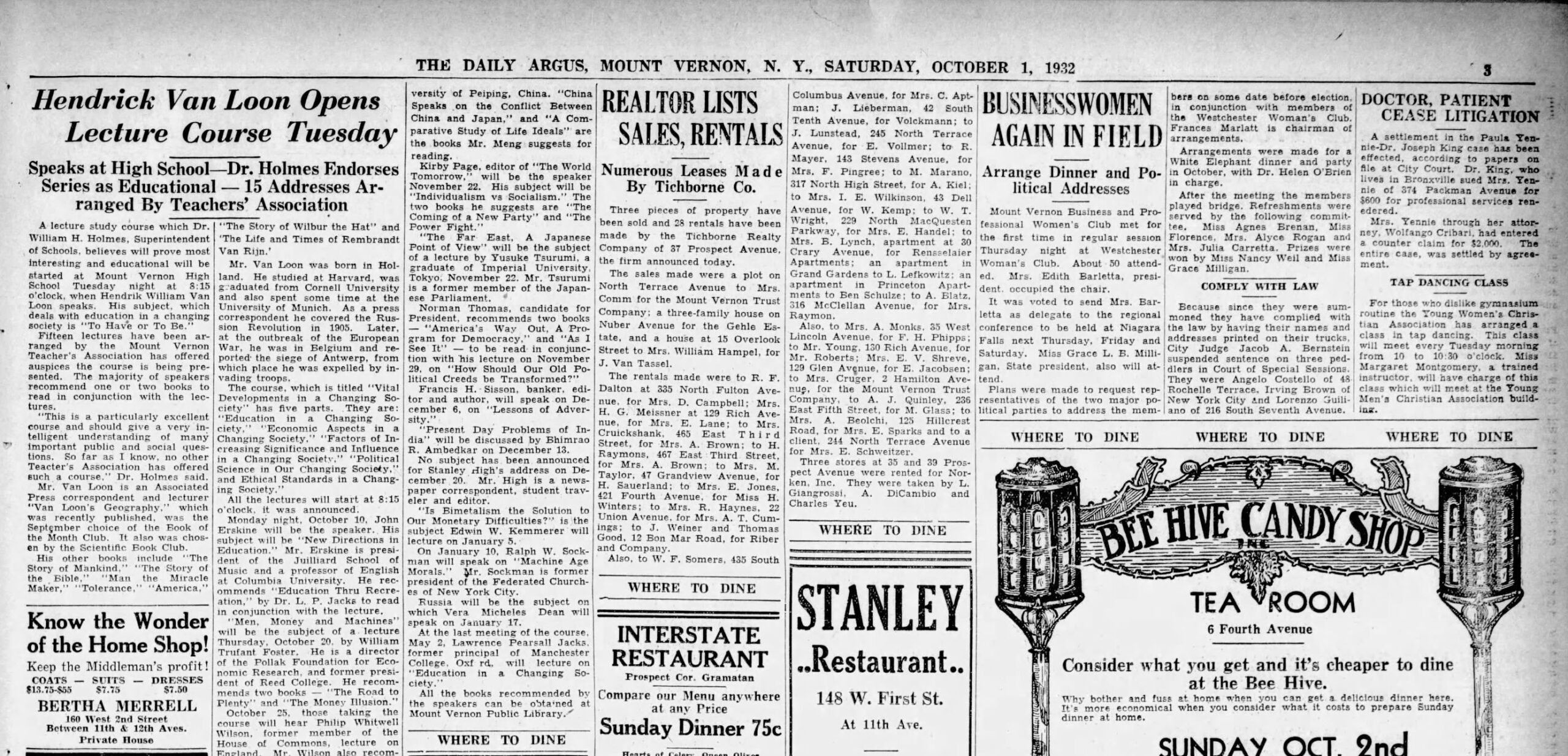
Courtesy: The Daily Argus, Mount Vernon, NY, 1 October 1932, p 3
A succeeding advertisement carried by the newspaper on 3 October 1932 (and also 21 October 1932 reproduced below) listed him among the 15 speakers who could be heard for $1 per seat. Unfortunately, Dr Ambedkar was caught up in the deliberations for the Round Table Conferences and the audience at Mount Vernon was deprived of an opportunity to hear his thoughts and views[26] on the present-day problems of India. He was in London as late as 19 December[27] and could not possibly have delivered the speech, across the Atlantic, on the outskirts of New York city.
Notice for Ambedkar’s Vernon High School Lecture by fpbooks
Courtesy: The Daily Argus, Mount Vernon, NY, 3 October 1932, p 2
Mount_Vernon_Argus_1932_10_21_39 by fpbooks
Courtesy: The Daily Argus, Mount Vernon, NY, 21 October 1932, p 9
The last in this series of notifications from The Daily Argus, Mount Vernon, NY dated 8 December 1932 (reproduced below), close to the day on which Dr Ambedkar was to speak, stated that since Dr Ambedkar could not travel to the US he was substituted by another speaker. Perhaps, Dr Ambedkar did send them a message from London, informing them of his unavailability.
Notice about Dr Ambedkar being unavailable for Mount Vernon School Lecture by fpbooks
Courtesy: The Daily Argus, Mount Vernon, NY, 8 December 1932, p 12
All the same, when the day arrived, they forgot to update their calendar and notified on December 13 (reproduced below) that Dr Ambedkar was going to speak that night!
Notice says Ambedkar is the speaker at Mount Vernon Lecture despite his unavailability by fpbooks
Courtesy: The Daily Argus, Mount Vernon, NY, 13 December 1932, p 12
Ford Hall Forum, US (1932)
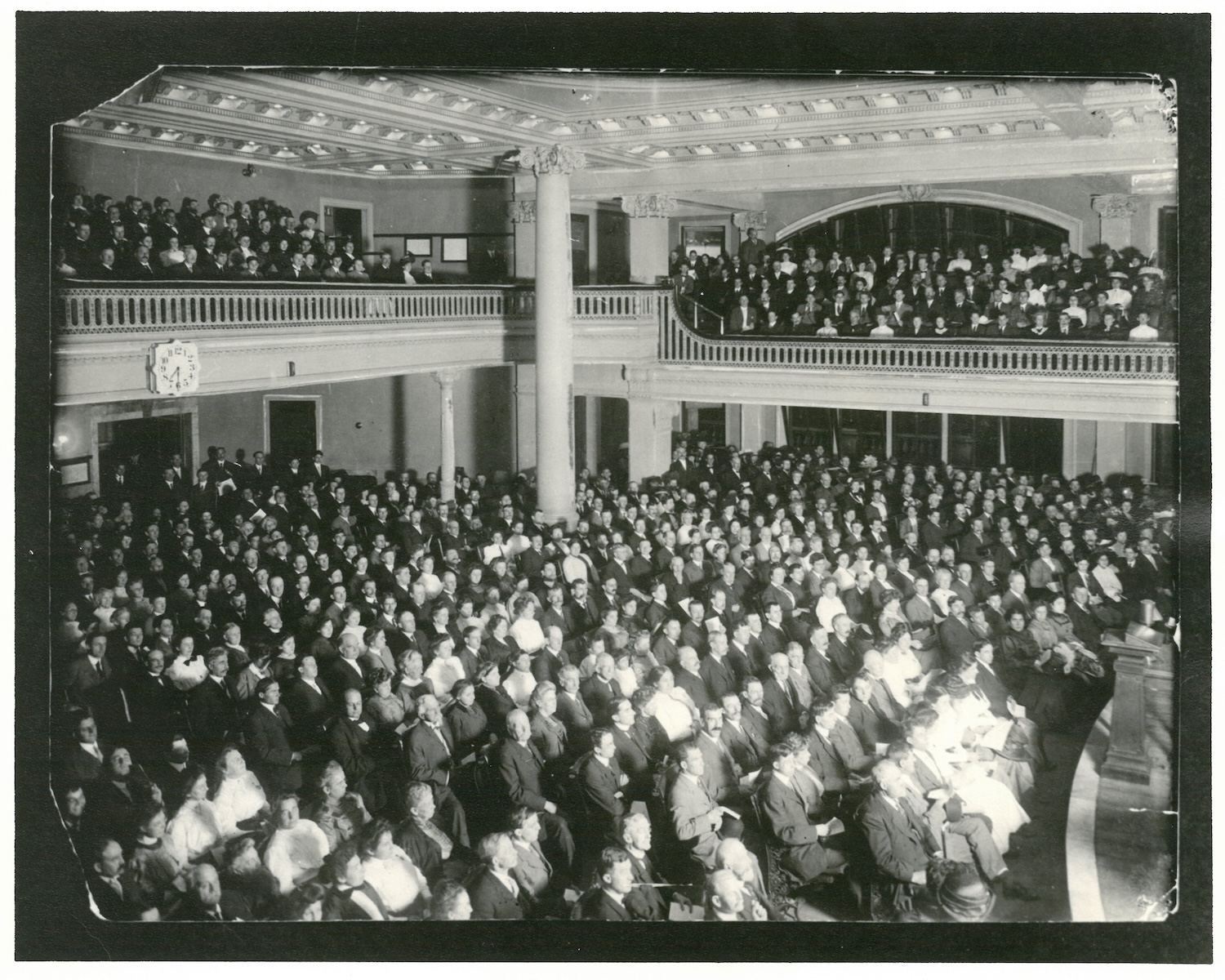
A Ford Hall Forum gathering in Boston. Image for illustrative purpose only. Courtesy: Suffolk University[28]
Dr Ambedkar named as one of the speakers for the Ford Hall Forum by fpbooks
Courtesy: The Boston Globe, 3 October 1932, p 20
In the case of the lecture Dr Ambedkar was invited to deliver at Mount Vernon High School, the newspaper notices started appearing a few months in advance. That did not happen in the case of the Ford Hall Forum. Founded in 1908, the Forum is the oldest free public lecture series in the US and still continues to host an impressive group of intellectuals and activists. The same day, 3 October 1932, when The Daily Argus, Mount Vernon carried the aforementioned advertisement, Dr Ambedkar figured in a notice in The Boston Globe among a list of speakers who were to speak at the Ford Hall Forum. The forum was “to open its 25th season, Sunday evening, on Oct. 16, with Heywood Broun of New York as the speaker … title will be ‘It Seems to Me’”. Unfortunately, the advertisement about their Silver Jubilee event did not elaborate on the topic or give the dates assigned to each speaker, including Dr Ambedkar. However, when I reached out to Ford Hall Forum, they were happy to provide me with the season programme card for 1932-1933 that had recorded Dr Ambedkar’s lecture topic as “Present Position of the ‘Untouchables’ of India”. Unfortunately, they did not have any transcripts of the lectures from that period. The lectures may not have been recorded. Ford Hall Forum lectures were held in the Ford building at the intersection of Ashburton Place and Bowdoin Street (opposite to Beacon Hall Monument, Boston), but unfortunately, the building does not exist anymore.
Dr Ambedkar figures in the Ford Hall Forum 1932-1933 Season Program by fpbooks
Dr Ambedkar mentioned in the season card (1932-33). Courtesy: Suffolk University
An illustrious group of speakers was chosen for the event. Prof Julian Huxley was a well-known evolutionary biologist of the time whose books could be found in Dr. Ambedkar’s collection. Dr Julius Curtius had been the Weimar Republic’s (Germany’s) Minister of Foreign Affairs (before Hitler took over) and had overseen the “Young Plan” that dealt with the reparations Germany owed from the Great War (the First World War). Baroness Ishimoto of Japan (Kato Shizue) was born into a former Samurai family and would go on to become “Japan’s foremost advocate of family planning and reproductive rights in prewar 20th century Japan”.[29] Sir Norman Angell, a British journalist, lecturer and a Member of Parliament from Labour Party, served on the Chatham House (Royal Institute of International Affairs) and would win the Nobel Peace Prize the following year (1933)[30]. Don Roscoe Pound was a legal luminary and the Dean of the Harvard Law School until 1936. Prof Felix Frankfurter, another legal luminary who founded the now popular American Civil Liberties Union (ACLU) and would, the following year, become the closest legal adviser to the 32nd American President Franklin D. Roosevelt, and a little later a Supreme Court Justice.
Later, on 31 October, 1932, Dr Ambedkar was announced as a delegate to the third Round Table Conference[31] and the week after, on November 7, he sailed to UK on Lloyd Triestino’s vessel Victoria from Alexandra Dock in Bombay[32]. From the ship he wrote to Mr. Shivtarkar asking him to send copies of Times, Chronicle, Free Press, Kesari and Janata every week without fail[33]. Dr Ambedkar arrived at the Victoria Station in London on 19 November 1932[34]. Unfortunately on this trip, unlike in late 1931, Dr Ambedkar could not make time for lectures. He returned to India by the steamer S. S. Gange, arriving in Bombay on 23 January, 1933[35]. Thus, another opportunity to hear him (for the West then) and to read him (for us today) was lost.
University of Vermont, US (November 1932)
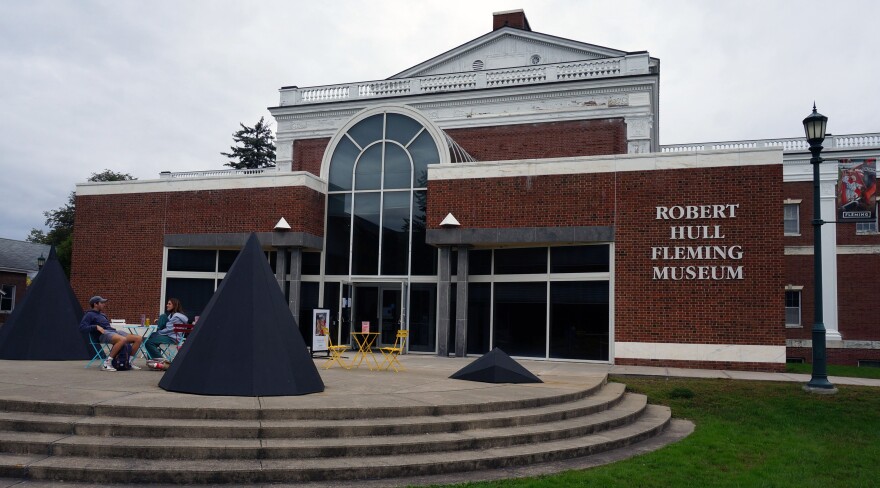
Robert Hull Fleming Museum today. Courtesy: Vermont Public[36]
On 19 October 1932, while Dr Ambedkar was still in India, The Burlington Free Press and Times, carried a notice that a series of lectures would be delivered at the University of Vermont, with him as one of the speakers. Prof John Dewey was born in Vermont and attended the university, with his brother, before he went on to teach at Columbia in 1904. Prof Dewey was buried[37] on the University of Vermont campus and his grave has a beautiful epitaph[38] worth checking out. In Dr Ambedkar’s own words, it was to Prof Dewey that he “owed all [his] intellectual life”. From India, Dr Ambedkar must have established communication with either Prof Dewey, or Prof J. T. Shotwell or someone from his circle at Columbia, who may have urged him to participate in the lecture series. Had it not been for the Round Table Conferences, Dr Ambedkar would have met his professor here. Twenty years later, when Dr Ambedkar went back to Columbia, Dewey had just passed away.
The lecture series was to be opened on 22 November 1932 by John Clair Minot, who was “… the literary editor of the Boston Herald, distinguished critic and lecturer …” and would share his thoughts on books that were published recently. The second speaker was to be Dr Ambedkar who was described as “…a man of unusual personal interest who occupies a prominent and influential position in Indian affairs. Delegate to the Round Table Conference, member of the Bombay Legislative Council, founder and president of the Depressed Classes Institute, he has gained fame and acclaim as the acute and forceful champion of the Untouchables. Dr Ambedkar is himself an Untouchable in the Hindu social system despite his great learning, his preeminent authority in the field of Indian Finance, and his political position. He will speak the evening of December 9 upon ‘The Present Day Social Problems of India’.” The only academic credential they missed was that Dr Ambedkar was a barrister. Perhaps, one day, the language of this citation will provide leads to who wrote it and sent it to the newspapers.
The third speaker was Arthur Haas, a professor of physics at the University of Vienna. He was nominated for the Nobel Prize in Physics, a total of four times, twice by Albert Einstein (in 1917 a little after his General Theory of Relativity was published, and in 1921 when Einstein himself won the prize) and once by Louis de Broglie (who himself won the Nobel Prize in 1937) for his work on atomic models[39]. Suffice to say he was a brilliant physicist. The lectures were all slated to be held at the Robert Hull Fleming Museum, which is today known by the name of “Fleming Museum of Art” at the heart of the University campus.
Ambedkar introduced as one of speakers at the University of Vermont Lectures by fpbooks
Courtesy: The Burlington Free Press And Times, 19 October 1932, p 7
Their subsequent notification on October 26, this time carried by The Monitor, Barton, Vermont carried the same schedule and announced that Dr Ambedkar, an “authority on Indian affairs”, would be speaking.
The Monitor names Dr Ambedkar as a speaker at the University of Vermont Lecture Series by fpbooks
Courtesy: The Monitor, Barton, Vermont, 26 October 1932, p 2
It is no surprise that since Dr Ambedkar remained busy in the UK with the Round Table Conference Debates, and could not take time out for a trip to the US, The Burlington Free Press and Times, announced on 29 November 1932 (barely 10 days before his scheduled lecture) that Canadian businessman, philanthropist and politician Sir Herbert Ames had substituted him.
My dear friend Dr S.P.V.A. Sairam has recently brought to my attention the fact that the State of Vermont has been celebrating Dr Ambedkar’s birth anniversary, as ‘Equality Day’ since 2023, though they may not be aware of this connection[40].
Dr Ambedkar unavailable to speak at University of Vermont lectures, Sir Herbert Ames to take his place by fpbooks
Courtesy: The Burlington Free Press And Times, 29 November 1932, p 6
People’s Forum, Church of the Messiah, Canada (November, 1932)
Had it not been for the extension of debates, owing to Christmas holidays, of the Third Round Table Conference that clashed with Dr Ambedkar’s commitment at such forums, he could have visited Canada, and the world would have witnessed him tear apart the sham that the likes of Gandhi and Congress had created in India. Dr S.P.V.A. Sairam shared with me a letter that Dr Ambedkar received from Robert McFall, a friend at Columbia University, in 1916. Dr Ambedkar was nearing the end of his study period at university. McFall urged Dr Ambedkar to step out of the East Coast and explore more of the United States and visit him in Canada before sailing to London. This would have been his first opportunity to visit Canada.[41] About a decade and a half later, on 28 October 1932, The Gazette Montreal carried a notice saying that the People’s Forum season was to be opened by Jiddu Krishnamurti, then “a young philosopher who was hailed a few years ago as a new Messiah”, with a lecture on the topic “Life: What Does It Mean?”. Again Dr Sairam pointed out to me a passing reference Dr Ambedkar wrote, in 1945, with regard to this personality and his mentor, Mrs Annie Besant, quoting her casteist views extensively: “... Mrs Annie Besant was well-known for rearing up Mr. Krishnamurti, the son of a Brahmin retired Registrar for a future Massiah… So far as I know she felt great antipathy towards the Untouchables …”[42]
As per the notice published on Sunday, 13 November, Dr Ambedkar was slated to speak at the Church of Messiah in Montreal (not far from the University of Vermont) on the topic of “India, Gandhi and the Untouchables” that was announced as a “subject of great current interest”. I haven’t been able to locate this church because of the presence of many similar old churches in the city of Montreal.[43] Needless to say, Dr Ambedkar would have zeroed in on this topic to inform the general public of the events that led up to the Poona Pact and to share his thoughts on these events. This could have easily been the opening chapter of his magisterial work, replete with detailed research, that he produced in the form of What Congress and Gandhi Have Done To The Untouchables. In his interview with the BBC later, he expressed his impression of Gandhi in no uncertain terms: “I’m prepared to save your life, you see, providing you don’t make hard terms but I’m not going to save your life at the cost of the life of my people. I always say that as I met Mr Gandhi in the capacity of an opponent I’ve a feeling I knew him better than most other people, because he had opened his real fangs to me, you see, and I could see the inside of the man … He was absolutely an orthodox Hindu”[44]. As mentioned earlier, Dr Ambedkar could not visit the US this time, let alone Canada, and thus this speech remained undelivered as well. His third opportunity to visit Canada would present itself a decade later, in 1942, in response to an invitation by the Institute of Pacific Relations to speak at a conference the institute had organized. Dr Ambedkar prepared a paper on the “Problem of the Untouchables” for the conference. After presenting the paper at the conference, in response to the widespread interest on the subject, he published it in the form of a book Mr Gandhi And The Emancipation of The Untouchables.[45]
Dr Ambedkar was to speak at the Church of Messiah, Montreal (Canada) on ‘India, Gandhi and the Untoucha… by fpbooks
Courtesy: The Gazette Montreal, 28 October 1932, p 5
It is a matter of great misfortune that there have been no drafts found of, or even passing references to, these speeches of Babasaheb in any of the other archives that are accessible. For people of our community, every remark made by Dr Ambedkar, however short it may be, means a lot and is something to learn from and reflect on.
I would like to end this article with a photo of Dr Ambedkar (shot by Erich Salomon[46]) arriving at London for the Round Table Conferences, that remains largely unknown; his official caricature (work of Emery Kelen[47]); and a portrait at the Round Table Conferences; all courtesy of Nottingham University.
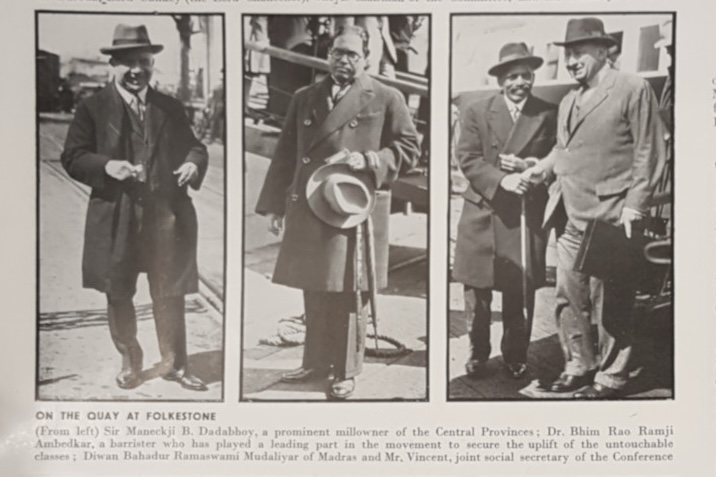
Dr Ambedkar’s arrival at Folkestone for the First Round Table Conference. Courtesy: Nottingham University[48]
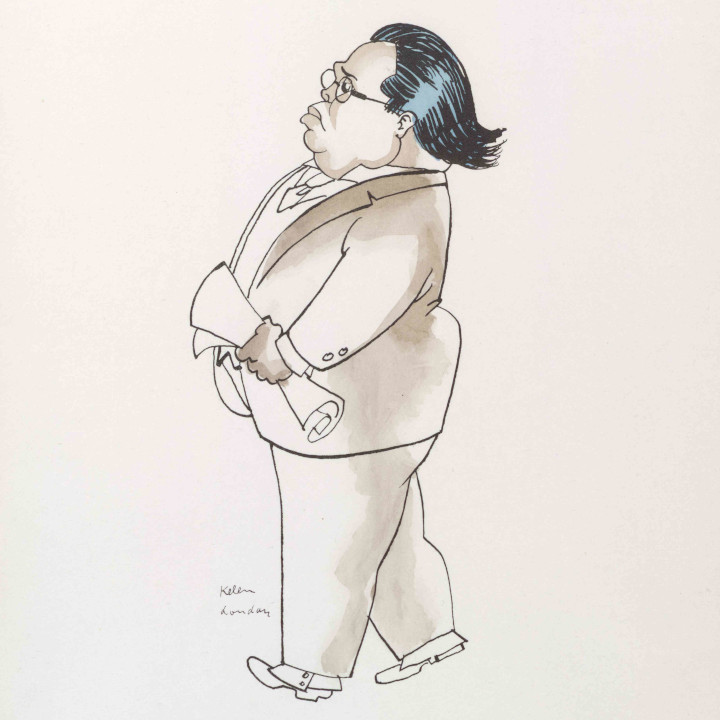
Official caricature of Dr Ambedkar. Courtesy: Nottingham University, drawn by Emery Kelen[49]
Dr Ambedkar official bio for the Round Table Conferences by fpbooks
“Official Who’s Who”. Courtesy: Nottingham University[50]
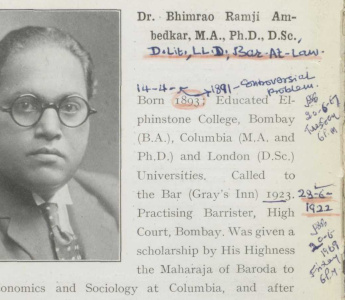
“Official Who’s Who” markup. Courtesy: Nottingham University[51]
(I am thankful, as we all must be, to institutions like Chatham House (London, UK) and Suffolk University (Boston, USA) that either preserved Dr Ambedkar’s speeches or digitised newspapers that had information concerning his scheduled lectures. As I have mentioned in my previous articles, I hope that the references to such lectures are included and referred to in future biographies of Dr Ambedkar, even if some of them were not delivered, as part of documenting his efforts in sharing his vision, wisdom and learnings, all the while struggling for reclaiming our dignity and India’s fraternity. My gratitude extends to my dear friend Dr S.P.V.A. Sairam whose continuous help in reviewing my work and offering me references from the vast literature of and on Babasaheb has helped me in this series immensely. Jai Bhim!)
[1] Times of India, p 12, January 4, 1930
[2] https://securityconference.org/en/events/summits-roundtables-conversations/
[3] https://www.brookings.edu/articles/key-takeaways-reimagining-democracy-globally/
[4] https://www.chathamhouse.org/venue-hire
[5] “General Meetings, Section Meetings and Group Meetings”. Dr Ambedkar’s was a General Meeting. Sir Muhammad Shafi reveals early in his part of the speech that he was approached by Sir Stanley Reed (British Conservative politician who was also until a few years ago the then Editor of Times of India) to speak in Chatham House, so it is likely that Reed, who then chaired this meeting, also invited Babasaheb to put his case.
[6] https://www.jstor.org/stable/3015844
[7] View online at https://catalogue.nla.gov.au/catalog/7822291
[8] “From Millions to Fractions”, in “Untouchables or The Children of India’s Ghetto”, BAWS Vol. 5
[9] “Roots of the Problem: Parallel Cases”, in “Untouchables or The Children of India’s Ghetto”, BAWS Vol. 5 & “Which is Worse? Slavery Or Untouchability?”, BAWS Vol 12
[10] He clarifies this later in the speech. And when he says that it is “not a religious problem”, he is probably trying to point out that despite caste not being sanctioned by the texts of non-Hindu religions (such as Islam or Christianity, for example), the members of those faiths on the Indian subcontinent also practise casteism, which results in civic problems for the marginalized who are adherents of their religion and others.
[11] He expanded on this in his writings later: https://baws.in/books/baws/EN/Volume_07/pdf/300
[12] Probably alluding to the work of American Catholic intellectual Orestes Brownson’s work on “territorial democracy” where he refers to its usage by Benjamin Disraeli in The American Republic: “The American constitution is democratic, in the sense that the people are sovereign that all laws and public acts run in their name; that the rulers are elected by them, and are responsible to them; but they are the people territorially constituted and fixed to the soil, constituting what Mr. Disraeli, with more propriety perhaps than he thinks, calls a ‘territorial democracy’.”. However, it is not clear if Orestes’ work has so far been found in Babasaheb’s library, or any other works that he read that referred to them. No reference to Orestes, or the sense in which this term is used, has been found in any of his published works. But he did quote Disraeli a few times. Either way, Babasaheb is calling for a modification of society first, instead of blindly applying territorial evaluations, which is the correct solution.
[13] BAWS Vol 17 Part 3: https://baws.in/books/baws/EN/Volume_17_03/pdf/91
[14] Times of India, 2 October 1930. The travel was postponed “in view of the advancing of the date when the Conference is likely to meet”.
[15] Times of India, 18 October 1930
[16] Letter to Bhaurao Gaikwad dated 11 October 1930 in “Vol 21 Correspondence”
[17] Times of India, 27 October 1930
[18] Times of India, 12 December 1930
[19] Letter dated 15 January 1931, from 42, Clifton Gardens, Maida Vale, London.
[20] Charlotte Despard, an LSE alumni, Anglo-Irish suffragist, novelist and supporter of Irish Home Rule. Bio by South Asian Britain retrievable at https://southasianbritain.org/people/charlotte-despard/
[21] Socialist, anti-colonial and supporter of women’s suffrage. Bio by Churchill Archives Centre retrievable at https://archives.chu.cam.ac.uk/collections/research-guides/the-member-for-africa-fenner-brockway
[22] A Quaker (member of a Protestant Christian sect) intermediary between Gandhi and the British Government. Bio retrievable at https://www.quakersintheworld.org/quakers-in-action/192/Horace-Alexander
[23] Documented at https://visitingamuseum.com/2024/07/10/chatham-township-historical-society-red-brick-schoolhouse-museum-24-southern-boulevard-chatham-nj-07928/
[24] Preserved on HathiTrust retrievable at https://hdl.handle.net/2027/uc1.$b593963
[25] Described at https://www.nj.gov/dca/njht/funded/sitedetails/Mount_Vernon_School.shtml
[26] He made a distinction between fluid “thoughts” and established “views” as per foreword of Thoughts on Pakistan
[27] Times of India, 20 Dec 1932
[28] Accessible here https://dc.suffolk.edu/fhf-images/index.2.html
[29] Bio at https://archive.mith.umd.edu/gcr/public/displayPerson.php%3Fid=22.html
[30] Bio from Nobel Committee at https://www.nobelprize.org/prizes/peace/1933/angell/biographical/
[31] UK Parliamentary discussions at https://api.parliament.uk/historic-hansard/commons/1932/oct/31/round-table-conference-delegates
[32] Times of India, 8 November 1932
[33] National Archives, letter dated 10 November 1932, identifier NAIDLB00017255
[34] Times of India, 21 November 1932
[35] Times of India, 24 January 1933
[36] Accessible at https://www.vermontpublic.org/vpr-news/2021-10-01/fleming-reimagined-a-university-museums-journey-to-decolonize-its-collection
[37] Recorded at https://www.findagrave.com/memorial/279/john-dewey
[38] Prof Dewey passed away when Dr Ambedkar was on his way to New York to receive his LL.D. degree from Columbia University.
[39] Nobel Prize Archive at https://www.nobelprize.org/nomination/archive/show_people.php?id=3756
[40] All the proclamations published at https://governor.vermont.gov/search/node?keys=Ambedkar
[41] Letters on baws.in: https://baws.in/letters?letter=054b5bf4e96f4619a33755fd7c39cf68
[42] “What Congress and Gandhi Have Done to The Untouchables” readable at
https://baws.in/books/baws/EN/Volume_09/pdf/32
[43] My best guess is The Unitarian Church of Montreal, https://www.ucmtl.ca/
[44] BBC interview, in early 1955, transcripted at https://baws.in/books/baws/EN/Volume_17_01/pdf/456
[45] Preface, “Mr. Gandhi and the Emancipation of the Untouchables” in BAWS Vol 9 at https://baws.in/books/baws/EN/Volume_09/pdf/422
[46]He was evidently the world’s first photojournalist who captured candid photos with his Ermanox camera, which he hid in his hat for easy access to his subjects. Unfortunately, he was imprisoned by the Nazis and later died in the Holocaust at Auschwitz (1944).
[47]One of the most famous caricaturists, drafted into the Hungarian Army in the Great War (WW I) emerging as a lifelong opponent of war. Original image at https://www.nottingham.ac.uk/research/groups/conferencing-the-international/images/representations/kelen/kelen-ambedkar-bhimrao-ramji.jpg
[48] Original Image available at https://www.nottingham.ac.uk/research/groups/conferencing-the-international/representations/candid-camera.aspx?MediaGallery_List_GoToPage=2
[49] Original Image available at https://www.nottingham.ac.uk/research/groups/conferencing-the-international/representations/caricature.aspx?MediaGallery_List_GoToPage=5
[50] Profile available at https://www.nottingham.ac.uk/research/groups/conferencing-the-international/documents/india-office-guides/rtc1-delegates.pdf
[51] Marked up profile available at https://www.nottingham.ac.uk/Research/Groups/Conferencing-the-International/images/Representations/IO-Guides/Ambedkar-markups.jpg
(Edited by Amrish Herdenia/Anil)