Imtiaz Ali’s Main Vaapas Aaunga follows Ishar Singh Grewal (played by Naseeruddin Shah), an old man on his deathbed whose fragmented memories gradually reopen the unresolved histories of Partition. Yet this is less a film about historical trauma itself than about what human beings continue to carry across generations. In an age obsessed with reinvention, speed, and constant movement, the film asks a deceptively simple question: What does it mean to remain committed? Not merely to another person, but to memory, promises, histories, and the fragile threads that bind generations together.
At its heart stands an old man who refuses to let go. Ishar Singh Grewal’s longing to return to Sargodha, a place in Pakistani Punjab, is often read as nostalgia for a lost homeland. Yet the film’s emotional power lies elsewhere. What drives him is not simply geography. It is fidelity. He remains loyal to a promise made decades earlier, to a version of himself that history attempted to erase, and to relationships that survived even when political maps changed beyond recognition. Modern life celebrates movement. We admire those who adapt and (re)invent themselves. The film recognizes this reality: lives, nations, families, and identities change. Yet some things resist change.
One of the film’s most subtle achievements lies in its quiet critique of modern society’s obsession with achievement itself. Contemporary life increasingly demands perpetual motion, trapping individuals in a kind of endless hamster wheel where success is measured through constant productivity, ambition, and self-reinvention. In this race, people often become detached from any genuine understanding of human suffering. The pursuit of achievement gradually erases introspection. It conditions individuals to value progress while forgetting the emotional histories that make compassion possible.
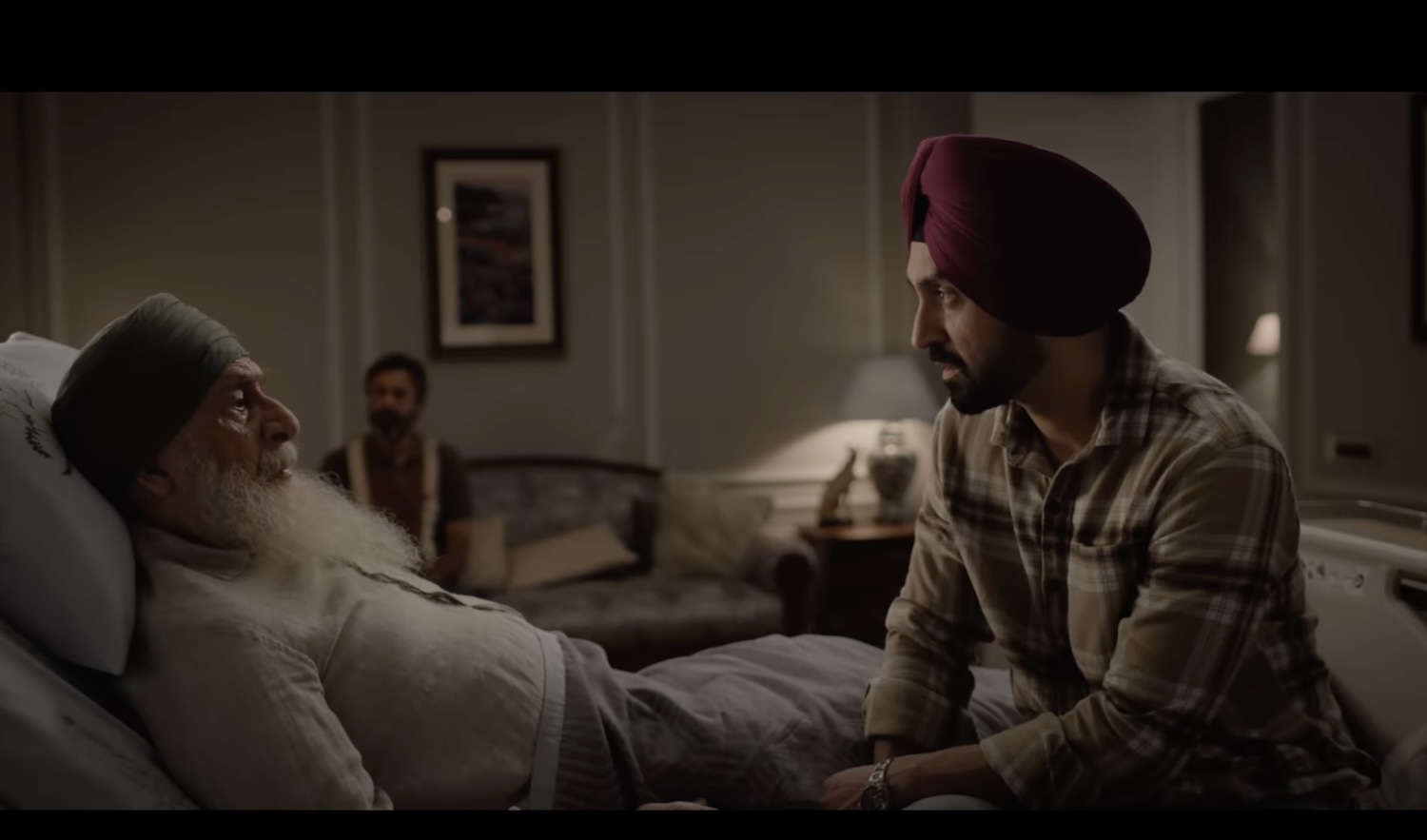
This tension is embodied through Ishar Singh’s grandson Nirvair Singh, played by Diljit Dosanjh, whose journey throughout the film is not simply physical but deeply psychological, too. Initially burdened by his own anxieties about success, failure, and the pressure of constructing a meaningful life, he remains trapped within the familiar logic of achievement. Yet as he becomes immersed in Ishar Singh Grewal’s memories, he slowly begins detaching from this fear-driven understanding of existence. By entering the emotional reality of an older generation, he confronts something modern life rarely permits: the recognition that human experience cannot be reduced to accomplishment alone.
Love may alter its form, but not its essence. The lovers of pre-Partition Punjab and the younger generation inhabit different worlds. Their languages of affection differ. Their expectations differ. Their understanding of commitment differs. Yet beneath these differences lies a persistent human desire: the desire to belong to another person, to be remembered by them, and to matter beyond the contingencies of time. This is where the film becomes less about romance and more about inheritance. Families inherit more than property or tradition. They carry emotions, silences, regrets, and unfinished stories across generations. The younger generation in Main Vaapas Aaunga inherits a history and carries it within itself despite not having experienced it firsthand. Memory becomes less an individual possession than a shared family archive.
The film also approaches Partition with remarkable nuance, refusing to flatten history into a singular narrative shaped by patriotic fervour or simplistic binaries of victimhood and heroism. Instead, it presents Partition as a chequered past, one that resists ideological certainty. History here is shown as malleable, constantly retold and reinterpreted across generations. This constant regurgitation of memory serves an essential purpose. These stories are not retold because younger generations simply forget historical facts. They are retold because they reveal the complexity of human experience itself. Remembering suffering becomes an act of education in empathy.
This is also where the film’s larger argument about memory becomes complicated, and worth pressing further than the film itself does. Not all inherited memory carries equal weight, and not all forgetting is an escape. The desire to leave Partition’s wounds behind, while still being shaped by them, is not the same as the desire to leave behind the memory of caste atrocity and historical deprivation. Partition’s grief, however devastating, was not structured by a hierarchy that assigned some lives less dignity than others; caste memory is. To “move on” from caste history in the way the film urges us to remain faithful to Partition memory would mean abandoning a record of harm that still organizes everyday life. The shackles of caste are not nostalgia to be honoured; they are a structure to be dismantled. So when Main Vaapas Aaunga asks what is worth carrying forward, the more difficult question it leaves unasked is: Who gets to decide which memories are fidelity and which are merely chains?
The film recognizes that history lives not only in textbooks or monuments but in dining rooms, family photographs, half-finished conversations, and stories repeated over decades. Nations remember through archives. Families remember through affection. And sometimes through pain. Ali is particularly attentive to the relationship between memory and place. The yearning for Sargodha is not reducible to nationalism or territorial attachment. Places acquire meaning because relationships happen there. A street matters because someone waited for us there. A house matters because we felt loved by someone there. A city survives in memory because a part of ourselves remains lodged in it.
In this sense, the film offers an alternative understanding of identity. Contemporary politics often treats identity as a hardened category defined by religion, nationality, ethnicity, or ideology. Main Vaapas Aaunga proposes that our sense of identity is not formed in isolation but emerges through relationships, shared histories, and acts of care, memory, and remembrance.
The film simultaneously raises an uncomfortable question about contemporary generational divides. Younger generations are often criticized for lacking emotional depth or failing to understand the complexities of human suffering. Yet perhaps this criticism misdiagnoses the problem. The failure does not lie entirely with the young themselves, but with the world they inherit. A society consumed by achievement mania systematically erases visible hardship, insulating people from experiences that cultivate compassion while teaching them to prioritize success above understanding. To then blame younger generations for emotional detachment is to ignore the very structures that shaped them.
Ali’s most significant achievement may be his insistence that compassion is not weakness but endurance. In a world increasingly organized around outrage, grievance, and revenge, he returns repeatedly to the possibility of kindness. Not as sentimentality, but as a moral choice. The characters in the film who remain capable of love despite loss, of empathy despite suffering, and of forgiveness despite betrayal end up as true survivors.
The opposite of violence, the film suggests, is not victory. It is understanding. The opposite of hatred is not triumph. It is compassion. The opposite of forgetting is not revenge. It is remembrance without bitterness. That may explain why Main Vaapas Aaunga resonates beyond the specific history of Partition. It speaks to anyone living amid contemporary anxieties about borders, displacement, migration, and belonging. It reminds us that while history may separate people through lines on a map, they continue to search for connection across those lines.
As the film concludes, “returning” acquires a meaning far deeper than physical homecoming. One returns to forgotten memories, neglected relationships, inherited histories, and promises left unfulfilled. One returns to the parts of oneself abandoned in the pursuit of survival. Perhaps that is Imtiaz Ali’s most profound insight. We spend our lives changing, adapting, and moving forward. Yet some journeys are not about moving ahead at all. They are about returning to what made us human in the first place.
Forward Press also publishes books on Bahujan issues. Forward Press Books sheds light on the widespread problems as well as the finer aspects of Bahujan (Dalit, OBC, Adivasi, Nomadic, Pasmanda) society, culture, literature and politics. Contact us for a list of FP Books’ titles and to order. Mobile: +917827427311, Email: info@forwardmagazine.in