Even in 2026, when the practice of manual scavenging continues in India, how can we, the people forced into this work, claim that we are truly free? We remain trapped in the chains of a caste-based social order. This system has imposed, by birth, the degrading task of handling and carrying human excreta upon us.
Even today, the practice of manual scavenging continues in four states – Uttar Pradesh, Madhya Pradesh, Bihar and Jammu & Kashmir.
Dalit women continue to be engaged in the inhuman practice of removing human waste by hand from dry latrines. At the same time, men from the “sanitation community” are losing their lives from exposure to poisonous gases while cleaning sewers and septic tanks.
What a cruel irony it is that, on the one hand, India has made extraordinary advances in technology: Chandrayaan has reached the Moon and Mangalyaan has reached Mars. Yet, on the other hand, we have still failed to develop and implement safe technology for cleaning sewers and septic tanks.
The problem is not that we lack technological capability. Rather, it reflects the indifference of our governments and administration. India continues to be deeply affected by caste discrimination, and administrative attitudes are also shaped by caste. The mindset of some officials appears to be that people born into communities traditionally engaged in sanitation are destined to clean filth and handle human waste – that this is their hereditary occupation. If some of them die while doing this work, the officials don’t seem overly concerned.
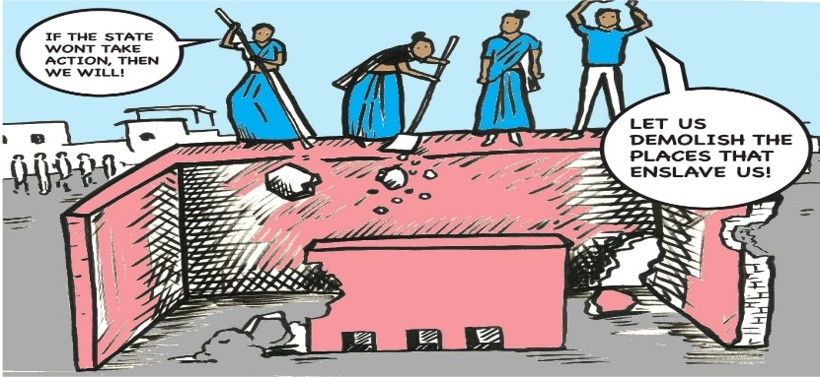
Caste discrimination and untouchability play a major role in the continuation of manual scavenging. Poor communities engaged in this work often face enormous barriers to education. Even while pursuing education, they may encounter untouchability and discrimination, which discourages and demoralises them. Similarly, when someone from the “sanitation community” attempts to start even a small self-employment venture, caste discrimination can become an obstacle. Their businesses may struggle because people from so-called upper castes refuse to join their clientele.
Article 17 of the Constitution abolished untouchability. Yet, because caste-based social practices continue to exert influence, untouchability remains present in everyday life in many forms.
Article 21 of the Constitution guarantees every citizen the right to life and personal liberty, which has been interpreted by the courts to include the right to live with dignity. Forcing a person to handle human excreta is a violation of that dignity. It is a violation of our basic human rights.
Eighty years after Independence, we remain shackled by the chains of manual scavenging, untouchability, caste-based oppression, servitude and patriarchy. India cannot truly free itself from the shameful practice of manual scavenging as long as there is even one person who is forced – by their socioeconomic situation – to handle another person’s human excreta.
For almost half a century after Independence, dry latrines remained part of India’s sanitation system. Until 1993, local bodies and households continued to employ Dalit women and children to manually remove human excreta. This was a direct violation of the fundamental rights guaranteed by the Constitution.
It took India 46 years after Independence to enact its first law against manual scavenging. Two decades later, the country enacted The Prohibition of Employment as Manual Scavengers and their Rehabilitation Act, 2013. Despite these legal measures, dry latrines, manual scavenging, and deaths in sewers and septic tanks remain a brutal reality.
After a nationwide survey conducted in 2024-25, the government announced that there was not a single district in the country with manual scavengers. Yet, as we celebrate 80 years of Independence, reports and accounts from Uttar Pradesh, Madhya Pradesh, Bihar and Jammu & Kashmir indicate that Dalit women continue to clean dry latrines by hand.
These women, ignored by the system despite having to do manual scavenging and clean dry latrines for a living, are leading a democratic struggle for their dignity and rights.
We are fighting for: an India where no one is born into a particular occupation; where no one is forced to clean another person’s excreta; where there are no dry latrines; and where no citizen is sent into a sewer or septic tank at the risk of losing their life.
India cannot be truly free as long as caste continues to determine who will clean our waste.
This cannot be the struggle of one community alone. It must become a struggle for all of us.
We, the Safai Karmachari Andolan (SKA), have launched a yearlong campaign to free India from the shameful practice of manual scavenging. There is a need for all who believe in the Constitution to come together and stand in solidarity.
The Safai Karmachari Andolan has resolved that by 15 August 2027, the country should be free from the practice of manual scavenging. This campaign is underway.
Manual scavenging exists because of caste. That is why Dr B. R. Ambedkar spoke of the annihilation of caste. Untouchability and patriarchy can be dismantled only when we confront the roots of caste itself.
The roots of caste and associated hierarchy are deeply embedded in the Hindu social order. Consequently, a religiously sanctioned hierarchy can become major obstacles to humanity, equality, liberty and fraternity. They stand in the way of Dalits living with dignity.
These barriers can be removed only when people place their faith not in the Manusmriti but in the Constitution of India.
Sadly, given the prevailing circumstances in the country, there are concerns about the protection of Constitutional values and the possibility of a return to a social order based on Manusmriti.
In such circumstances, those who believe in the Constitution and democracy need to remain more vigilant and alert than ever. Only then can practices as inhuman as manual scavenging be eradicated, and can Dalits live with the dignity that the Constitution guarantees them.
Forward Press also publishes books on Bahujan issues. Forward Press Books sheds light on the widespread problems as well as the finer aspects of Bahujan (Dalit, OBC, Adivasi, Nomadic, Pasmanda) society, culture, literature and politics. Contact us for a list of FP Books’ titles and to order. Mobile: +917827427311, Email: info@forwardmagazine.in