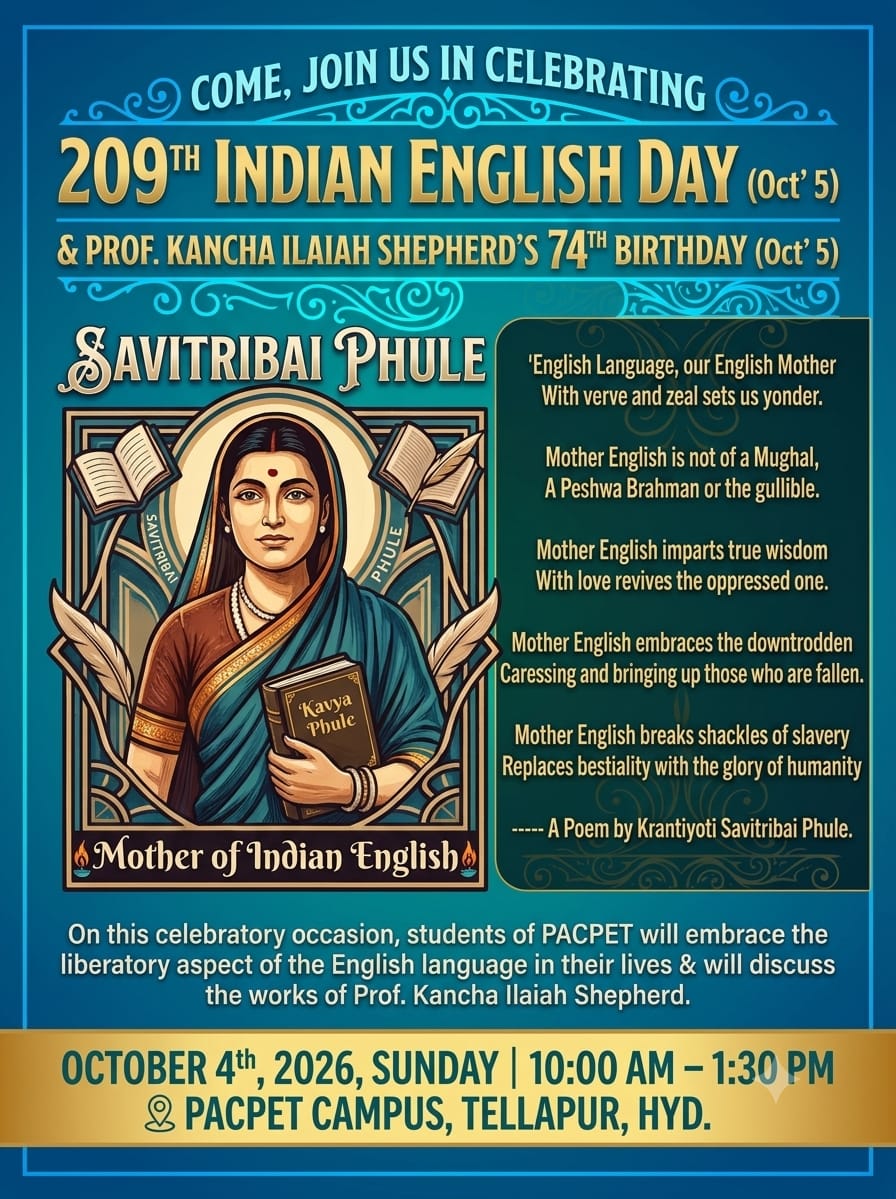
The Phule-Ambedkar Centre for Philosophy and English Training (PACPET), Tellapur, Hyderabad, will celebrate the 209th Indian English Day by declaring Savitribai Phule as the Mother of Indian English at the PACPET campus on 4 October 2026. Indian English Day – the anniversary of the starting of the first English-medium school in India – falls on Monday, the 5th, but we are celebrating it on Sunday due to the availability of the participants.
The celebration of this day is to pressure the hypocritical Indian rulers in Delhi into realizing that they cannot continue with two modes of school education in India – English for the rich in private schools and regional-language education for the poor in government schools. For the last 12 years, the BJP/RSS government in Delhi has widened the gap between government and private education by allowing corporate monopolies and foreign educational institutions to set up private schools, colleges and universities offering education in English and charge huge fees, while starving government educational institutions by all means.
The central and BJP-ruled state governments constantly push for de-Anglicising school, college and university education run by the government.
In ‘Chatron Ki Goonj’ meetings, Rahul Gandhi has repeatedly heard students studying in government institutions explain how opportunities after a regional-language education are almost nil. The standards in government institutions are falling year by year as the governments do not recruit teachers or improve infrastructure. Regional-language textbooks are substandard compared to English-medium books used in the private institutions.
This is a deliberate drive of the RSS/BJP to destroy the government education system so that the total education system can be sold to private businesses. That will automatically lead to the isolation of the masses who cannot afford private education.
Why Savitribai, and not any other woman of her time, should be the Mother of Indian English
Savitribai was the first woman to take a bold stand and write a poem about how the English language liberates oppressed lower-caste women and men more than regional-language education in India. The Phules lived just after the British ended the Peshwa Brahminic barbaric Raj in Maharashtra.
Mother English
In 1854, Savitribai published her poetry book Kavya Phule. This collection consists of three poems on the English language. Through these most striking among the poems in the book, Savitribai Indianized the English language 172 years ago. She was the first English-speaking woman willing to write in that language, even though she had no formal education. I do not think any Brahmin/Bania woman was allowed to learn reading and writing in English during Savitribai’s time.
These poems were originally written in Marathi:
Mother English I
Gone is the reign of the ‘Peshwas’
Mother English is with us
Deep Darkness of despair
The fear of heaven and hell is there
Thoughts of inferiority plague the mind
In such dark times … mother English has arrived
Caste away the yoke of custom
Prise open the doors of tradition
Learn to read and write
Good times have come … mother English has arrived
The Brahmanic religion with innumerable ruses
Exploits the ‘Shudras’, showers abuses
Only on account of ignorance, Savitri muses
Dead and gone is the ‘Peshwa’ dominance … mother English is amidst us
The sovereignty of the Brahmins has been burnt to ashes
The wise English have emerged victorious
The outcasts stand to gain from these changes
The death knell of ‘Manusmriti’ has been sounded …
The rule of mother English has been founded
The outcasts rest in the cooling shade of knowledge
The untouchables are helped and encouraged
The English rule has brought respite from caste-terror …
Here comes our English saviour
India belongs to none
Iranis, Europeans, Tartars or the Huns
The blood of the natives flows in its veins
Let us cry aloud and proclaim … that mother English is here
Mother English II
Mother English, so clear of speech
Resurrects the ‘shudras’ with powers within her reach
This is mother English, not the Mughals
Nor the reign of fools, the Peshwas
Mother English true knowledge doth give
Lovingly grants the ‘shudras’ a chance to live
Mother English feeds the ‘shudras’ the milk of human kindness
Nurtures them and gives them confidence
Mother English ends their beastly existence
Grants human dignity to the ‘shudras’ with her able guidance
Golden Chance
To attain self-reliance let us pledge
And accumulate a wealth of knowledge
Without learning, life is an animal existence, a waste
Don’t rest, get an education, make haste
The outcasts can wipe away their woes if they wish
Here’s a golden chance to learn English
Learn English and do away with caste discrimination
Cast away the tiresome tales of the Brahmins to damnation
(Excerpted with permission from ‘Kavyaphule’, translated from the original Marathi into English by Ujjwala Mhatre, edited by Lalitha Dhara, Dr Ambedkar College of Commerce and Economics, Mumbai, 2012)
Background of the poems
Though Ambedkar later wrote volumes in English, including the Constitution of India, and burnt Manusmriti, the book of Brahminical oppressive laws, as the father of the new knowledge and constitutional democracy, he too did not make such a brave statement on the role of the English language as a liberator of SC/ST/Shudra/OBCs. Though he tried to declare English as the national language, he did not succeed. However, the Brahminical forces in the Constituent Assembly agreed to declare English as the Indian administrative language and Hindi as the official language. The RSS/BJP regime is trying to use that to de-Anglicize education in the government institutions, gradually moving towards undoing that Constitutional guarantee that English will be the administrative language.
Savitribai’s designation of the English language as “Mother English” was earth-shaking. From the state of Peshwa Brahminism and living amidst the most conservative Brahmin nationalists in Poona, who were opposing all the reforms that the Phules were fighting for, she wrote those poems and worked for the spread of the English language along with Mahatma Phule. The Brahminical upper-caste conspiracy of denying Sanskrit education to Shudra/Dalit/Adivasis from their Vedic period onwards kept the agrarian and artisanal productive Indians illiterate. The upper castes controlled and exploited them for millennia. Even the Muslim rulers were obedient to the Brahmins in not allowing the Shudra/Dalit/Adivasi masses to learn the Persian language, leave alone Sanskrit.
We have no idea why the masses did not learn even reading and writing in Pali, which was a Buddhist language. Of course, Buddhist monasteries were influenced by Brahmanism in later years, and they never tried to open a large number of schools in India.
In modern times, though the British opened the doors of education to the Shudras and Dalits, the Brahmins controlled the British education system with an iron grip. Tilak, M.K. Gandhi, and many other Brahmin-Bania Congress leaders opposed the Shudra/Dalit/Adivasis learning English during the British period, too. Gandhi went on advocating for regional-language education. Earlier, from the 1840s onwards, the Phules had fought against Brahmin control. Even the Bengali and Tamil Brahmins did not allow the productive castes to learn English.
Savitribai’s declaration of English as Mother and her clarion call for Shudra/Dalit/Adivasi women and men to educate themselves and learn English is a major breakthrough in the history of the English language in India.
PACPET’s ideology
Starting about four and a half years ago, PACPET has by now trained about 750 girls and 750 boys (as the admission policy is 50-50, with separate exclusive girls’ Data Science training) – that is 1,500 rural youth from all over India – to speak, read and write in English. All of them read Savitribai, Phule, Ambedkar and my writings as part of the syllabus.
Savitribai is special to the Centre. There is a hidden expression in Savitribai’s “Mother English” poems that English should become the mother tongue of all Indians irrespective of caste, class and gender. In Poona, Rahul Gandhi attacked Manudharma, and the BJP/RSS leaders responded saying that he was opposing Sanatana Dharma of Manu. Look at what Savitri said about Manu in her poem: “The death knell of ‘Manusmriti’ has been sounded …” Her message has to be taken to every door in India in order to liberate our women and men from casteism and patriarchy.
By declaring Savitribai as the Mother of Indian English, PACPET throws a challenge to the RSS/BJP forces that they cannot stop the spread of English education in Indian government schools and its use as an administrative language. English is the only language that exists in every state’s school books, whatever their regional language may be. Even the most remote tribal children, whose so-called mother tongue is confined to a small group, know some English. Whether one is an Urdu-speaking Muslim boy or girl or a Punjabi-speaking Sikh, English is a common language for all of them. Such a presence of English among all youth enabled PACPET to train youth from about 20 states, whose mother tongues are all different. They communicate among themselves only in English. English has strengthened nationalism among them. Hindi cannot do that now or in the future.
In Telangana and Andhra Pradesh, English has become the medium of teaching in all government schools. Though pro-Hindutva forces like Venkaiah Naidu, Justice N.V. Ramana and Jayaprakash Narayana tried to convince Andhra Pradesh Chief Minister Chandrababu Naidu and Telangana Chief Minister Revanth Reddy to discontinue English-medium education in government schools, they did not succeed.
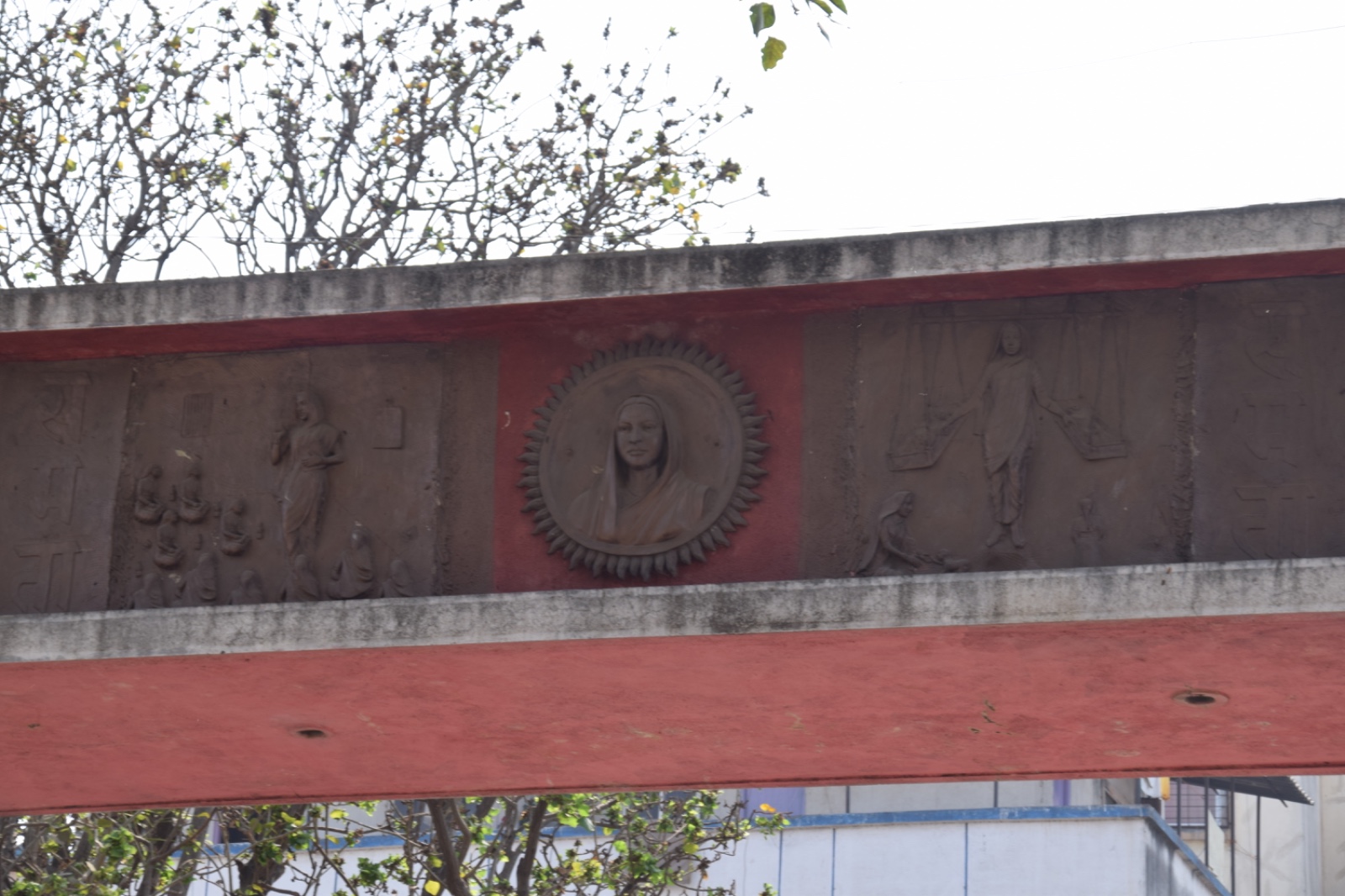
By celebrating Indian English Day every 5 October alongside a beautiful portrait of the Mother of Indian English – Savitribai Phule – PACPET wants to immortalize Savitribai’s heroic declaration in 1854 that English is the Indian mother.
(This article was originally published in Countercurrents. It has been republished here with the author’s permission.)
Forward Press also publishes books on Bahujan issues. Forward Press Books sheds light on the widespread problems as well as the finer aspects of Bahujan (Dalit, OBC, Adivasi, Nomadic, Pasmanda) society, culture, literature and politics. Contact us for a list of FP Books’ titles and to order. Mobile: +917827427311, Email: info@forwardmagazine.in