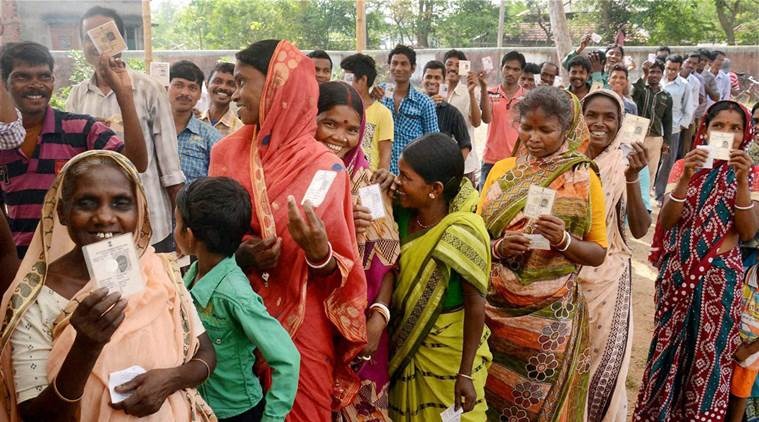
The poll outcome in constituencies reserved for the Adivasis in the recent assembly elections in West Bengal has conjured up a complicated, multi-layered and thought-provoking picture. The participation of Adivasi women in politics has definitely grown. But we also need to consider the skewed power equations and the geographical diversity of these constituencies. If these three dimensions, namely participation, results and geography, are considered together, it becomes clear that the issue of Adivasi representation is not limited to seats won or lost. It lays bare a complex inter-relationship between power, ideology and Adivasi politics.
According to the 2011 Census, the total population of Adivasis in West Bengal is 52,98,953, while the number of seats reserved for them is 16. According to the data of the Election Commission of India, a total of 23 Adivasi women were in the fray in 10 of these reserved constituencies. Of them, 19 were candidates of different political parties while four were independents. The constituencies that had Adivasi women candidates were: Madarihat (Gan Suraksha Party), Mal (Two independents), Phansidewa [TMC, CPI (ML), Congress, SUCI (Communist), AJUP, Independent], Tapan (TMC), Sandeshkhali (TMC), Keshiari (CPM), Binour (TMC, Congress), Manbazar (BJP, TMC, CPM, Congress), Ranibandh (TMC, CPM, Congress) and Raipur (TMC, Congress).
Thus the TMC fielded seven Adivasi women candidates and the Congress four. Among the Left parties, CPM nominated three Adivasi women as its candidates and SUCI and CPI, one each. Besides, BJP, NJUP and GSP fielded one Adivasi woman candidate each. In terms of national political groupings, the ruling BJP picked only one Adivasi woman as its candidate and the Congress, four. The Left parties – CPM, SUCI and CPI (ML) – together fielded five Adivasi women. These figures show that different parties have different priorities and strategies as far as giving representation to Adivasi women is concerned.
The fact that the Phansidewa constituency had the maximum number of Adivasi women candidates – six – shows that their presence in the electoral arena is higher in areas which have a history of Adivasi struggle. Phansidewa is the area where Adivasi tenant farmers waged a struggle for land rights, which not only challenged the local power structure but also had a decisive influence on the course of Indian politics. The Naxalbari Movement, a major farmer-Adivasi uprising known the world over, saw large-scale participation of Adivasi women. They were not just cogs in the wheel. They were at the forefront of the movement, in leadership positions. Six Adivasi women contesting from Phansidewa represent the remnants of that heritage and the consciousness to fight and be part of the struggle.
But despite the enthusiastic participation of Adivasi women in the election, the results were disappointing. Of the 22 Adivasis women candidates, only one could win – the BJP nominee from Manbazar. And the BJP won all 16 seats reserved for the Adivasis. This is not just another election result. It shows how power has become concentrated in a few hands and how the ideology of Hindutva has struck deep roots among the Adivasis. We need to dwell seriously on this phenomenon.
We need to keep in mind that these 16 constituencies are not contiguous. They are spread over four different regions, with different socio-economic conditions and diverse primary means of livelihood. The Tarai and Dooars regions of north Bengal – including constituencies like Kumargram, Kalchini, Madarihat, Mal and Nagrakata – are known for their tea plantations. A large number of Adivasis have been working in these plantations for generations. Labour, wages, land rights, condition of the plantations and displacement are the key issues here. Phansidewa borders this area, where tea plantations and traditional farming co-exist.
In contrast, areas like Tapan and Habibpur are rural belts, where farming is predominant. The Adivasis in these areas are either small farmers or farm labourers. Here, irrigation, land, agricultural productivity and rural employment are the primary issues. Sandeshkhali – located in the Sunderbans Delta – falls in a different ecological zone. Here, life is a struggle with rivers, tides, mangroves and cyclones. The life of the Adivasis and other residents of the area hinges on forests, water and the climate.
Jangalmahal, in the western part of Bengal – which includes constituencies like Nayagram, Keshiari, Binpur, Manbazar, Ranibandh and Raipur – is different geographically. It is a forested plateau adjoining Jharkhand. Adivasis have been the inhabitants of this area for ages and their culture has the deepest roots here. Jal-Jangal-Zameen (water, forests and land) are the key political issues here and the politics revolves around forest rights, mining, displacement and unequal development.
Interestingly, one political party has won all these 16 constituencies located in ecologically diverse zones. Do the winners represent local aspirations? Or are these results the outcome of a vast, systematic Hindutvavadi political project? This is a matter of concern as the problems facing the Adivasis inhabiting different ecological zones and their priorities may be diverse, but their fundamental issue is common, and they have been fighting for its resolution since the colonial era. This political domination – which is basically a part of the project for religious-cultural domination – not only ignores these diversities but also buries the core Adivasi issue.
Things are even more complex from the perspective of women. Adivasi women are entering the electoral arena in growing numbers, which indicates that the footprint of their social and political initiative is expanding. But at the same time, the probability of them winning an election remains low. Thus, symbolic representation is cast in relief from real empowerment. Political parties nominate women as their candidates to show that they are inclusive. But they don’t help create the conditions necessary for their victory, such as providing them adequate resources and political and organizational backing.
It is important to note that the BJP fielded only one Adivasi woman candidate and she won. The representation of women is thus not really at the top of the agenda of that party. The Congress and the left parties fielded a higher number of women but all of them lost. Clearly, nominating more women does not change the poll outcome, unless they have the backing of the party organization and their candidature is a part of a wider political balancing act.
From the perspective of the Adivasis, these elections are both a warning as well as an opportunity. A warning in the sense that unless the Adivasis strengthen their own political outfits and leadership, political forces and ideologies from outside their realm will continue to exercise control over their representation. And it offers an opportunity in the sense that these elections may inaugurate a new era of women’s participation in the electoral process – a participation that is not peripheral, but that places women centre stage. But if Adivasi women enter politics taking the Hindutva route, it would hold little meaning for their community.
We also need to remember that the elections are not genuinely democratic in the sense that they give the highest weightage to the choice of the majority. They serve to muffle the voice of the communities which are small in terms of numbers or are scattered over a large area. Such communities are gradually pushed out of the political stage. The Adivasis have their own languages, culture, faith systems and philosophy of life. But electoral politics is gradually sucking them into a societal structure that has been built outside their community. This is given the veneer of representation but the moot question is whether this “representation” strengthens their independence and autonomy or makes them a part of a broad religious-political project.
The tendency has been palpable since the 2014 elections. The political forces driven by the religion of the majority come to power through elections and turn State institutions subservient to their ideology. This translates into an existential crisis for religious and cultural minorities – including the Adivasis – and issues related to their rights become more complicated.
What needs to be clearly understood is that the West Bengal elections can’t be seen in isolation with the long-term project focused on Adivasis launched by the Hindutva forces. It is well known that attempts to subsume the Adivasis within the wider Hindu identity have been made since the 1940s. This project is not merely religious, but it is also cultural and political – their philosophy of life, deities and their nature-centric beliefs and community traditions are being redefined to fit them into a straitjacket of another cultural system.
Opposing these attempts, the Indian Adivasis – from Mundas, Santhals, Bhils and Gonds whose population runs into several lakhs to tiny communities like the Shompens of Andaman and Nicobar islands – have been persistent in their struggle to protect the realms of their ancestors, to secure their forests, water and land and to preserve their distinct cultural identities. This struggle is not only about protecting resources, but also about protecting their rights and their existence. That is why the Adivasis have long been demanding a separate religion code so that their distinct religious and cultural value systems get constitutional recognition.
The West Bengal elections lay bare the contours of this struggle. On the one hand, Adivasi women have enthusiastically joined the electoral process, sending out a strong message that they want to enter the field of politics and occupy positions of leadership. On the other hand, the results of the elections demonstrate the domination of Hindutva political forces – whose ideology is in conflict with the Adivasi philosophy of life at many levels. The issue of Adivasi representation cannot be grasped fully without taking into account this contradiction.
So, elections should not be seen just as a celebration of democracy, but as a socio-political process that is an interplay of power, numbers, and cultural identity and existence. From the perspective of Adivasis, elections are not only about electing their representative, but it is also a decisive moment that defines the trajectory for their existence, rights and future.
The representation of Adivasis should not be seen just in terms of numbers but they should get a genuine say in the political process. For this to happen, it is imperative to strengthen communal solidarity, political organization and leadership on the ground. The Adivasi women need to bring their real issues – jal-jangal-zameen, as well as livelihoods, health and education – to the centre of the election discourse.
What the victory of the BJP in all the 16 constituencies reserved for Adivasis in West Bengal tells us is that for the Adivasis, political representation is not only about wins and losses, but it is also a part of the broader process that gives the community a voice and an identity and carves out its future. The political representation of the Adivasis will remain incomplete as long as the Adivasis – and especially their women – do not become strong, organized and self-reliant.
(Translated from the original Hindi by Amrish Herdenia)
Forward Press also publishes books on Bahujan issues. Forward Press Books sheds light on the widespread problems as well as the finer aspects of Bahujan (Dalit, OBC, Adivasi, Nomadic, Pasmanda) society, culture, literature and politics. Contact us for a list of FP Books’ titles and to order. Mobile: +917827427311, Email: info@forwardmagazine.in