It would be interesting to study the education system prevalent in British India’s Hindi-speaking region to know about the status of the Dalitbahujan in schools. The Hindu reformers were in favour of allowing the backward communities to acquire some education but they had no such plans for the Dalits. A few Dalits could acquire an education courtesy of Christian and Arya Samaj schools. Here, it would be pertinent to find out where the girls of these communities stood in the education system.
In his article published in “The Nineteenth Century and After” in August 1914, Andrew Fraser tells us that the Indians embracing Christianity were overwhelmingly Adivasis and low-caste Hindus. The Christian missionaries not only educated them, but also tried to improve their standard of living. Fraser did not consider the “Hindu Christians” of Punjab, Central Province and Bombay as Untouchables. He was in favour of using their services for farming. “The elite class is watching chamars, kolis and bhangis wearing trousers, coats and hats and shaking hands with others unhesitatingly and calling themselves Johns and Thomases,” said Swadesh-Bandhav (October 1914: 156), a Hindi magazine published during the period known as the Indian Renaissance. These conversions were the key reason why the Arya Samajis opened the doors of education to the Dalits.
While allocating funds meant for promotion of basic education under different heads, Lord Hardinge kept aside some money for “spread of education in a particular caste”. A committee was constituted to decide how to spend this money, which, Mahavir Prasad Dwivedi, described as “Nainital walee committee”. Acharya Dwivedi’s suggestions for “spread of education in a particular caste” are shocking. He writes:
“Arrangements must be made for the education of the Shudras. The sons of those from whom people accept water should be admitted to all schools, just like boys of the other castes. Separate seating arrangements should be made for the untouchable castes. This is already being done in many schools and nowhere has it led to protests. If there is a locality in which only Chamars, Bhars, etc reside, a separate school can be opened for them there. A portion of the budget should be set aside for the District and Municipal Boards that open such schools.” (Saraswati, July 1913: 380).
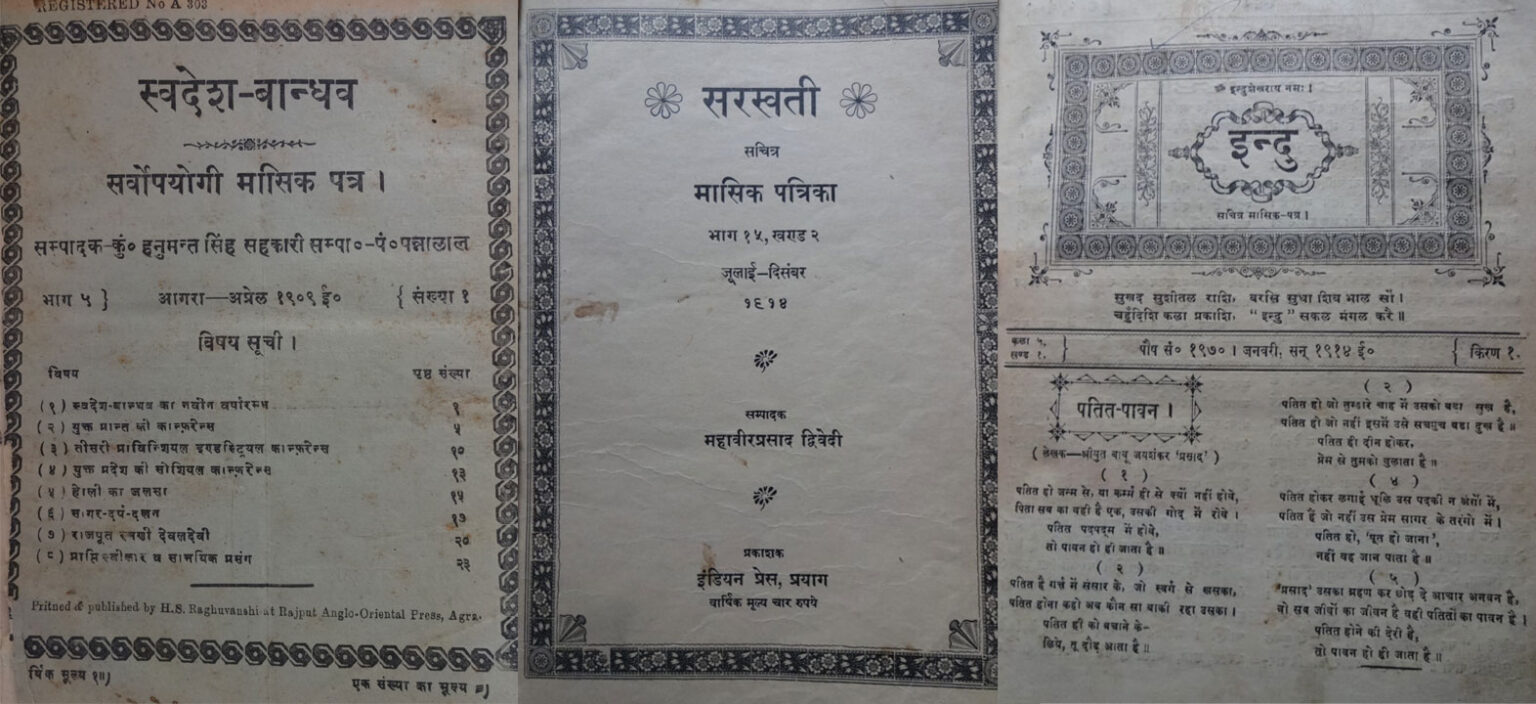
A longish article titled “Adhunik Stree Shiksha” (Modern Women’s Education) by Sanwal Ji Nagar and published in Indu (March 1914) can help us understand the contemporary milieu. It also introduces us to the prevalent ideology. Nagar wants to save the varna system and Hindu households at any cost. “Due to modern education, girls from Dalit and backward classes have quit their traditional professions and are working as teachers and nurses,” says Nagar. He doesn’t want the girls to quit their traditional work. He is bitterly opposed to uniform education. He writes, “The second major problem with the modern education system is that the same kind of education is imparted to girls from all castes and communities. Whether poor or rich, Brahmin or Vaishya, Sunar [goldsmith] or Halwai [maker of sweets], Lohar [ironsmith] or Kumhar [potter], Kshatriya or Chamar [leather worker], the girls from all these families are imparted the same kind of education at a common place.” Instead of uniform education, he wants different schools for different castes and education in keeping with the varna system. He wants every person to follow the social norms and behaviour ordained for his caste, class and community, because doing what your ancestors have been doing is one’s “lofty obligation”.
He goes on, “But that is not happening now. For want of different categories in social education, our business/industry has gone bankrupt. Educated women don’t want to continue with their ancestral business or work. And how would they when they have not been given that kind of education? When they don’t follow their traditional vocations, their children also don’t. That has led to deterioration in our skills. Things have come to such a pass that even arranging two square meals a day has become an ordeal.”
He further writes, “Would the daughter of a Sunar or a Lohar, who has acquired modern education up to middle or matriculation level, ever have respect, love or reverence – which she is dutybound to have – for her kin who work day and night crafting gold ornaments or iron chests? Would the daughter of a chamar, who has been educated under the modern system, have feelings of reverence, love and devotion for her brothers engaged in making footwear? Would a Brahmin girl, having studied with girls from Dhobi and Christian families for 10-12 years and later married into a family that performs sacred yagnas, have respect for the smoky ritual of yagnas?”
Sanwal Ji Nagar urges the reformers to establish more and more “samajik pathshalas” (social schools) so that old trades get a fresh lease of life and women can be trained to become ideal housewives.
However, a short story entitled “Shiksha Ka Phal” and published in Swadesh Bandhav pleads the opposite. The short story that was serialized by the magazine advocates educating the Shudras.
The short story opens in a small village called Champapur, where a group of little girls is playing. Two of the girls in the group are from rich families. A conversation between two other girls reveals that “one of the two is Satyawati, the daughter of the village zamindar, and the other is Gokuli, the daughter of a Nai [barber]”. Of the two girls who are chatting, one refuses to believe that the rich girl’s father is a Nai. The other, however, reiterates that it is true. “I am telling the truth. One of them is the daughter of a Nai. Her father is very rich. He no longer works as a barber. Money matters a lot. She is the only child of her parents, who adore her. That is why she wears such nice clothes and eats such fine food which even a zamindar’s daughter cannot dream of.”
Gokuli is good-looking. She is humble and good-natured. Most importantly, she is well versed in Sanskrit. That is the secret of the friendship between Satyawati and Gokuli. Now, let us hear how the conversation progresses:
First girl (surprised) – ‘So, Gokuli has studied Sanskrit? Where? And who taught her Sanskrit? A low-caste girl and Sanskrit! How can she know this language of the Brahmins? I am sure that you are just joking.’
Second girl – ‘The days when it was impossible for persons of the Shudra varna to learn Sanskrit are gone. Now, everyone has the right to the same kind of education. Satyawati has learnt Sanskrit from a pandit and now she is now quite adept in the language. Besides, she is quite good at sewing and other work.
First girl – ‘Fine, my sister! But can you explain to me how teaching the lower castes will do any good? It will only be harmful.’
Second girl – ‘Harmful! There is no harm. And there are many advantages. I don’t need to deliver a sermon to you as many articles have been written on this issue. But for your sake, I will tell you something. Just tell me if someone severs your legs, will that make you sad?
First girl – ‘It definitely will. My legs are as much a part of my body as my stomach or my hands.’
Second girl – ‘Now you have understood. Those whom we called Shudras are the legs of Hindus. If they are severed from us, it will not only make us sad, we will collapse and die.’
(Swadesh-Bandhav, September 1914: 133-36)
Obviously the author of “Shiksha Ka Phal” was aware that losing the Shudras from the Hindu fold would not only be distressing for the upper castes but also signal their end. The author does not want Hindus to be reduced to a minority. This is the truth of that period. However, the so-called renaissance reformers were trying their utmost to ensure that the varna system is adhered to in post-Independence India.
In a letter to Suryakant Tripathi ‘Nirala’ on 12 November 1927, Nanddulare Vajpayee affirms, “Varnashram is everything to us and dismantling it would bring no good, only harm” (Nirala Ki Sahitya Sadhna – Vol 3, p 163). This letter should be read by every student. It not only apprises us of the deceit of the upper castes and the quandary of the renaissance literature but also tells us about the views Harioudh, Vajpayee and others harboured about Dalits, Backward Classes and women.
(Translated from the original Hindi by Amrish Herdenia)
Forward Press also publishes books on Bahujan issues. Forward Press Books sheds light on the widespread problems as well as the finer aspects of Bahujan (Dalit, OBC, Adivasi, Nomadic, Pasmanda) society, culture, literature and politics. Contact us for a list of FP Books’ titles and to order. Mobile: +917827427311, Email: info@forwardmagazine.in)