The draft voters’ lists, based on the Special Intensive Revision (SIR) of the Uttar Pradesh electoral rolls, were published on 23 December 2025. The names of around 2.89 crore people have been earmarked for deletion from the lists. A cursory glance at the data from the states where SIR has been conducted, shows that 47 lakh names were deleted in Bihar, 41.85 lakh in Rajasthan, 42.74 lakh in Madhya Pradesh, 97 lakh in Tamil Nadu, 58 lakh in West Bengal, a lakh each in Puducherry and Goa, 27.34 lakh in Chhattisgarh, 64,000 in Andaman and Nicobar, 24.08 lakh in Kerala and 1,429 in Lakshadweep. Around 50 crore voters would be subjected to the exercise in the forthcoming phases of SIR. At the end of it, an estimated 12-15 crore voters in the country may lose their franchise.
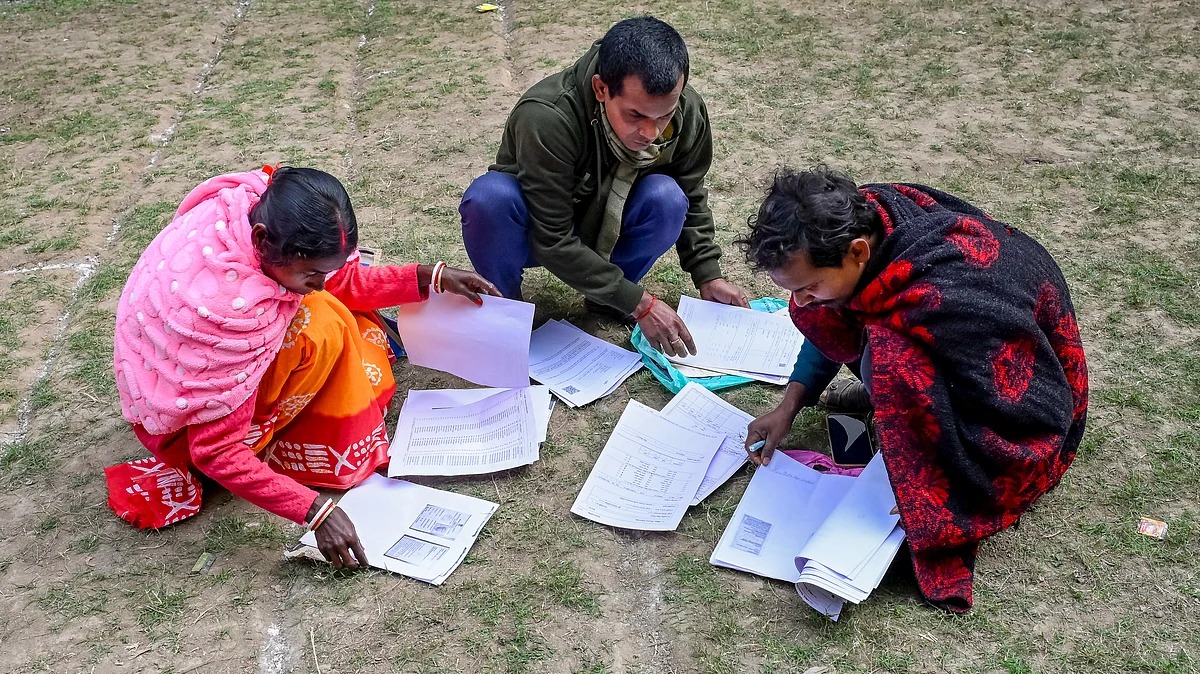
A Booth Level Officer (BLO) involved in the exercise in a rural area in the southern part of Allahabad district said that he was given a list of 1,286 voters for scrutiny. Most of them were from his village and the rest were from three neighbouring villages. Since his own village was involved, he tried to ensure that not a single name was deleted and no one had to face a problem. So, he worked hard and located all the voters. Under the SIR, voters are being classified into three categories. The first category is “Self” – the voters whose names figure in both 2003 and 2025 lists. The second is “Progeny” – voters who were not on the 2003 list but are on the 2025 list. Such voters are required to produce documents to prove that their parents were on the 2003 list. The third is “Neither” – voters whose names figure neither in the 2003 list nor in the 2025 list.
He said that of the 1,286 voters, he categorized 592 as “Self”, the rest as “Progeny” and zero as “Neither”. School teachers were deployed to upload the data. After the uploading was done, he was shocked to discover that 342 voters on his list were placed in the “Neither” category. “I amended the data using my mobile phone. Had I not done that, these 342 people would have faced unnecessary harassment. They would have got notices and would have been forced to make rounds of the Tehsil office. Since they all were from my village, I went the extra mile,” he said.
“Which religion or caste did the 342 ‘Neither’ voters belong to?” I asked. The BLO said that most of them were Brahmins. Some were from the other castes. “It was not as if any particular religion or caste was targeted,” he said. The BLO explained, “Weak mobile networks are a big problem in the rural areas. Sometimes, uploading a single form may take more than 30 minutes. Categorizing the voters as ‘Neither’ is quicker. As such, due to pressure for meeting the deadlines, saving one’s job and the fear of FIR, the designated personnel prefer to categorize voters as ‘Neither’. They want to somehow complete the work, no matter in which category they place a voter,” he said.
Initially BLOs were pressurized, then data was fed from circuit houses, municipal offices
A BLO deployed in the western urban parts of Allahabad said that in September-October 2025, 10-12-day training sessions were held for the BLOs. They were told to compare the 2003 and 2025 voting lists and identify those who figured in both. Those who were on the 2025 list but not on the 2003 one were supposed to furnish any one of the 13 listed documents. Those proffering Aadhar cards were required to submit another document along with it. “Now, suppose I have to identify 1,200 voters. Despite all efforts, the names of 353 voters don’t tally. As everyone is in a hurry, an official at the Tehsil office asks me to bring the forms as they are. ‘Just say that you could not find these voters,’ he tells me. Now, the left-out voters phone me and threaten me on WhatsApp,” he said.
The BLO says that 35-40 per cent of the voters are being categorized as ‘Neither’. “I worked on 1,200 voters but could not locate 353. They were placed in the third category. Now, they will get notices through their BLO or SMS or post and they will have to furnish the requisite documents,” he said.
The BLO added that there was an additional issue. “Initially, the officers mounted tremendous pressure on the BLOs. ‘Complete this much work today or an FIR will be registered against you, your salary will be withheld, you will be placed under suspension’, and so on. Unable to withstand the pressure, many BLOs died. These threatening messages were WhatsApped to us tagging the SDM. When they found that even that was not working, they told us not to do the work of feeding the forms. The feeding, it was decided, would be done at Tehsil office, Circuit House, Municipal Corporation offices, etc. They took away all our forms and handed them over to contractual or other employees for feeding. The result was that those figuring in the 2003 voters’ list were also slotted in the third category. The same was done with those whose parents figured in the list. All of them were slotted in the third category,” he said.
“They entered my mobile number on the app and I received an OTP. Then, I got a call saying that we are calling from the Tehsil office. Saheb has asked us to get the OTP from you for feeding the forms. That will lighten your burden. In fact, they were lighting their own burden. Now, to feed data of voters figuring in the 2003 list [Self] or those who are not on the 2003 list but their parents are, you have to click at least 15 times. You have to feed all sorts of information. But in case of ‘Neither’ you have to enter just three things – date of birth, mobile number and name of parents. Next, you click a picture of the form and it’s done. So, you have to press the ‘Enter’ key only five times. For the other two options, you have to click 15 times. So which is easier? On top of it, the server is down most of the time. It is always buffering. The result is that most of the voters were placed in the third category.”
He further explained how this created problems for the BLOs. “Somehow, members of the Muslim community came to know of the goings-on. They began queuing up before us. They wanted to know in which category they had been placed. They began asking how when everything was OK – when their names were both on the 2003 and the 2025 lists – they were listed in the third category. All this was done at the Tehsil office or at the Circuit House. We just shared the OTP and all our hard work went down the drain. People lost faith in us. The feeding of data was not based on mapping. People are approaching us every day. They want to make sure that their names haven’t been deleted. Nothing will happen to those who have fed incorrect data using our OTPs. They were supposed to scan the forms as well as the photographs. But they didn’t scan the photographs. They okayed the photos printed on the forms. In my presence, the SDM and the Tehsildar told them that there was no need to scan the photo and that they should feed the data without the photo. We don’t know who are the people feeding data day and night sitting in the Municipal Corporation office and Circuit Houses,” he said.
Irregularities in the SIR process touched a new high in a village in the Kabrai block of Mahoba district. On 23 December 2025, when the BLO concerned reached the Srinagar village with the draft voters’ list, it was revealed that the names of 2,300 persons, including that of the village Pradhan, were missing from the list! After the issue grabbed headlines, the residents of the village were asked to fill out forms and present their claims between 24-30 December.
After large-scale irregularities came to light, the BLOs complained to the District Election Officer and sought action. The BLOs allege that hundreds of names have been deleted from the lists without following due procedure and without collecting the required information. This has caused resentment among the residents of the village who are blaming the BLOs for their predicament.
The BLOs are overworked, they have to meet tight deadlines and the SDMs and other officers have been threatening them with suspension and registration of criminal cases against them. Teachers and ASHA and Anganwadi workers and employees of other departments have been appointed as BLOs. To date, more than 36 BLOs have died across the country. With 12 BLOs dead, Uttar Pradesh leads the pack, followed by Madhya Pradesh (9), Gujarat (5) and West Bengal (4). Six BLOs have died in other states. According to a BLO, more than 50 BLOs have died by suicide in the country and yet the challenges they face haven’t received media attention.
Migrant labourers may lose franchise
Listing the issues with the SIR process, a BLO says, “Today, you need your Aadhar card for almost everything. You cannot even buy a reserved train ticket without it. There have been several cases where women in labour were turned back from hospitals because they could not produce their Aadhar cards and they were forced to deliver babies on the road at the gate of the hospitals. That is why those travelling to big cities for work carry their Aadhar cards with them. Their old parents living in their homes neither have mobiles nor any documents. Similarly, labourers working in brick kilns have migrated to other places along with their families. There is no one who can provide documents.”
In Uttar Pradesh, FIRs have been registered against many voters. When asked about it, a BLO related an interesting incident. He said, “The borders of two villages touching each other is common enough. But in my area, there was a place where the borders of three villages met. Now, there were around 10 homes, the residents of which were listed as voters in all the three villages. They were not responsible for it. The candidates contesting village Pradhan elections had got their names added to the lists of their villages. During elections, the candidates from all the three villages would offer chicken, liquor and money to them in return for their votes. They felt they were lucky. When this came to my notice, I told them that enrolling as voters in more than one village was illegal and that they may be prosecuted for it. So, they should retain their names in the voters’ list of the village in which they have land, house, etc and get their names deleted from other lists. They agreed. An insensitive BLO with a who-cares attitude could have easily got FIRs registered against them.”
Another BLO, deployed in the southern rural area of the Allahabad district, said that they were not given proper training. They were just summoned for a meeting and were given the task. He said that in most of the villages, houses don’t have numbers. The forms handed over to them carried the names of only the voters. There was no information about their fathers, their caste and so on. He took out one form and said that it only said that the voter is a woman called Kalawanti. Now, in villages, people don’t know the first names of women. They are known either by the names of their parents or their husbands. Similarly, young men are known by their fathers’ names. The houses don’t have numbers. Villages have clusters of houses, segregated on caste basis. Had this woman’s caste been mentioned, I could have visited the tola of that caste to locate her. How am I supposed to find her only on the basis of her name and her voter number?”
Referring to another problem, he said, a Tehsil-level officer had asked him to take the forms, distribute them among the voters and ask them to fill out the forms and return them within a week. “But I went against his orders. I did not give the forms to anyone. I filled in the details myself, showed the filled form to them and after obtaining their signatures, submitted them at the Tehsil office. The officers are well aware of the educational level of the men and women living in the villages. How can they be so irresponsible? How can they lay down a process that would put the people in unnecessary inconvenience?” he said.
Is there any scope for injustice or bias in the process, as the opposition parties have been alleging? Responding to this question, a BLO said, “Look, whatever the process is, everything depends on the government, the local administration and the personnel involved. A window has been created for the priests and sadhu-sants of Ayodhya, Kashi and other places in the state. But no provision has been made for the lakhs of nomads in the state. They are not close to the powers that be, they have no say in the corridors of power, so nothing was done for them. The members of the nomadic communities, who have no permanent address and who keep on moving from one place to another, are the worst sufferers of the SIR process.”
On 28 December 2025, speaking at the First Ravikiran Jain Lecture series in Allahabad, senior journalist Abhay Dubey, who is also associated with the Centre for the Study of Developing Societies (CSDS), underlined the connection between SIR and the concept of Booth Level Agents (BLAs), or representatives of political parties for a polling booth. According to him, SIR is tailored to capture the country’s electoral system. The BJP’s current vote share is 36.5 per cent. The SIR has been launched to raise it to 40 per cent. Till now, enrolling voters was the responsibility of the Election Commission and the government – not of the voter. But under SIR, it is the voter who is responsible for getting themself enrolled. They are supposed to furnish documents to prove that they are citizens of India and have the right to cast their ballots. Earlier, personnel deployed by the Election Commission used to fill out the forms. The voters were not required to do anything. But now, a new category called BLAs has been created. He said that in the Constitution, the word “party” figured nowhere. It was only after the promulgation of the anti-defection law that political parties became a part of the constitutional lexicon. The Constitution only said that a group of elected representatives would form the government. The anti-defection law, for the first time, formally recognized political parties. The concept of BLAs has made political parties a part of the electoral process. The job of EC personnel has been taken over by the BLAs. In a country where 80 crore people are surviving on free food grains, in which 67 per cent population is living in rural areas, where unskilled workers form a big chunk of the population – in such a country it is nothing short of a joke to expect that the people would fill out forms and make rounds of Tehsil office to register themselves as voters.
According to Dubey, the SIR gave the ruling party an opportunity to delete and add names to the electoral rolls to suit its interests. And the BLAs came in handy for this purpose. There is no mention of SIR in the Indian Constitution and the country’s statutes. The People’s Representation Act 1960 doesn’t mention BLAs. The BLAs and EVMs made it possible to know which party got more votes at which booth. The BLAs know who votes for which party. BLAs are involved in the SIR process. As such, it is not difficult to discern how transparent the entire process is, or can be.
When we asked a BLO about the involvement of BLAs in SIR he said, “In Uttar Pradesh, only two parties have BLAs – the BJP and the Samajwadi Party.” He also added that the services of the BLAs are being used for identifying and locating the voters.
(Translated from the original Hindi by Amrish Herdenia)
Forward Press also publishes books on Bahujan issues. Forward Press Books sheds light on the widespread problems as well as the finer aspects of Bahujan (Dalit, OBC, Adivasi, Nomadic, Pasmanda) society, culture, literature and politics. Contact us for a list of FP Books’ titles and to order. Mobile: +917827427311, Email: info@forwardmagazine.in