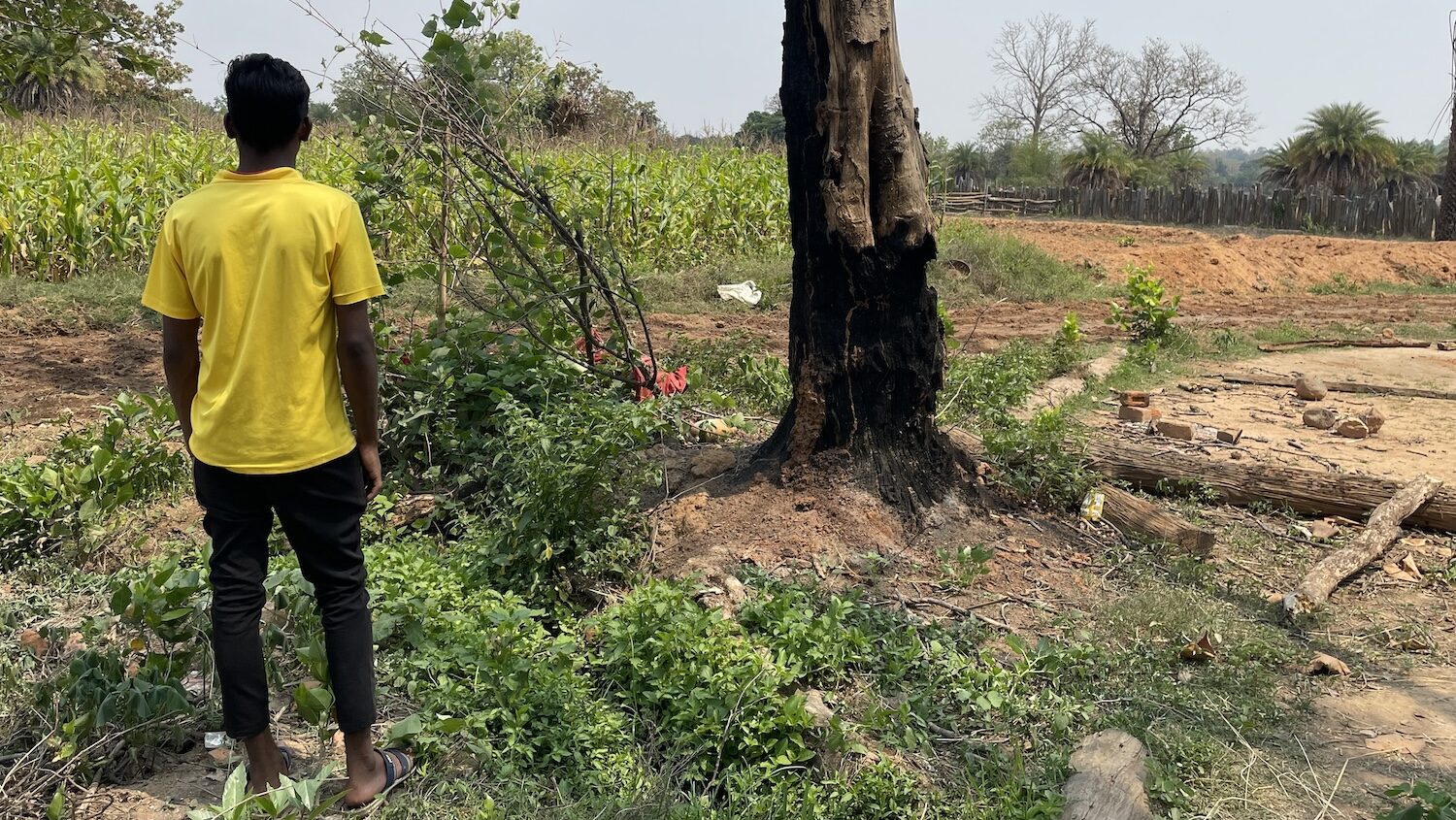
“What savings? We just live from day to day,” says Chandra Lohar (50), when asked about how much he has saved for the rainy day. Exasperation is writ large on his face. Chandra is from a nomadic community called Gadia Lohar. Chandra is camping at the border of a village in Rajasthan.
In the official records of the Rajasthan government, they are known as “Gadia Lohar”. They are itinerant ironsmiths and that is the source of their livelihood.
It is December and their temporary abode adjoins a three-way road junction, a short distance away from Saahba village in the Taragaon block of Rajasthan’s Churu district. Biting cold and the unending noise of vehicles passing by make living there a difficult proposition. But this is nothing new for them.
A family is seated around a bonfire. The bonfire doubles up as a stove for cooking food and a place to sit around and gossip. Arranging cow-dung cakes for the fire is a challenge for the Gadia women. “When we go into the villages to sell iron implements, we collect cow dung cakes from the womenfolk. That’s how this fire is lit in the evening,” says Maina Devi, as she cooks rotis on the fire. Clearly, they get nothing easily. Maina also reveals the division of work between men and women of the community. Men fashion iron implements and women go from door to door in the villages vending them.
Tracing the history of the Lohar community adopting a nomadic life, Narsi says, “When Maharana Pratap was forced to flee Chittorgarh after facing defeat at the hands of Akbar, our ancestors accompanied him. They upturned their cots, and took a vow that they would not return to their villages till the Maharana got his kingdom back. The cots are still upturned.” But even as he underscores the self-respecting nature of his community, present-day concerns overwhelm him. “There are no kings and no kingdoms now. The country became independent long ago. But I don’t know why we still continue living the same way?” Narsi, who, at just 26, is the father of two children, is clearly worried about the future.
Narsi is not alone. Almost all nomadic communities have similar concerns. For the 15-16 families in this camp, living under the open sky is less about freedom and more about being forced to brave the elements. They carry tarpaulin sheets in their bullock carts to protect themselves from the heat, rain and cold. Chandra is worried because his old, worn-out tarpaulin is no longer of any use. About 15-20 days ago, he got a fever. Without any knowledge of government health schemes and no Ayushman Card or health insurance, he went from hospital to hospital seeking treatment. The fever left him but not before he had spent a couple of thousands. “Not only are all my savings gone but I am also under debt,” he says, with palpable sadness. Bitter cold nights are round the corner, the tarpaulin is torn and there is no money.
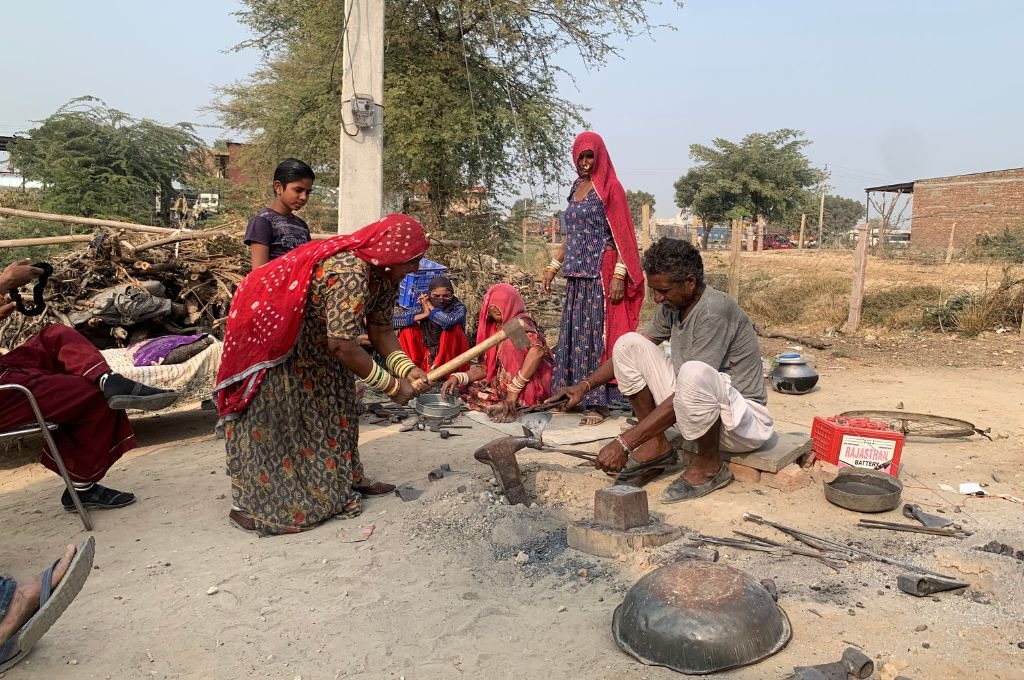
“Whom do we borrow money from? All of us are in the same boat,” says Maina, 55. While the middle class is worried about tax slabs and interest rates, the marginalized have no one to give loans. Ours is indeed a nation of contradictions.
Their living conditions are the source of the many health problems for the Gadia Lohars. They are forced to defecate in the open as public toilets are either not there or are far away. This is especially difficult for women. For drinking water, they depend on the villages they are camping at. For want of potable water, digestive disorders and water-borne diseases are common among the children as well as the adults. Pregnant women can neither get regular health check-ups done nor get immunization. And then, they have to be constantly on the move.” In villages, mother and the newborn don’t leave their homes for five weeks after delivery. But we can’t afford it. Even if the child is ten days old and it’s time to move, we have to do so,” Maina says. Maternal health programmes of the state and the central governments don’t exist for the women of this community, although they are much-needed.
They carry their homes on bullock carts – cots, equipment and minimal kitchenware. So, what is their permanent address? I asked a young man to show his Aadhar Card. It carried the name of a village in Haryana as his address. “We don’t have any house or land in this village. We just live there from May to September,” he explains. Narsi explains, “Yes, we are listed as voters in that village. During elections, candidates do contact us. But we don’t get the benefit of any government scheme.” These families spend five-six months every year in that village but they don’t own any land or house there. As such, their “permanent address” is just notional. Their voter IDs were issued some years ago. Though Special Intensive Revision (SIR) of electoral rolls is yet to begin in Haryana, when it does, their franchise will be at risk.
Children at the camp have smartphones but not slates. When asked about the education of children, Dhoili (25) says, “We are constantly on the move. How can the children go to school? They do attend classes when we stay for extended periods at a particular village but not the year round.” In this age, when formal education is of crucial importance, these children being out of the schools makes future just gloomier. Smartphones may entertain them for a while but a life overflowing with challenges awaits them, and it will be next to impossible for them to navigate through them without formal education.
The market for the products of Gadia Lohars is shrinking. Mechanization of farming has caused the demand for their hand-made implements to plummet. Savage price rise is only adding to their problems. Obviously, they need to settle down in one place. “Many of our people have put back their upturned cots the right way up. There are some like us who are yet to do it,” says Narsi, explaining that in the jargon of the nomads of the area, putting the cot back on its legs means to settle down at a place permanently. “We do want to settle down. But for that, the government needs to help us. The sarpanch had got a form filled out about five months ago but there has been no news since then,” Narsi says. Lack of education and knowledge about government schemes, coupled with excessive digitization of official processes and procedures, has made it almost impossible for Gadia Lohars to access public welfare programmes. Local politics and lack of a permanent abode are additional hurdles.
An interaction with the Gadia Lohars camping at this site makes it amply clear that despite being the citizens of a public welfare state, nothing has been or is being done for their welfare. In 1955, Jawaharlal Nehru had led 4,500 Gadia Lohars in circling the Chittorgarh town four times as a symbolic fulfillment of their vow. Some Gadia Lohars were settled there. But there was no follow-up in the form of long-term awareness campaigns or programmes. Ashok Gehlot-led Rajasthan government launched “Maharana Pratap Sthayi Niwas Yojana” for permanent settlement of Gadia Lohars. But an indifferent bureaucracy ensured its burial. The scheme involving an assistance of Rs 10,000 to them for buying raw material was never implemented.
The camps of the Gadia Lohars might be getting a 5G network but they are losing the battle for livelihood and identity. A government that has been harping on the Haldi Ghati battle between Maharana Pratap and Man Singh should take care of the progeny of the Maharana’s self-respecting supporters. The Centre should seriously consider launching a campaign for permanent settlement of Gadia Lohars and other nomadic communities. Only permanent settlement can resolve the challenges facing these communities related to education, health, drinking water and identity.
(Translated from the original Hindi by Amrish Herdenia)
Forward Press also publishes books on Bahujan issues. Forward Press Books sheds light on the widespread problems as well as the finer aspects of Bahujan (Dalit, OBC, Adivasi, Nomadic, Pasmanda) society, culture, literature and politics. Contact us for a list of FP Books’ titles and to order. Mobile: +917827427311, Email: info@forwardmagazine.in