A lecture by Subhash Chandra Kushwaha on “Kabir’s relevance in the present times” scheduled for 4 December 2025 at the University of Allahabad (A Central University) was cancelled by the university administration without giving any reason. Thus, not a single word of the lecture needed to be delivered to show Kabir’s relevance today!
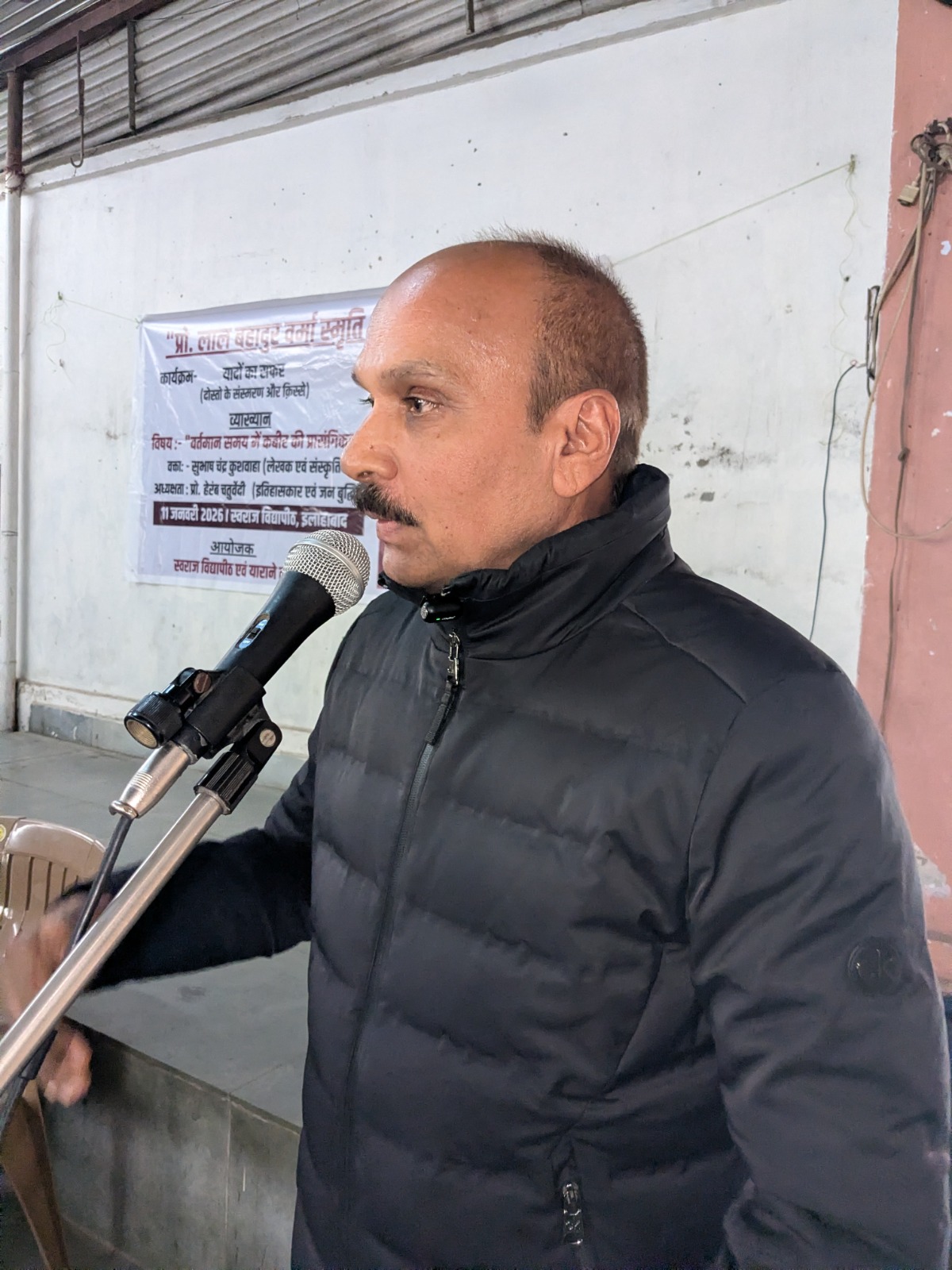
In a show of defiance, members of Allahabad’s civil society, Swaraj Vidyapeeth and Yarane Lalbahadur took it upon themselves to organize this lecture on 11 January. A large number of college and university students attended the event, which was a part of a lecture series commemorating historian Lal Bahadur Verma. Prof Ankit Pathak, who hosted the programme, remarked that Kabir has answers to challenges we are facing today. Historian Heramb Chaturvedi chaired the event.
Before starting with his lecture, Subhash Chandra Kushwaha remembered Lalbahadur Verma. “Professor Lalbahadur Verma was my teacher. At the time, he was a professor at Gorakhpur University. As his students, we were naturally deferential towards him. But he never behaved as a professor but as one of us – a student. He sat on the ground with us and readily took part in street plays. Once when meals had to be arranged at an event and we were short of money, he gave a practical idea: “Go to the market and buy brinjals with seeds – the cheapest vegetable available. Slice the brinjals, boil them in a cauldron and add turmeric, salt and chilly powder. Then make puris and eat them with the brinjal curry directly from the cauldron. You won’t even need a pattal-doney (leaf bowl).”
Relating another anecdote, Kushwaha said, “Once Verma Sahib reached my village [Jogia Janubi Patti, Fazilnagar, Uttar Pradesh] unannounced to attend the ‘Lokrang’ programme. I felt embarrassed because I had not even invited him and yet he had come. We made him the chief guest although we already had one. He spent two days and two nights at the village, going around and talking with everyone. Before leaving, he gave a Rs 2000 note to me saying that this was his contribution to Lokrang. When I said I couldn’t accept it, he replied, ‘Through Lokrang, you are grooming the people, training them. You are doing my work.’ Professor Verma was always thinking about how to associate students with pro-people ideas and how to groom a new generation. He told me, ‘You have to take my work forward.’ Till his last breath, he was handing over responsibilities to others. Professor Verma was steeped in the ideology of Kabir.”
Moving closer to the subject, Kushwaha said, “You are free to disagree with me. Kabir was comfortable with disagreement. He did not believe that ideological differences should be necessarily resolved. For Kabir, practical issues of life were more important than ideological matters.”
He added, “The way Kabir is taught in universities and the way I see him are very different. In high school examinations, an oft-asked question is: ‘Prove that Kabir was a social reformer.’ My answer was: ‘The question itself is wrong. Social reformers are those who want to correct the wrongs and improve society. Kabir did not fall in that class. He wanted to build an entirely new society by uprooting the existing one because he believed that contemporary society was beyond redemption.” The teacher who evaluated my copy pulled me up. ‘Next time round, you write such rubbish, you will be failed.’”
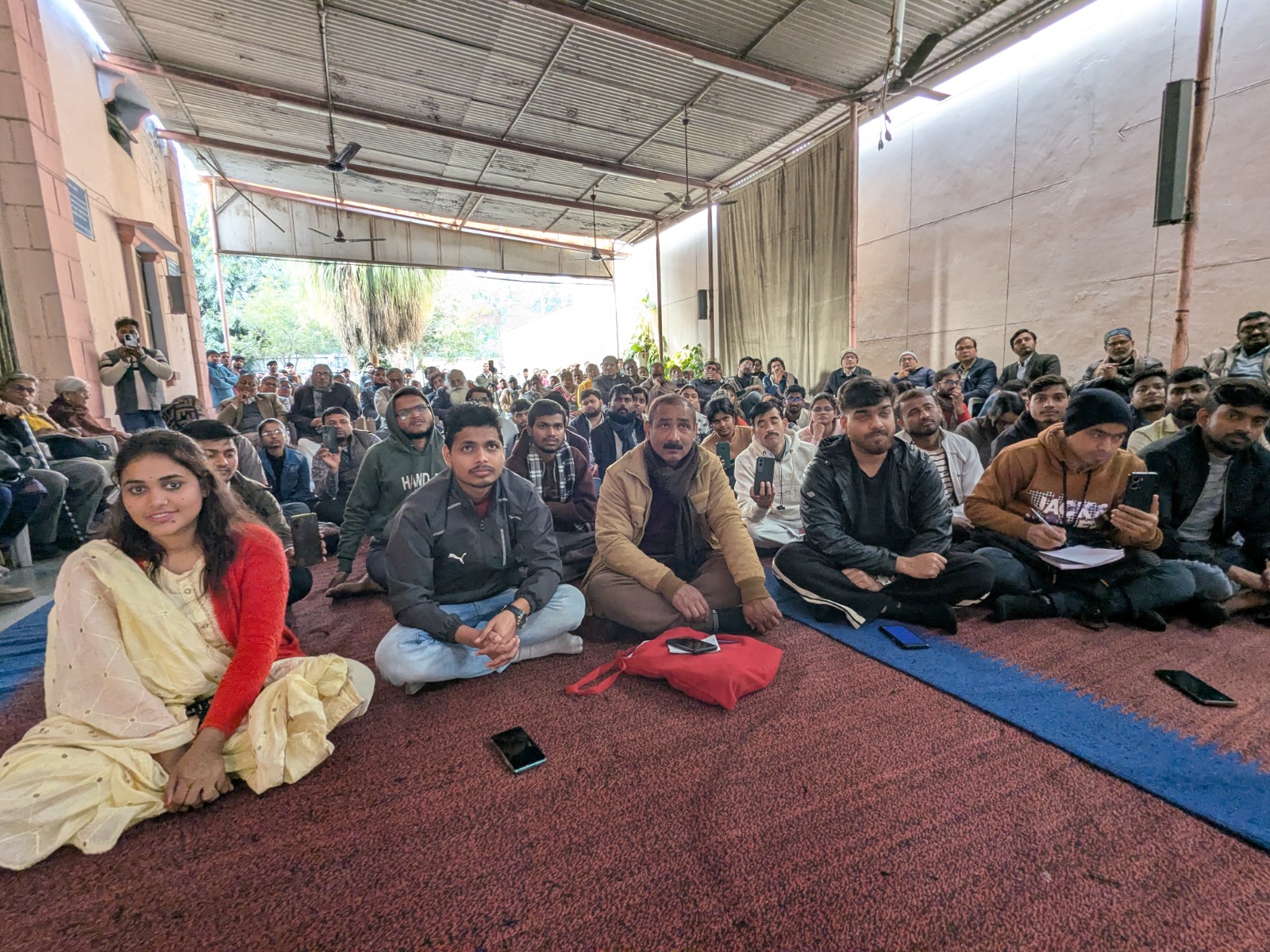
On the decision of the University of Allahabad to cancel the lecture, he said, “Kabir is so relevant today that when a humble student of Kabir like Subhash Chandra Kushwaha is invited to speak on him, the university doesn’t allow it. He is not allowed to speak. This is what makes Kabir relevant. You already teach Kabir in Class 10, you teach him in universities. I would not have spoken on anything except what Kabir wrote. I would have talked only about what Kabir wrote, what he went through. You teach those things but if a speaker wants to go over them again, you don’t like the idea. That is Kabir’s relevance – it makes us recall and compels us to think.”
Here is a lightly edited version of the rest of the lecture:
Obfuscating his birth, death
Kabir was a victim of what we now call WhatsApp university. Today, WhatsApp university builds the narrative: Mr A is a Pappu, Mr B works for 18 hours. Did society build such a narrative around Kabir? Did it accept Kabir voluntarily? Did it want to accept him? No, not at all. Let me begin from the end of Kabir’s life. He is supposed to have lived from CE 1440 to CE 1518. Some even say he was born in 1398, giving him an extraordinarily long life. Today, we find it difficult to even make it to 100 despite popping in umpteen pills of vitamins and minerals. And you say he lived for 120 years! That’s not all. Ramanand Swamy’s age is stretched to 300 years! If your thinking is not scientific, you may be teaching anything but Kabir. You are just completing the prescribed syllabus. A few years after Kabir’s death, “Kabir Parchai” and “Kabir Kasauti” were written. Do you know why they were written? It is like, make a Dalit the chief minister of a state and then you can freely commit atrocities on the community. Similarly, if you want to oppress Adivasis, just appoint an Adivasi to a top position. So, to destroy Kabir, they brought forth Nabhaji – a Dalit. And a book “Kabir Parchai” was written. I won’t go into the contents of the book but suffice it to say that it turned Kabir into a god and designated Swami Ramananda as his guru.
I have been asking Hindi scholars whether they adopted Kabir voluntarily. Kabir’s works were printed in Britain in 1812. In 1841, he found mention in the Observer newspaper and went on to figure in the British Press up to 1915. Kabir was being talked about in countries where his language was alien to the writers and the readers both. But he was shunned in India.
In 1915, Rabindranath Tagore translated 100 verses of Kabir into English. Around the same time Ayodhya Prasad ‘Harioudh’ published the couplets of Kabir. In 1928, Dr Shyamsundar edited a compilation of Kabir’s works. Then, in 1960, Hazari Prasad Dwivedi wrote on Kabir. They all insist that since Kabir was a “sant”, he could live for 120 years. All these books were out to prove that Kabir was a Hindu and whatever he said and taught was imbibed from Hindu Vedanta philosophy and Advaitvad. He had no other influence. My dear, why are you adamant to prove that a person born into a Muslim family was a Hindu? This is difficult to comprehend.
At one place, Dwivedi writes that Kabir was brought up in a weaver family. What do you want to prove? Why can’t you say that he was born into a weaver family?
The year CE 1440 is not pre-history. The chronicles of that era mention specific dates. It is recorded that Guru Nanak was born in 1469. Couldn’t we have determined the year of Kabir’s birth? Why does so much confusion surround the birth and death of Kabir? You can go on researching but you won’t be able to determine when Kabir was born and when he died.
That’s because a story was concocted that Kabir was the son of a Brahmin widow. Where is the evidence for this? And if that was so, please tell us that widow’s name.
The story that has been woven is unbelievable, unscientific and idiotic. A girl tells her father that she wants to meet Swamiji. The man – a Brahmin – takes his widowed daughter to Swamiji, who blesses her saying “Putravati Bhava” (May you give birth to a son). When the girl’s father reveals that she is a widow and cannot become a mother, Swamiji has a solution. He tells her that her son will be so brilliant that he will enlighten the world.
We take leave of our reasoning power for a moment. If Swamiji was such a great soul that his blessings alone could lead to the birth of a child (which, as we know, is an impossibility), then how couldn’t he tell that the girl brought to meet him was a widow?
Kabir’s [real] parents are also shrouded in mystery. It is said that they were Brahmins in their previous birth. Who could have known it? Was there any record to prove it? It is clear that they were Muslim weavers. Why don’t you want to discuss and debate this issue? Is it only because the 15th-century personality was described as India’s Luther by W.W. Hunter?
Grierson says that Kabir inaugurated an ideological revolution in India. He was a great scholar. You want to prove that he was a great scholar because he was a Brahmin by birth. Otherwise, he would have been a fool.
Kabir was born in the Sultanate era, long before the advent of Mughal rule in India. What conditions prevailed in India at the time vis-à-vis ritualism, hypocrisy and blind faith? That was the period which shaped Kabir. Another part of the world was also witnessing anarchy at the time. The period of Renaissance in Europe – which was a favourite topic of Lal Bahadur Verma – broadly matched the period when Kabir led a renaissance in India. You call this era the Bhakti period. I don’t agree. Whose Bhakti (devotion)? What Bhakti (devotion)?
Kabir took the tradition of the Charvak, Siddha, Sufi and Nath forward
Kabir’s ideology is not his alone. It did not emerge from a vacuum. The people of this land have been long engaged in a battle on the issue of the Varna system. On the one hand there was a pro-Varna system movement and on the other hand there was a parallel movement against it. The latter began with the Charvak. After the Charvak, Buddha led it. Then the Siddha took over. The Siddha lived in the 8th century. By then, Sufism had entered India. The Sufi and Siddha shaped the philosophy of the Nath. And then Kabir came along.
What the Siddha said was echoed by Gorakhnath. What he said was repeated by Kabir. There is no difference. All the three say exactly the same thing. So, the stream to which Kabir belonged was not a new one. Kabir doesn’t come into being suddenly. What you learn from the Siddha is what you learn from Gorakhnath and what you learn from Kabir.
Siddha Sarhapa had written a poem in the 9th century:
Pandia sal satth bakkhanyee
Dehahi Buddha basant na janayee
Taruphal darisane nau agghayee
Pejj dekhi kim rog pasaye
(The Pandit interprets all scriptures, but remains ignorant of his own self. Seeing a fruit hanging from a tree is not eating it. Your disease does not disappear merely by seeing the doctor)
Similarly, Gorakhnath says: “Pothi padhi-padhi pandit bhaya, yog na janya koyee” [They became scholars by reading books but none of them understands “yog” (the coming together of man and God)]. Kabir delivers the same message, using different words: “Pothi padhi-padhi jag muya, pandit bhaya na koy; dhayee aakhar prem ka, padhe to pandit hoyee.” (They read numerous books but they couldn’t become scholars and died; only one who understands “prem” (love) can be a scholar). So, Kabir just replaces “yog” with “prem”.
Thus, there is a long tradition that extends from the Nath and the Siddha to Kabir. Gorakhnath writes, “Hindu dhyawe dehura, Muslim dhyawe maseet, jogi dhyawe param pad, jahan dehura na maseet” (Hindu looks for god in temple, Muslim in mosque; but Yogi looks for the supreme god, for which you need neither a temple nor a mosque).
Kabir went about making acerbic assaults on everything he saw as evil. But our scholars were hard at work trying to prove that Kabir had roots in Hindu Vedanta. Theirs was a deliberate amnesia about the philosophies of the Sufi, Siddha and Nath that shaped Kabir. A book, ‘Kabir’, written by Hazari Prasad Dwivedi pains me. You must also have read it. It is taught in all universities. Almost 80 per cent of the content of the book is devoted to explaining what “avdhoot” means in Hindu religion, what is Hathyoga, what is Nath sect, who is a Jogi, what is Nirgun Ram, etc. You will find chapters on all of these. But there is nothing about the basic elements of Kabir’s thinking.
Kabir: A victim of WhatsApp University
Coming back to the relevance of Kabir, I warn you that if someone tells you Kabir had written this or that, don’t believe it. That’s because “WhatsApp University” has been adding things to Kabir’s works. This has been done from Kabir’s era. If you want to understand Kabir, focus on his thinking, not his poetry. Collect Kabir’s writings against the Varna system and then try to understand him.
In one of his poems, Kabir says, “Mala japoon na kar japoon, mukh se kahoon na Ram” (Neither do I pray to Ram holding a rosary or by placing my hands together, or utter his name). Then, something is added to it to show that Kabir invoked Ram. We are ready to accept that Kabir was a devotee of Ram. Then, you should accept everything he said. Why do you fear him? If Kabir was a devotee of Ram, then accept whatever he said. But that is not done.
Another stratagem has been devised to defame Kabir. In villages “Jogira Kabira” is sung around Holi. Some of its verses are so vulgar that women can’t bear to hear them – so dirty they are. But why are they still sung? That’s thanks to the WhatsApp university. The idea was to give a bad name to Kabir and Jogis so that he no longer remains the symbol of the struggle against the Varna system.
Neither was Gorakhnath spared. The word ‘Gorakhdhanda’ has been coined for anything fishy. These words were coined for a reason. The objective was to stigmatize the saints who talked of equality, of love, of brotherhood; to find ways to belittle their position in society.
Buddha, Kabir and Gorakhnath
While analyzing Kabir’s philosophy, Hazari Prasad Dwivedi writes that Kabir was influenced by Vedanta and that his couplets show that he had imbibed a lot from Advaitvad.
An article in a newspaper I read at the British Library (I have quoted from it in my book) says that Kabir was more influenced by the Sufi than by Advaitvad. He was even more influenced by the Pir. Gorakhnath was entirely a product of Pir influence. The Mehta community reveres Gorakhnath and Ghazi Miyan both. Ghazi Miyan had launched a movement demanding a ban on cow slaughter and was close to Gorakhnath.
That is the reason Gorakhnath repeatedly said “Utpati Hindu Jarna, Jogi, Akli Pir Musalmani”. What he is saying is that he considers himself a Pir, for whosoever is a Jogi is a Pir. If you read Gorakhnath’s verses on Hindu-Muslim relationship, it will be clear to you that Gorakhnath was influenced by the Pir and the Sufi.
Hazari Prasad Dwivedi’s book has a long chapter on Jogis. There are 420 houses of Jogis in the Khabrua village of Balrampur district. All of them are Pasmanda Muslim. Shravasti, Kushinagar, Gaya and other places associated with Buddha are also associated with Gorakhnath and Kabir. You will also find a big population of weavers at such places. Sitapur is home to 40 lakh Jogis. But with time, they are abandoning their traditional vocation, they are abandoning their Sarangis. The Jogis followed the tradition of Sufis. The tradition of seeking alms comes from the Buddhists.
It is from the Jogis that Gorakhnath and Kabir learnt how love is essential for humanity; how the Hindu-Muslim divide can be healed and why Hindustan needs the concept of Param Brahma. This was basically a battle between polytheism and the concept of a sole supreme god.
‘Amardesva’ is the gist of Kabir’s philosophy but Hazari Prasad Dwivedi’s book does even mention ‘Amardesva’. Kabir’s Amardesva is a close cousin of Raidas’ Begumpura.
Jahnwa se aayo amar wah desva,
Pani na paun na dharti akaswa, chand soor na tain divaswa,
Brahman, chhatri na soodra baisawa, mugli pathan na syed sekhwa,
Aadi joti nahin gaur ganeshwa, brahma visnu mahes na seswa,
Jogi na jangam muni darvesva, aadi na ant na kaal kalesva,
Das Kabir le aaye sanseva, saar sabd gahi chailevahi desva
Kabir says in “Amardesva”, there will be no place for Gauri, Ganesh, Vishnu and Mahesh. But you are out to prove that Ramananda was his guru. If Ramananda was Kabir’s guru, then we are Vishwaguru.
Even if we concede that Kabir was born in the year 1398, we know that Ramananda died in 1410. That means Kabir was 12 when Ramananda died. How could Kabir have imbibed the teachings of Ramananda? And then there is this story about how Kabir acquired knowledge from Ramananda. Was Kabir such a fool that merely because Ramananda had put his foot on his chest, he would presume that he had been accepted as his disciple by the preacher? Now, Ramananda was a Vaishnavite. So, as his disciple, Kabir should also have been a Vaishnavite. But Kabir negates idol worship. Brahma, Vishnu and Mahesh don’t find a place in his “Amardesva”.
Ram Prakash Gupta writes that Ramananda was Kabir’s guru but Kabir completely rejected his guru’s philosophy. This, when Kabir considered guru greater than god.
Guru govind dou khade, kake lagoon paaon
Balihari guru aapki, govind diyo batay
So, a person who accorded such an exalted status to the guru wouldn’t have hesitated for a moment in accepting Swami Ramananda’s greatness. Please also note that Ramananda has been cited as the guru of all the great saints who lived in that era – Kabir, Raidas, Dadu and others. For that to happen, Ramananda would have to live 300 years – from the 14th to the 16th century. So, there are two ways of looking at Kabir. One is the way of Hazari Prasad Dwivedi, Hairoudh and Purushottam Agarwal. The other is of the Bahujan. To understand Kabir, we need to study the second stream, which includes the likes of Kanwal Bharti, Bihar’s Rajendra Prasad Singh and some others. Theirs is a different stream.
It is also important that Ramananda’s disciples included Anantananda, Sursurananda, Sukhananda and others whose names ended with Nanda. But ‘Nanda’ was never added to Kabir’s name or to Raidas’. Then, how could he have been Ramananda’s disciple? They have only one line to prove that Ramananda and Kabir were teacher and disciple. And that is: “Ham Kashi mein prakat huye, Ramanand chetaye”.
They would have done themselves a favour had they added a few words to convey what Ramananda ‘chetaye’ (warned) Kabir about. What wrong was Kabir doing? What foolishness was he committing that Ramananda had to warn him? Kabir’s philosophy is very clear:
“Brahman Guru Jagat ka, Sadhu ka Guru nahi” (Brahmin is the guru of the world but not of Sadhu).
Kabir was patronized by Sharqi rulers
You ignore Kabir’s thinking. You quote from interpolations in his works, you refer to knowledge gained from WhatsApp university to claim that Ramananda was Kabir’s guru. But Kabir could not have survived but for the patronage of the Jaunpur Sultanate. This hasn’t been written anywhere. I am saying this on the basis of facts. You just have to see the ruins of the Jaunpur mosque to realize that it represents a shared Hindu-Muslim culture.
A verse written by Hussain Shah Sharqi, the Sultan of Jaunpur, has an uncanny resemblance to Kabir’s:
Main piya ke manuali, na maane, piya mori manmani re
Lok kahe tu to bavri, aape rog purani re
Piya more main poya ki sajni, piya ke haat bikini re
Shah Hussain banavein, jangal jay samani re
Before 1497, when Sharqi rulers of Jaunpur faced Sikandar Lodhi in the battlefield, Benaras was a part of the Sharqi kingdom. Kabir lived in Benaras at the time and couldn’t have said the things that he did unless he had some kind of patronage, some sort of security. Unless he had a thousand-strong contingent of lathi-wielding men to protect him, he would have been killed. There is historical evidence that Sultan Sikandar Lodhi came to Jaunpur. And no, we are not inferring this from couplets.
It is said that after Kabir’s death, his body was not found, it disappeared. It is said that the Hindus and Muslims were at loggerheads as they wanted to perform his last rites in keeping with their respective religions. But when the shroud was lifted, some petals were found instead of his body.
Kabir was a human being. Let us analyze this incident from a scientific perspective. Sikandar Lodhi had met him. Is it not possible that Lodhi got him killed and had his body dumped in a river, hence his body was not found? Then, what was the option? It was for Hindus and Muslims to share the flowers. Unless we resort to science and reason, we are bound to fall for unscientific things. Kabir symbolized freedom of expression. Today, that freedom is under threat. Kabir did not see Hindus and Muslims as different people. He described himself as a weaver, but not as a Muslim. He rejected and discarded communal divisions.
Respecter of labour
Ideologically, Kabir was Karl Marx’s predecessor. Kabir’s writings about the deprived have largely been ignored. Kabir’s love for toil and the toilers is hard to find in other works. That is because the institutional structure of our country treats manual labour as something to be ashamed of. But Kabir had a lot of respect for the barbers, weavers, ironsmiths and potters.
About weavers he says:
Ham Kashi ke Julaha, Ram Naam Rang Rancha,
Aisa rang laga kabira, kabahun na chhote khwaja
About barbers he writes:
Nai ke ghar sabun nahin, phir bhi ujli deh
Man ka mail utaar de, soyee saccha she
Just look at how he views potters:
Kahaar kahoon ya, kou kahoon
Sir par lade bhaar, man ka bhojh utaar le, tau pehchane
And Kumhars:
Guru Kumjar, shishya kumbh hai, gahi gahi kadhe khot
and
Maati kahe kumhar se, tu kya roondhe mohi, ek din aisa aayega, main rodungi tonhi
Lower castes figure consistently in Kabir’s writings.
About ironsmiths, he writes:
Lohe ko tapay ke ghan mare barambar, aise man hari payeye kahe Kabir vichar
And
Sadhu aisa chahiye, jaisa soop subhay
But Kabir never refers to mullahs and pandits with respect. Just quote me one line, if you can, where he does that. In fact, he challenges them with “Pande chhoot kahan se aayee”.
That is why I say that Kabir stood by the toilers. Today, ten capitalists own half of the country’s wealth. But Kabir says, “Sayeen itna dijiye, jamein kutumbh samay”. And he shames those born in elite families – “Ucche kul ke janmiya”.
Sikhism and Din-e-Ilahi were influenced by Kabir
Just think – what was it about Kabir that enamoured Nanak? Nanak met Kabir in 1498 when the former was 27 years old. Nanak had set out to collect verses on the deprived communities of the Hindi belt. In 1604, Guru Arjun Dev edited Aadi Granth, which overflows with the verses of Kabir and Raidas. Ramcharitmanas was written shortly after Kabir’s death. But Nanak doesn’t pick a single line from the immensely popular work. Nanak had realized how relevant Kabir was. Kabir’s relevance is also reflected in Akbar’s Din-e-Ilahi and Sikhism. Both carry Kabir’s stamp. Both are humanistic religions. Today, we are passing through a period of crisis. Our existence, our freedom of expression, our brotherhood – all are under threat. No nation can grow without education, without knowledge.
That’s why Kabir repeatedly insists: “Santon aaye gyan kee aandhi re, bhram ke tati sabai udani, maya rahe na bhandi”. Kabir wants to shatter the myths. What a scientific idea! Myths exist only in the absence of reason. At the sight of reason, myths fly away. Why was Kabir saying all these things? That was because he came from the Shudra community, from the community of the weavers. Religious conversion had taken place mostly in the Shudra community of the Purvanchal region. Kabir came from that community. At the time, the weavers were not allowed to touch vessels and utensils. The Shudras were not allowed to acquire an education. Kabir was illiterate. So, how could he have been emancipated? Kabir considered knowledge as the most potent power. The Shudras were deprived of it. Kabir’s battle was for knowledge. Knowledge would efface discrimination. It would annihilate the idea of high and low. Kabir fought and died for that. The battle for establishing Kabir’s relevance continues. Even today, Dalits are not allowed to ride horses. They are forced to drink urine. Being a Muslim is the greatest crime one can commit. Kabir wanted no Hindu-Muslim divide. If we read Kabir with these things in mind, we will discover a new Kabir.
(Translated from the original Hindi by Amrish Herdenia)
Forward Press also publishes books on Bahujan issues. Forward Press Books sheds light on the widespread problems as well as the finer aspects of Bahujan (Dalit, OBC, Adivasi, Nomadic, Pasmanda) society, culture, literature and politics. Contact us for a list of FP Books’ titles and to order. Mobile: +917827427311, Email: info@forwardmagazine.in