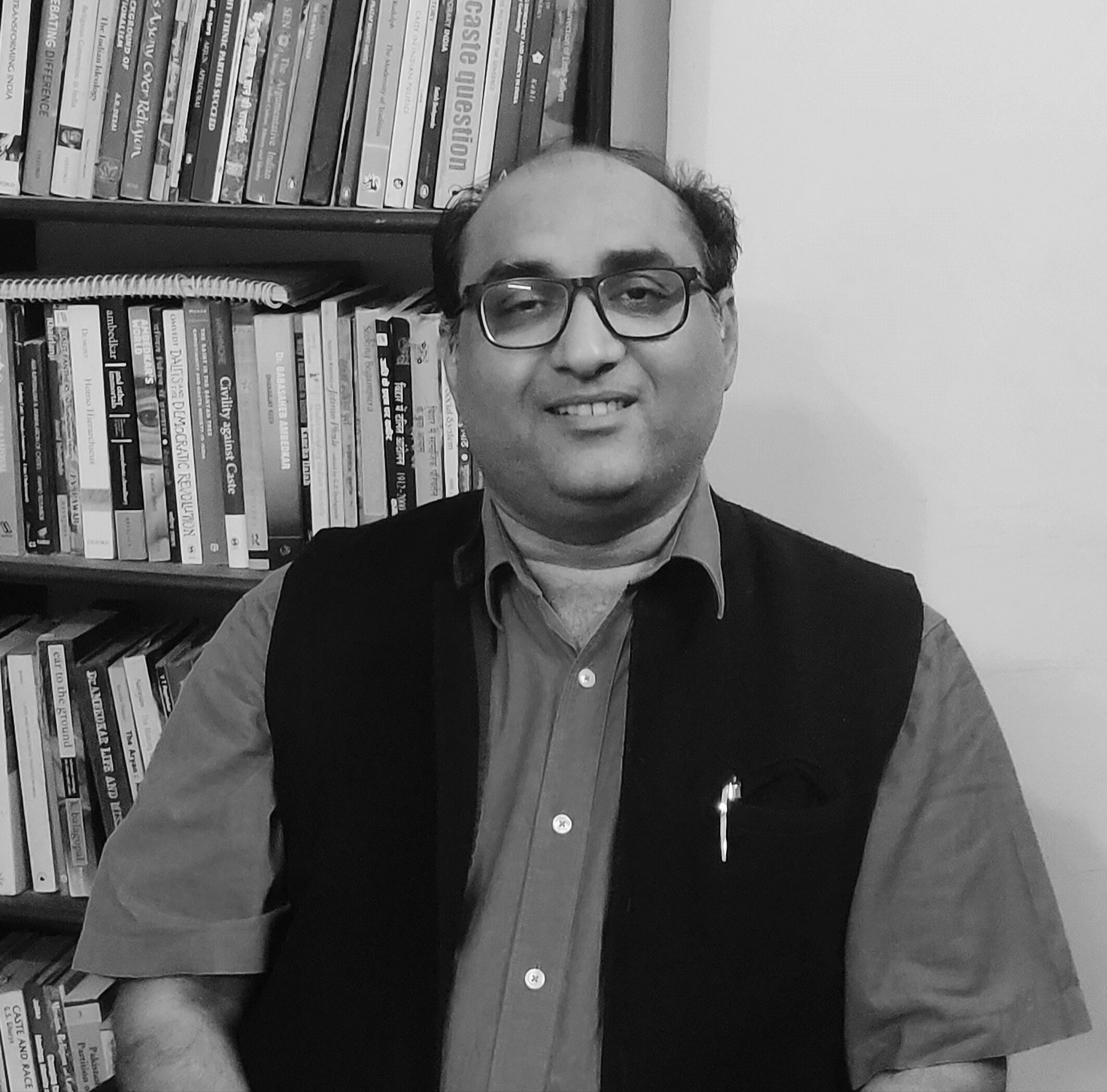
(This is a slightly revised version of the keynote address Dr Khalid Anis Ansari delivered at the International Dalit Literature Festival, organised by the South Asian American Coalition to Renew Democracy (SACRED), Northeastern Illinois University, and other affiliated organisations at Roosevelt University (Chicago) on 18 April 2026.)
Friends, comrades, writers, and truth-tellers.
We gather in the United States to celebrate “Ambedkar Jayanti” – a country that gave Ambedkar John Dewey, pragmatism, and a living sense of democracy as “a mode of associated living.” Yet today, the nation that gave him important lessons in democracy has become its most powerful violator. From the manipulation of the electoral process to police violence, from Islamophobia to the criminalisation of dissent, the US no longer nurtures democracy. It backslides.
And this is a global crisis. Elite capture of parliaments. Breakdown of the rules-based order. The return of colonial language of conquests, most recently in the US-Israeli military adventures against Iran and Lebanon. Liberal democracy is in intensive care.
For anti-caste movements, this is not a distant headline. It is a direct threat to our conditions of possibility. To respond, we must rethink our politics. And we may begin, probably, with a conceptual distinction from the American political theorist William Connolly.
Connolly warns us not to confuse pluralism with pluralisation.
- Pluralism is the fact of diversity – the administrative recognition that many groups exist. The liberal state loves pluralism because it is manageable. It carves society into neat boxes (Dalit, Muslim, Adivasi, woman) and offers token representation. Pluralism contains.
- Pluralisation is the process of becoming different – the active, unruly, creative unsettling of settled hierarchies. It refuses the box. It demands not just a seat at the table, but a questioning of who built the table and why it is shaped like a hierarchical pyramid.
Contemporary anti-caste movements have become experts in pluralism (counting identities, demanding quotas) but have lost the art of pluralisation. The global crisis of democracy is a crisis of pluralisation – elites are happy to have many cultures, as long as none challenge the underlying structure of exploitation.
Ambedkar’s resignation from the “Hindu” fold in 1935 and final exit in 1956 was not pluralism. It was pluralisation, a radical rupture, akin to a mass strike against the caste order. Today, we need to recover that spirit. To further that process, I propose a conceptual framework: the 4Ds – Decolonisation, Diversification, Democratisation, and Development.
Let me walk through each D, showing how it connects to pluralisation and the crisis of backsliding democracy.
- Decolonisation – Unlearning the Orientalist Cage
The “postcolonial predicament” means we are free from foreign rule, but colonial knowledge-administrative regimes still shape our public life. Four orientalist moves still trap us:
- Religion as an essentialist, overarching identity.
- History written through the lens of Hindu-Muslim antagonism (British historiography).
- Hinduism as tolerant but inegalitarian, Islam as fanatic but egalitarian – thus caste is religionised, rendered residual in non-Hindu communities.
- Geographical origins of faiths determine “foreignness” – Islam and Christianity remain alien despite centuries of presence.
This is the opposite of pluralisation. Pluralisation would require us to decolonise our categories – to see caste across religions, to refuse the Hindu-Muslim binary as the only horizon, and to build pan-religion solidarity of the oppressed. Without decolonisation, anti-caste politics remains trapped in the very map the coloniser drew.
- Diversification – Breaking the Vanguard Caste Monopoly of Culture
All Bahujan communities experience caste humiliation, but differentially – in interlocking relation with gender, religion, language, class, sexuality. Why have most Dalit-Bahujan chosen to stay back in the “Hindu” flock? The usual answer – false consciousness – takes away agency. We need to investigate Dalit-Bahujan meaning-making seriously.
One may list multiple Bahujan strategies regarding faith: exit/conversion (Ambedkar), radical atheism (Periyar), internal reform/liberation theology (Narayana Guru, Abdul Qaiyum Ansari, Arvind P. Nirmal), new faiths (Phule’s Satyashodhak Samaj, Ram Swaroop Varma’s Arjak Sangh). Can we settle on one? No. Pluralisation demands diversification of culture– accommodating peripheral narratives of Bahujan women, LGBTQI+, Pasmanda Muslims, Adivasis, and nomadic tribes. Not just the vanguard Bahujan castes.
True pluralisation is not one voice speaking for all, but many voices speaking from their specific locations, without hierarchy.
- Democratisation – Internal Justice and the Limits of Representation
Within the Bahujan community itself, there are power differentials. The rise of Mahadalit, Atipichda, Pasmanda identities – demanding sub-quotas – is a sign of internal democratisation. However, we cannot vulgarise representation by delinking it from a transformative agenda. The founding anti-caste icons saw representation as a means to social justice and meaningful democracy, not an end in itself.
Today, we see reductionist battles between Bahujan communities over quotas, without any reference to the ideological propriety of the spaces themselves. That is pluralism without pluralisation. Democratisation would require constant contestation of internal hierarchies, as envisaged in Babasaheb’s conceptualisation of “graded inequality”, and a serious debate on proportional electoral systems, not just first-past-the-post.
- Development – Bringing Resistance to Capitalism Back
Ambedkar named two enemies: Brahmanism and Capitalism. However, one may contend that economic considerations were broadly sidelined by Dalit-Bahujan movements in favour of social, political, and religious concerns. One reason: elite capture – the hijacking of anti-caste movements by aspirational middle classes, content with identitarian politics in the attention economy, ignoring the broader Bahujan working class.
We must bring resistance to neoliberal capitalism back into the Bahujan agenda. The play of capital is embedded in the modernist-Enlightenment imaginary – instrumental rationality, consumerism, ecological destruction, automation, the military-big tech complex. Neither private capitalism (neoliberal) nor state capitalism (Soviet/Chinese models) has embraced workplace democracy.
Taking Ambedkar’s cue, Bahujans – the artisans, farmers, working classes – must envision economic democracy alongside political democracy. The road to a post-capitalist future would entail: learning from Adivasi cosmologies, Universal Basic Income, and Workers’ Self-Directed Enterprises. Not a competitive struggle for rights within exploitation, but a world-making project.
This is the deepest level of pluralisation: not just who represents us, but how we produce, own, and decide.
Now, the question of knowledge. Ambedkar made a strong analytical distinction between “learned men” and “intellectuals” and concluded that the Brahminical tradition has produced many learned men. It has never produced a Voltaire.
Why? Because a true intellectual must look beyond their own caste interests. Ambedkar argued that a Brahmin cannot, in principle, critique the Brahmanical caste order without losing privilege. But – and here is the uncomfortable question – can a Dalit, Pasmanda or Bahujan look beyond their caste interests?
We have assumed that marginalisation automatically produces authentic knowledge production. It does not. If a Dalit leader only fights for his jati, if a Bahujan activist only seeks benefits for his community, if a Muslim intellectual only defends his own clergy – they are merely learned men of their identity. Not intellectuals. Not Voltaires.
The problem of knowledge production is not only that Brahmins cannot produce a Voltaire. It is that all caste groups, including the oppressed, struggle to look beyond their immediate caste interests. This is the pluralisation challenge.
We need a Bahujan Intelligentsia – but not as a new elite. An intelligentsia that:
- Has courage against its own – critiques casteism within Bahujan jatis, patriarchy within Bahujan homes, class exploitation within anti-caste community organisations.
- Builds alliances without erasure – with queer, environmental, Adivasi struggles – not as a pluralist coalition of silos, but as a pluralising force that remakes justice.
- Abandons the learned man’s hoarding of knowledge. An intellectual makes themselves obsolete.
Ambedkar was inspired by John Dewey’s articulation of democracy in this very country. But he invented pluralisation in the slums of Mumbai and the hearings of the Constituent Assembly. He knew that without the constant, painful process of becoming different, democracy becomes majority tyranny.
The global crisis – elite capture, colonial language of conquests, the breakdown of rules – is a crisis of pluralisation. Elites want pluralism without the pain of real change.
Anti-caste politics must be relaunched as a world-making project through the 4Ds. Decolonisation, Diversification, Democratisation, Development. Not as slogans, but as practices.
So, let us commit to not being mere learned people who recite Babasaheb as a ritual. Let us use knowledge as a weapon to reshape society. Pluralise. Break the box. Build a thousand Dalit-Bahujan-Pasmanda Voltaires.
Jai Bhim!
(The views are personal.)