Nagraj Popatrao Manjule has long been celebrated for his unflinching ability to turn personal scars and societal fractures into compelling cinema. His early works (Sairat and Fandry among others) drew power from lived experiences of marginalization, caste hierarchies, and inter-caste longing — stories so rooted in reality that they carried an authenticity no research room could manufacture. Inevitably, that very authenticity became a cage. Critics and audiences began to slot him into a narrow category: the “issue-driven” filmmaker, the voice of the oppressed, the man who makes caste cinema. With Matka King, Manjule decisively breaks that mould while still carrying forward his core empathy for the striving underdog. This web series, streaming on Amazon Prime Video, proves he is far more versatile than the reductive label of “caste cinema” director allows.
Set against the sepia-toned nostalgia of 1960s and 1970s Bombay, Matka King joins the growing roster of period dramas that romanticize and simultaneously critique a particular era – think Scam 1992, Scam 2003 – and the broader wave of stories about ambition, systemic rot, and moral grey zones. It also shares striking tonal and thematic DNA with Farhan P. Zamma’s First Copy: the rags-to-riches arc, the supportive rich woman who sees something in the protagonist before the rest of the world does, an obsessive love for cars and flashy wealth, the intoxicating leap from chawl to mansion, and the relentless pull of paisa, paisa, paisa. Yet Matka King carves its own identity through the addictive, shadowy world of matka gambling – a game of numbers that once held an entire city in its grip.
Manjule directs with his characteristic grounded authenticity, and that quality is most evident in the texture he builds around the setting. The recreation of Bombay’s underbelly – crowded chawls, smoky gambling dens, political corridors, and the creeping shadow of the 1975 Emergency – feels lived-in rather than decorative. He layers the story with economic realities, rising mafia influence, police complicity, and the everyday grind of the working class without ever turning the drama into a lecture. The series smartly uses the matka ecosystem as both metaphor and engine: a game of chance that promises escape but exacts a devastating price. The narrative builds with patient tension, showing how one man’s honest hustle within a fundamentally dishonest system both creates an empire and leads him to ruin. The open-ended finale is particularly effective – it refuses easy closure, leaving viewers to weigh what was gained against everything that was quietly, irreversibly lost.
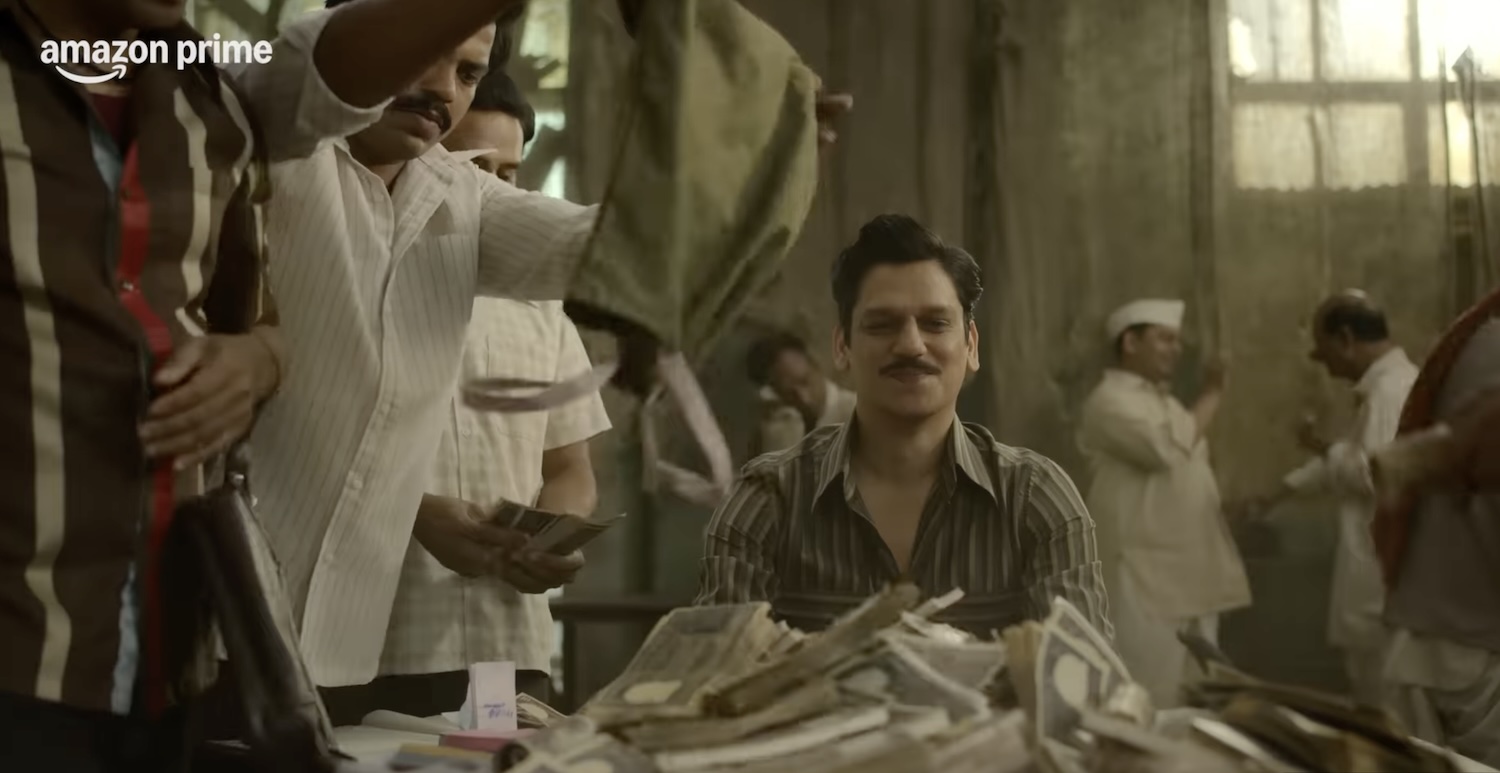
At the centre of all this Vijay Varma stands tall as Brij Bhatti. He brings swagger, vulnerability, and street-smart charm to a character who refuses to compromise his peculiar code of honesty even while running an illegal gambling operation. Bhatti is no straightforward hero or villain; he is an aspirational anti-hero who remains imaandaar on his own terms in a world that rewards the opposite. The empire he builds rests entirely on trust – and that is what makes his eventual unravelling so poignant. Varma’s physicality and intensity are magnetic, and the detail that he reportedly spent ten months practising card work shows in the ease and realism he brings to those scenes. The one minor reservation is a certain repetitiveness in his mannerisms and reactions across the arc – as Brij’s world rises and collapses around him, Varma’s emotional register doesn’t always shift accordingly, settling into a familiar set of expressions that eventually start to feel like a groove.
The supporting cast shines in the space it is given, though that space is never quite enough. Kritika Kamra as Gulrukh, the wealthy widow who becomes Brij’s confidante and later his conscience, brings grace and quiet intelligence to a role that could easily have been decorative. Sai Tamhankar as Barkha, Brij’s wife, is composed and sincere – a woman who wanted more than just the kitchen she got in the end. There is a line she delivers in the series, almost in passing, that stays with you: “Achhi chai banate-banate hi main chaar diwaaron mein qaid ho gayi [making good tea is what kept me locked up at home].” It is a grenade of a moment, and Tamhankar knows exactly how to throw it. Siddharth Jadhav as Dagdu, Brij’s loyal associate, is warm and grounded. Gulshan Grover as the antagonist Lalji Bhai commands the screen with the menacing authority the role demands, though the writing never fully capitalizes on what he brings. One of the series’ most quietly memorable sequences comes late, when Gulrukh and Barkha — two women bound to the same man in very different ways — meet and choose solidarity over jealousy. It is a rare and refreshing moment of sisterhood, and it hints at the richer, more layered story the female characters deserved but never quite received.
On the technical side, cinematographer Sudhakar Reddy Yakkanti vividly recreates the texture of old Bombay – from bustling trading hubs to shadowy gambling dens – capturing both the grit and the allure of the era without resorting to the glossy period-glamour trap that so many shows fall into. Priya Suhass’ production design and Priyanka Dubey’s costumes work in quiet harmony, making the setting feel genuinely inhabited. The music, composed by Amit Trivedi alongside B. Prasanna and Parag Chhabra, captures the era’s atmospheric flavour reasonably well, and Ketan Sodha’s background score knows when to press and when to pull back. The songs, however, are where the show stumbles most audibly. Well composed as they are, they don’t linger – they serve the narrative without transcending it. For a series so painstakingly assembled in its visual period detail, it is a real missed opportunity. What, after all, could have been Bombay in the 1960s and 1970s without music that keeps playing in your head long after you hear it?
The show’s core strength is its moral universe. Systemic corruption, Emergency-era politics, the collision between personal ambition and family loyalty – Manjule handles all of it deftly. He is particularly sharp on the double-edged nature of aspiration: the same dream that lifts Brij out of poverty becomes the force that hollows out everything he built the dream around. The rise-and-fall structure is familiar territory in the scam-and-ambition genre, and Matka King doesn’t entirely escape that familiarity. The mid-section sags. The female characters remain largely reactive despite the script’s occasional progressive gestures toward them. And for a filmmaker with as distinct a voice as Manjule’s, there are stretches where the series feels like it is following genre convention rather than interrogating it.
But when it works – and it works more often than not – Matka King is a confident, character-first swing by a director in the process of expanding his range. It celebrates the intoxicating dream of upward mobility while unflinchingly tracing its human cost: broken relationships, lost innocence, and empires built on sand. In a landscape crowded with larger-than-life scam sagas, Manjule’s grounded instincts and Vijay Varma’s fiery central turn make this a memorable, if imperfect, addition. Most importantly, it proves something worth proving – that Nagraj Manjule has stories to tell that stretch well beyond the frames critics once tried to confine him to.