Raakh, which debuted as the world’s No 1 non-English OTT series in its first week on Amazon Prime Video, is a cinematic reconstruction of the Ranga-Billa case. The series revisits the crime that shook the nation in 1978, when Kuljeet Singh (alias Ranga) and Jasbir Singh (alias Billa) abducted and brutally murdered teenagers Geeta – who was raped too – and Sanjay Chopra, the children of a navy officer. Beyond revisiting the crime, Raakh provides a powerful portrayal of Jayprakash Jatav (JP), a Dalit police officer tasked with the investigation, who carries the additional burden of having to repeatedly prove himself within institutional spaces. Prosit Roy, the director, does not draw attention to this reality through dramatic confrontation but conveys it through routine police work, family conversations and everyday interactions. The series rarely speaks about caste directly, yet it becomes visible by the distinction it draws between who is trusted and whose findings are accepted, and who is expected to prove themselves again and again. As the investigation progresses, these questions remain as important as the crime itself.
As the investigation begins, Sub-Inspector JP, the investigating officer (played by Ali Fazal), is repeatedly required to establish his credibility despite his commitment to the case. This struggle comes up in his conversations with his father, affectionately known as mutton wale bauji, a retired constable whose understanding of the police force has been shaped by years of navigating its informal hierarchies. While JP believes that sincerity, competence and hard work should be enough, Bauji places greater emphasis on the institution’s informal rules. As he remarks, “If merit were enough, I would have retired as an SP [Superintendent of Police] and not as a constable.”
Bauji’s understanding of the police force and its functioning becomes evident in his repeated attempts to maintain relationships with senior officials and the staff through his cooking – he visits the police station carrying mutton curry in a lunchbox. These apparent acts of affection and care towards his son draw on his understanding of a system where access to opportunities is not always determined by merit alone. For Bauji, these gestures are not unethical but pragmatic ways of navigating a system whose unwritten rules he had learnt over 30 years of service.
The complexity of Bauji’s character lies in the fact that he is not presented as simply right or wrong. He is portrayed as someone who has learnt through experience the value of relationships at the workplace, alongside hard work, skills and results.
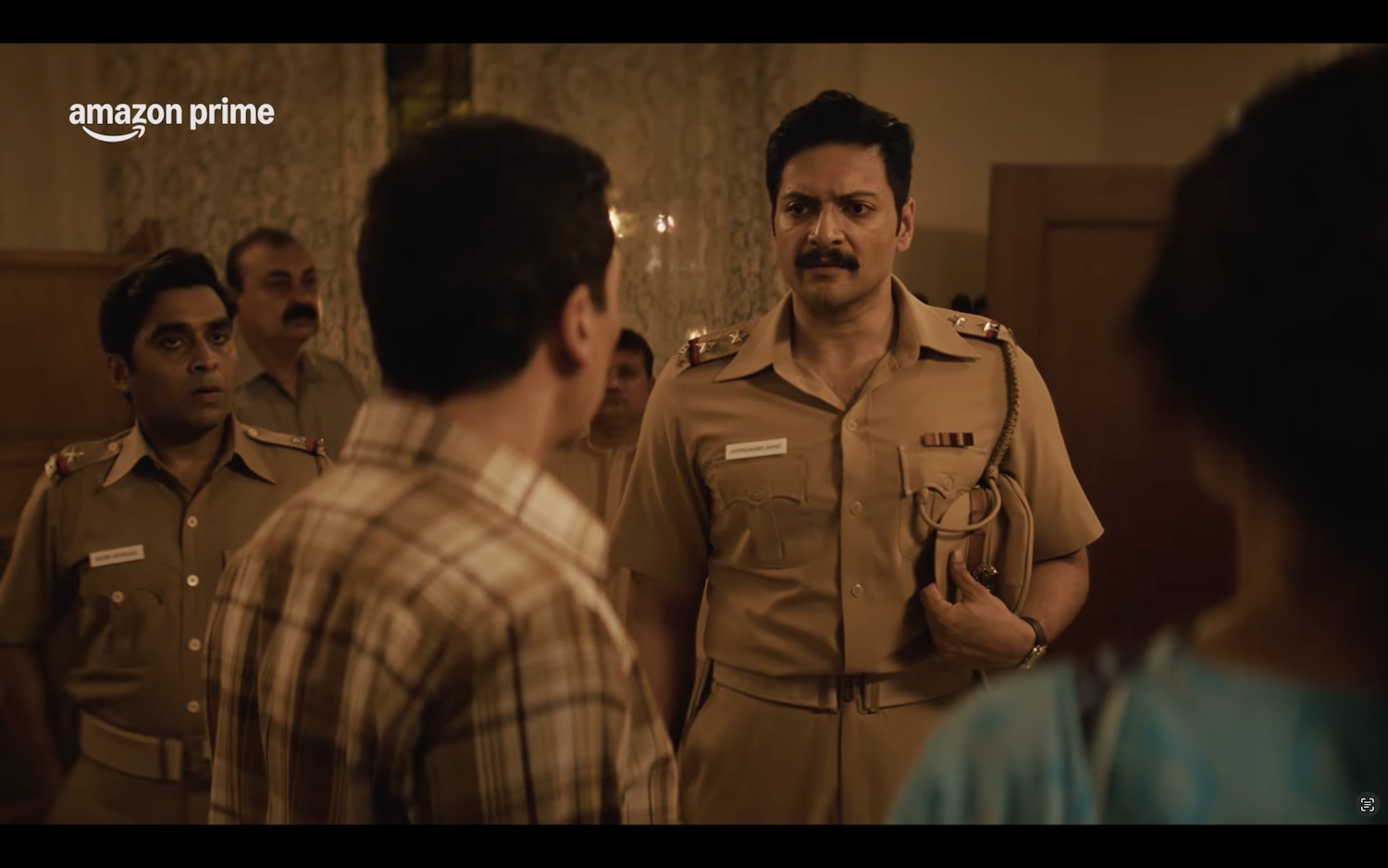
In an argument with Bauji, JP says, “There is a difference between khush aur khushamat”. While drawing this distinction, he quickly opens into a larger reflection on how recognition operates within the police force. For JP, khush signifies respect earned through one’s work, whereas khushamat points towards the act of pleasing superiors so that they do not obstruct the advancement of one’s career. However, as the investigation progresses, it becomes evident that competence alone is not enough. JP’s challenge is not merely to solve the case, but to be trusted while doing so. Even when his work repeatedly advances the investigation, his findings are rarely accepted at face value. Time and again, he finds himself having to prove what his work has already demonstrated.
This difference is crucial in JP’s situation. As a Dalit officer, he is not only expected to investigate the case but also repeatedly required to prove his capability. Even when his work advances the investigation, trust does not come automatically. Within the police station, confidence reposed on an investigating officer springs from their rank, experience, caste, relationship with the authority and only lastly from the evidence he managed to collect. In many ways, this echoes Gopal Guru’s (2002) argument that the experiences and claims of marginalized communities are often met with doubt before they are accepted. Raakh captures this reality with remarkable clarity. The question is never whether JP can do the job. The more unsettling question is why he has to keep proving that he can.
The series keeps returning to the spaces where these tensions remain. During the course of the investigation, police stations, government offices and everyday interactions become sites where authority, hierarchy and belonging are constantly negotiated.
The significance of Raakh lies not only in its revisiting of one of India’s most disturbing criminal cases – the Ranga-Billa case, which culminated in the execution of the accused in 1982 – but also in its depiction of a quieter struggle unfolding alongside the investigation. Through the character of Dalit Sub-Inspector Jayprakash Jatav, the series shows that entering an institution does not necessarily mean being accepted within it; that the challenge is often not reaching a position, but being recognized as someone who belongs there.
Nearly five decades separate the events of Raakh from the present, yet the series appears to be addressing the present. The distance of time is visible in its streets, uniforms, offices and methods of policing, yet many of the social realities it captures remain familiar. Appearances have changed but the handicap of caste continues to haunt many JPs today. It is this question that allows Raakh to offer something larger than a conventional crime narrative and speak of the concerns that continue to shape contemporary India.
Forward Press also publishes books on Bahujan issues. Forward Press Books sheds light on the widespread problems as well as the finer aspects of Bahujan (Dalit, OBC, Adivasi, Nomadic, Pasmanda) society, culture, literature and politics. Contact us for a list of FP Books’ titles and to order. Mobile: +917827427311, Email: info@forwardmagazine.in