Netflix’s Maa Behen (2026) disguises itself as a dark crime comedy, but beneath its murder mystery lies a sharp critique of patriarchy, social surveillance and the politics of respectability. The film is set in “Adarsh Colony”, the name is simultaneously the thesis and a pun, adarsh meaning virtuous or ideal. Director Suresh Triveni and writer Pooja Tolani have constructed the narrative around a setting that announces in its very name the ferocity of its aspirations – to preserve and protect its idealism and relentlessly surveil and shun those who deviate from it. The film demonstrates how communities police women’s lives through rumours, gossip, stereotypes and moral judgements – branding them “guilty” long before any crime takes place. The dead body at the centre of the narrative may drive the plot further but the film’s real plot lies in the social order that constantly puts women on trial.
The title itself is a reclamation. Maa Behen (Mother-Sister) are everyday North Indian words that serve a double function – the most sacred of kin relations and simultaneously the category of the most common expletives. To name a film after an insult and fill it with women who refuse to be shamed into submission is noteworthy.
The story revolves around Rekha (Madhuri Dixit), a single mother, and her two daughters Jaya (Triptii Dimri) and Sushma (Dharna Durga) who despite being different from each other are both controversial figures within their conservative neighbourhood. The women are constantly observed, interpreted by neighbours whose judgments often reveal more about societal anxieties than about the women themselves.
We all know a Charitra Gupta
At the heart of this social order stands Charitra Kumar Gupta (Ravi Kishan) – a figure who feels eerily familiar. We all know a Gupta ji, in our own neighbourhood, colony or apartment complex – he is the self-appointed guardian of morality, culture and tradition. He monitors your visitors, polices your clothing, constantly passes remarks, upholds vegetarianism as a marker of caste propriety and converts the proximity of neighbourhoods into an instrument for gendered control. Gupta ji functions as the human “normalizing gaze” in Foucauldian terms. Adarsh colony becomes a miniature panopticon where the women are always watched, judged and discussed. His brand of patriarchy can be understood through R.W Connell’s “hegemonic masculinity” – the cultural ideal that maintains male dominance through everyday mechanisms of shame, threats, gossip and the policing of feminine conduct. Gupta ji requires no legal authority; the neighbourhood grants him all the jurisdiction.
The widow who would not disappear into obscurity
Rekha, effortlessly played by Dixit, is particularly compelling and refreshing as she steps away from Hindi cinema’s portrayal of motherhood as inherently self-sacrificial and virtuous; the film presents her as flawed, anxious and unapologetic. Rekha is not a mythic maternal figure, she is a woman navigating complex circumstances. Mere aesthetic choices such as wearing a sleeveless blouse, marigold (genda) or rose tucked in her hair – read by the colony as transgressions – are simple signs of self, of a woman who refused to visually disappear into widowhood. Indian society has a well-documented script for widows: white or muted clothing, no adornments, no desire. She is doubly expelled from respectable womanhood and the neighbourhood – in one scene where she states that she doesn’t get invited to any events in the colony and doesn’t have any friends. As a widow she is “inauspicious”, excluded from weddings and social ceremonies but stubbornly visible as a woman with agency and appetite, hence considered a threat to marriages of her neighbours.
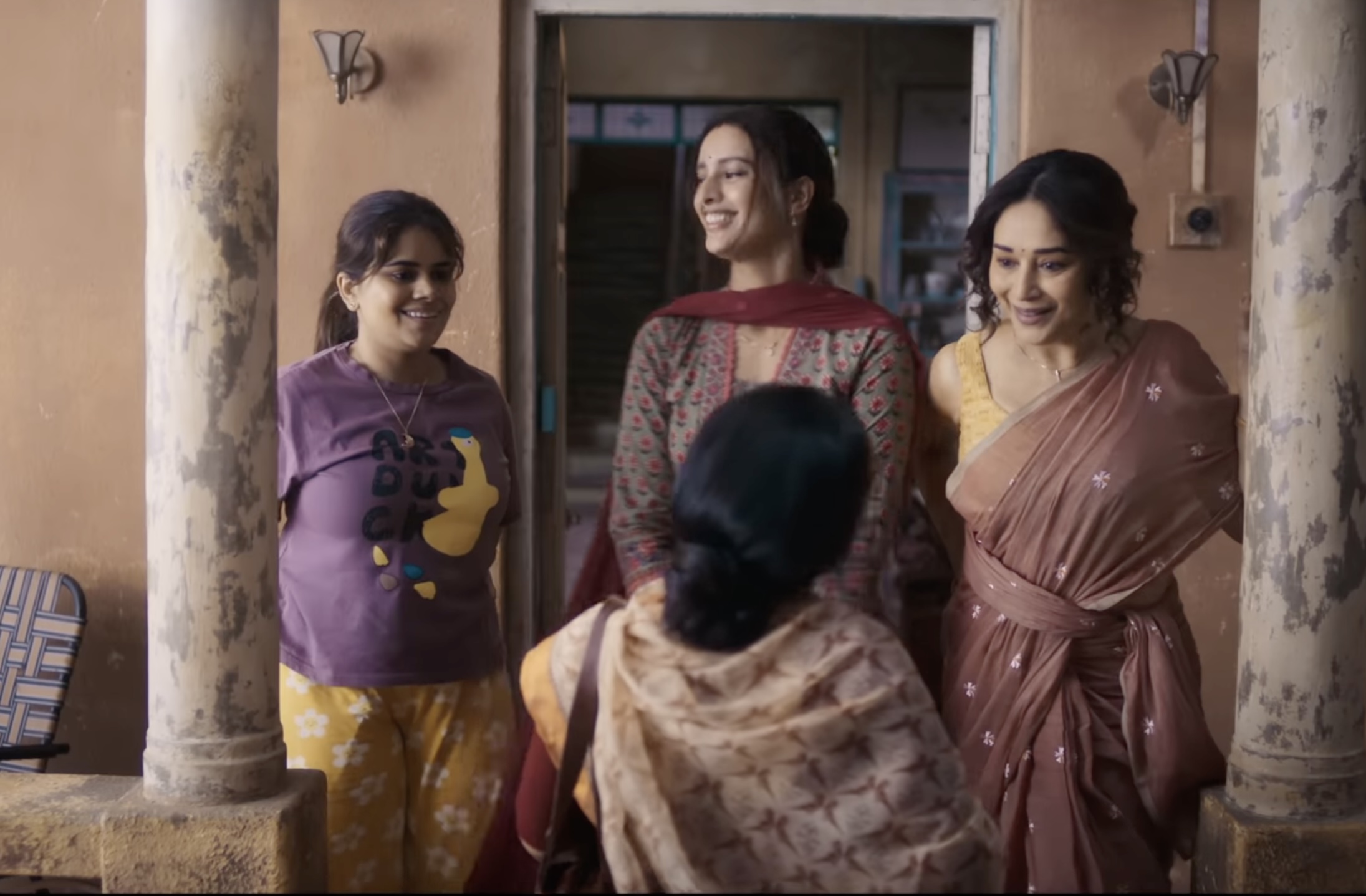
Her entrepreneurial activity – the businesses she runs to single-handedly raise her daughters and pay off her late husband’s debt – is misconstrued by the colony as greed or indecency. For her neighbours, it is never a straightforward act of economic survival, which it actually is. Economist Bina Agarwal documents this judgement extensively – women’s financial agency in South Asia is persistently pathologized, seen as desperation or dangerous ambition, never as a logical endeavour towards household welfare. Rekha refuses to perform the helplessness that is expected of her and shows how the system functions to make independent women pay a social cost for their independence.
The good daughter’s bargain
Jaya’s character provides another compelling dimension. She goes to painstaking lengths to distinguish herself from her mother and Sushma’s reputation. She chooses to conform to patriarchal notions of respectability through marriage and being a good daughter-in-law who stoically performs all domestic duties. Her full-sleeved suits, her investment in marriage to a tawdry husband and perpetually serving her in-laws reveals her desire to escape the labels she grew up witnessing levied on her mother. Jaya believes that following the normative rules will guarantee her protection and acceptance, what feminist scholars call “respectability politics”. Yet the film systematically dismantles the assumption and we see her years of frustrations erupt in a powerful monologue delivered by Dimri towards the climax of the film. The film shows that patriarchy is wholly extractive – obedience may temporarily be rewarded but its purpose is not to protect women but to regulate and control them.
Chasing followers, finding trouble
One of the film’s most contemporary interventions emerges through Sushma’s role as a budding social-media influencer. While Rekha and Jaya are primarily judged through neighbourhood, face-to-face surveillance, for Sushma it extends further to an equally oppressive world: the economy of online visibility. Five years after a kiss video involving her went viral, Sushma continues to live with its consequences. It becomes a part of her social identity, shaping how others perceive her – a reminder of how digital media creates permanent reputational archives for women. Her willingness to tolerate her brother-in-law’s inappropriate advances and online trolling is deeply connected to the pressure of the attention economy where virality rewards visibility and engagement – be it negative or positive. At the same time, digital visibility is also a pathway to a degree of economic independence for her.
Beyond the sensational headlines lies a human
Interestingly the film uses the fictional crime show Khalbali (inspired by the news television show Sansani), as both narrator and social commentator to reconstruct the lives of the three women – not through facts but prejudices and fantasies of the community. The women are portrayed as manipulative, sexually transgressive figures who ensnare innocent men. By filtering their backstories through the show’s melodramatic commentary the film exposes how sensationalist media transforms complex individuals into easily consumable caricatures and archetypes of female deviance. Maa Behen critiques voyeuristic logic of media narratives and their complicity in reinforcing patriarchal stereotypes, showing the similarities between the media and the neighbourhood: both manufacture certainty from rumour and imaginaries, converting women’s private lives into entertainment.
While the film has its strengths and succeeds in delivering a heartfelt experience, it also comes with its own set of flaws. The pacing occasionally drags, while the wine shop subplot and a special appearance by a popular actor feels weak and underdeveloped – these could have been written more impactfully. Certain character arcs would have benefited from greater development and few emotional beats rely too heavily on familiar tropes. Arunoday Singh’s Maheshwari, as the only character shown empathetic towards the women, could have been explored more. Sharadul Bhardawaj delivers an excellent performance as Jaya’s husband; a small-town man whose ego, parasitic and lecherous entitlement make him increasingly annoying every time he comes on screen.
Coming back home to sisterhood
The relationship between the three women is the backbone of the story. Although they start off as estranged, conflict-ridden, and distrustful of one another, the crisis forces them into cooperation and reevaluating their realities, ultimately facing up to their fears, trauma and insecurities. Significantly, the film does not depict female solidarity and sisterhood as natural or effortless; instead it emerges through disagreements and shared vulnerability, moments that feel very raw and convincing. One of the film’s most subversive scenes occurs during Gupta ji’s disappearance. When the women are enjoying a meal of chicken curry, it is mentioned that Gupta ji, the enforcer of caste purity, had prohibited them from cooking it in their own home. Their meal became a small but potent act of defiance against a social order that tries to govern even what enters their kitchen and bodies. The scene exposes how caste politics is sustained through everyday policing and how freedom can be experienced through recovery of ordinary pleasures. The flashback scenes from the daughters’ childhood, showing the three women supporting each other, dancing, loitering and even cleaning off the insults men had written outside their house, are heartfelt, evoking the realization that they had long shared love and solidarity, which was only temporarily fragmented by the society.
The reversal of shame and honour
The ending – three women laughing at a man whose only remaining weapon was their shame – is striking. The way shame is reversed, the onus shifting from women to a man – that he has the honour to maintain (and lose) in society, not so the women he is harassing, is cathartic. Those who are already expelled from respectability are paradoxically freed from its demands.
References:
Michel Foucault, ‘Discipline and Punish: The Birth of the Prison’, 1975
R.W. Connell and James W. Messerschmidt, ‘Hegemonic Masculinity: Rethinking the Concept’, 2005
Bina Agrawal, ‘Gender and Command Over Property: An Critical Gap in Economic Analysis and Policy in South Asia’, 1994
Forward Press also publishes books on Bahujan issues. Forward Press Books sheds light on the widespread problems as well as the finer aspects of Bahujan (Dalit, OBC, Adivasi, Nomadic, Pasmanda) society, culture, literature and politics. Contact us for a list of FP Books’ titles and to order. Mobile: +917827427311, Email: info@forwardmagazine.in