In the year 2026, we have seen attempts being made to muffle the voice of democracy at Jantar Mantar, New Delhi, but this is not the first time. This has been happening for the past many years in myriad ways. The idea is to push the exercise of the right to freedom of expression – a cornerstone of Parliamentary democracy – to the margins.
Those in pursuit of hegemony have always been resentful of the Indian Constitution’s declared objective of ushering in equality. Freedom of expression is integral to equality and the sites designated for exercising it, in turn, are integral to the freedom of expression. When MPs address Parliament, they address the entire nation and all its institutions. That’s the reason their speeches are taken seriously by the government. The attempt to increase the number of MPs by more than one and a half times is aimed at diluting the gravity of the institution of Parliament.
Today, instead of launching a direct assault on democratic rights of the people, the preferred means is pushing them to the margins or making them irrelevant. Jantar Mantar is not just a place, but an institution for collective exercise of the freedom of expression. That’s why cordoning it off to keep away protests is being seen as an attempt to crush the right to freedom of expression.
In a similar attempt in 2017, the government had tried to move the designated space for protests to the Haryana-Delhi border. The State has been consistently trying to make the echoes of the right to freedom of expression inaudible to Parliament. Until recently, one of the walls of the Press Club of India, situated near the Parliament building, was adorned with a photo clicked by a Delhi photographer, showing protesters raising slogans at the main Parliament gate used by MPs to enter the House. The picture was taken only a few years after India attained Independence. Those who have been visiting the Parliament House for the past 50 years or more are familiar with the consistent and dogged attempts to insulate Parliament from anger expressed by the people.
First, the main gate of the Parliament House on Parliament Street was made out of bounds for the common man. Next, demonstrations were banned at Boat Club so that the protesters couldn’t even see Parliament House. The State is not democratic. In fact, the State is the force that lays down the limits of democracy.
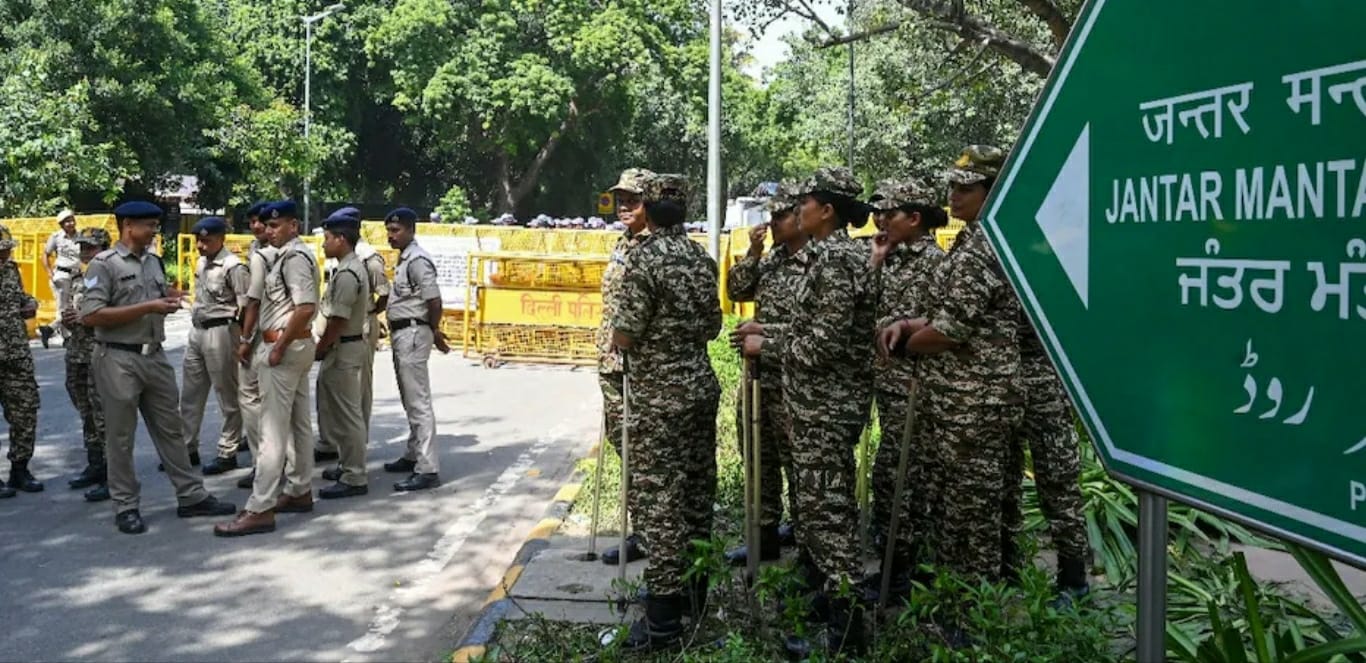
The past few years have witnessed a lot of clamour about India being the world’s biggest democracy even as people have been pushed farther and farther from Parliament. In other words, democracy is just a poster for the State – and posters have become a political weapon of late. The State has been using the Parliament building as a symbol of its democratic credentials. But when the common citizen tries to use this symbol, the State expresses fear about an attack on the symbol and gives it wide publicity among the common man. Excuses, fears and emotions have been used to shut down all the places around Parliament building one by one – the places where political and social workers could gather, discuss, debate and exchange ideas. In 2017, it was the National Green Tribunal (NGT) that proposed that people should not be allowed to publicly air their views at Jantar Mantar.
Amid the public resentment rooted in growing inequality engendered by the new economic policies, the process of shutting out all avenues for people to organize has been speeded up. Section 144 of the CrPC (and now Section 163 of the BNSS) is permanently in force around the Parliament building. The political parties and organizations which hold protests in collusion with the State introduced the practice of seeking permission from the police for demonstrations and sit-ins. If instances of protests being ignored, of police being let loose on protesters and of banning them are compiled, it would reveal that the curbs on freedom of expression today are worse than during British rule. We need to understand that an elected government cannot directly ban protests against its decisions and policies. And so, ruses and excuses are used to do it.
In 2017, the NGT banned Gandhian protests, sit-ins, hunger strikes at Jantar Mantar. The NGT’s order was based on a petition filed by some people living around Jantar Mantar, complaining of sound pollution. Efforts to stop people from protesting at Jantar Mantar have a long history.
The importance of “Jantar Mantar versus Parliament” for the upkeep of democracy has been established. Now, its death knell is being sounded.
(Translated from the original Hindi by Amrish Herdenia)
Forward Press also publishes books on Bahujan issues. Forward Press Books sheds light on the widespread problems as well as the finer aspects of Bahujan (Dalit, OBC, Adivasi, Nomadic, Pasmanda) society, culture, literature and politics. Contact us for a list of FP Books’ titles and to order. Mobile: +917827427311, Email: info@forwardmagazine.in