Buddha was born under a sal tree and he died under one. Obviously, at the time, sal trees were common both in the Himalayan foothills, as well as in other parts of the Indian subcontinent. But the biggest sal forest in Asia today is in the Kolhan area of Jharkhand. It is known as Saranda. Kolhan is also the home to ‘Ho’ – a prominent Adivasi community. Sal trees hold a great significance for the Adivasis and their Sarna Sthals are generally found under sal trees. That is the reason you will invariably find sal trees around Adivasi hamlets. And if there are none, the Adivasis try to grow them.
However, it is only in Kolhan that you will find an entire forest of sal trees. A major chunk of the forest has been destroyed by illegal mining and trees have been felled on a large scale in the name of combating the Maoists. But the forest still retains its charm. Towering Sal trees, bits of blue sky peeking through their canopies, and serpentine roads winding through them can captivate anyone. There was a time when these roads were of red murram (coarse red soil). Now, they have been paved with black tar on which ply an unending stream of trucks loaded with iron ore.
If the sal trees could withstand the onslaught of time, it is because of the Adivasis who dwell amid them and have been fighting to protect them right from the British era. The “Ho Revolt” was the outcome of the British making forays into the Saranda forest. In independent India, the year 1980 witnessed a determined struggle for protecting the sal trees, which culminated in the Gua firing incident on 8 September 1980.
The colonial rulers, as well as the governments of free India, bit by bit, deprived the Adivasis of their forest rights. The Gua firing incident, in a way, initiated the process of the restoration of their rights that led to the enactment of the Forest Rights Act in 2006.
Eleven Adivasis were brutally killed in Gua. Three of them were killed in the firing during a clash between the Adivasis and the police. The remaining eight were made to line up right outside the health centre where they had been taken for treatment after sustaining injuries and shot.
At the time, Jharkhand was a part of Bihar and the movement to save the jungles from mining and timber mafia was at its zenith. The then Bihar government wanted to replace the sal trees in Saranda forest with sagwan (teak) trees. The sal tree is of spiritual significance for the Adivasis while teak has commercial value. So, the movement soon turned into a “sal versus sagwan” battle. Devendra Manjhi, Soola Murti, Shailendra Mahto and Bahadur Uraon were among the leaders of the movement. Shailendra Mahto’s political rise can be attributed to his participation in the movement. Later, he joined the Jharkhand Mukti Morcha.
The Adivasis were also opposing reckless mining for iron ore. IISCO (Indian Iron and Steel Company) had mined the area and polluted the air. Contaminated water was seeping into the surrounding farmlands. The people were preparing to take on the government, but the government had made up its mind to crush the movement – or revolt, if you may – by force. The plan was to strike the Adivasis so hard that they would never dare to oppose a government programme.
The Adivasis decided to hold a protest in Gua on 8 September 1980. Beating drums and armed with their traditional weapons, they gathered at Sonua, Golyalkera, Manoharpur and other places. The Bihar Military Police tried to stop their march in vain. The protesters arrived at the venue of the weekly market, where a public meeting was planned. The police arrested Bhuvneshwar Mahto as the meeting was in progress. They also tried to arrest Bahadur Uraon and other leaders. But by then the protesters were in ferment. The Adivasis shot arrows and the police responded with indiscriminate firing. The public meeting venue turned into a battleground, leaving three dead each on both sides.
Meanwhile, police reinforcements arrived from Jaamda. The crowd was dispersing and the dead and the injured were lying on the ground. The injured were loaded into police vehicles and taken to a health centre. According to an eyewitness Behra, the cops gunned down seven Adivasis on the premises of the health centre.
The incident was widely reported as a case of infringement of human rights but it was never probed and no policeman or other official was punished. This was the second major incident of police firing on the Adivasis after the Kharsawan firing of 1 January 1948.
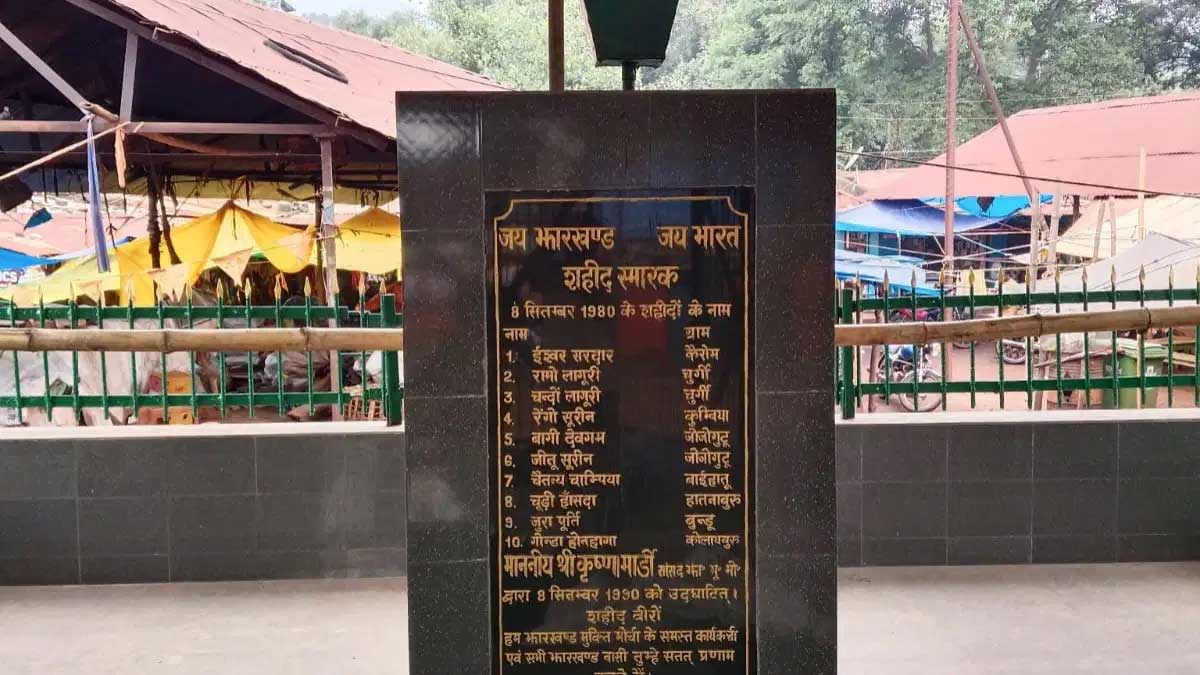
Later, ignoring government’s reservations, Krishna Mardi, MP at the time, got a martyrs’ memorial built in Gua Bazar with a plaque listing the names of the martyrs. They include Ishwar Sardar, Ramo Languri, Chando Languri, Regi Sureen, Baghi Devgam, Jitu Sureen, Chudi Hansda, Chaitan Champiya, Gonda Honhaga and Jura Purti. Though 11 were martyred, the memorial lists only 10 names.
The government did succeed in crushing the protest but it triggered a movement demanding autonomy for Kolhan under the leadership of the Kolhan Raksha Dal. It also rejuvenated the movement for a separate Jharkhand state, which had cooled off after the merger of Jaipal Singh’s Jharkhand Party with the Congress in 1962.
(Translation from the original Hindi by Amrish Herdenia)
Forward Press also publishes books on Bahujan issues. Forward Press Books sheds light on the widespread problems as well as the finer aspects of Bahujan (Dalit, OBC, Adivasi, Nomadic, Pasmanda) society, culture, literature and politics. Contact us for a list of FP Books’ titles and to order. Mobile: +917827427311, Email: info@forwardmagazine.in