Few terms in rural Rajasthan need less explanation than sarpanch pati. No law recognizes this designation, yet every village knows what the term means. He is the husband of a woman elected as a sarpanch – the man who campaigns on behalf of the sarpanch, speaks to officials and assumes the authority of the office himself.
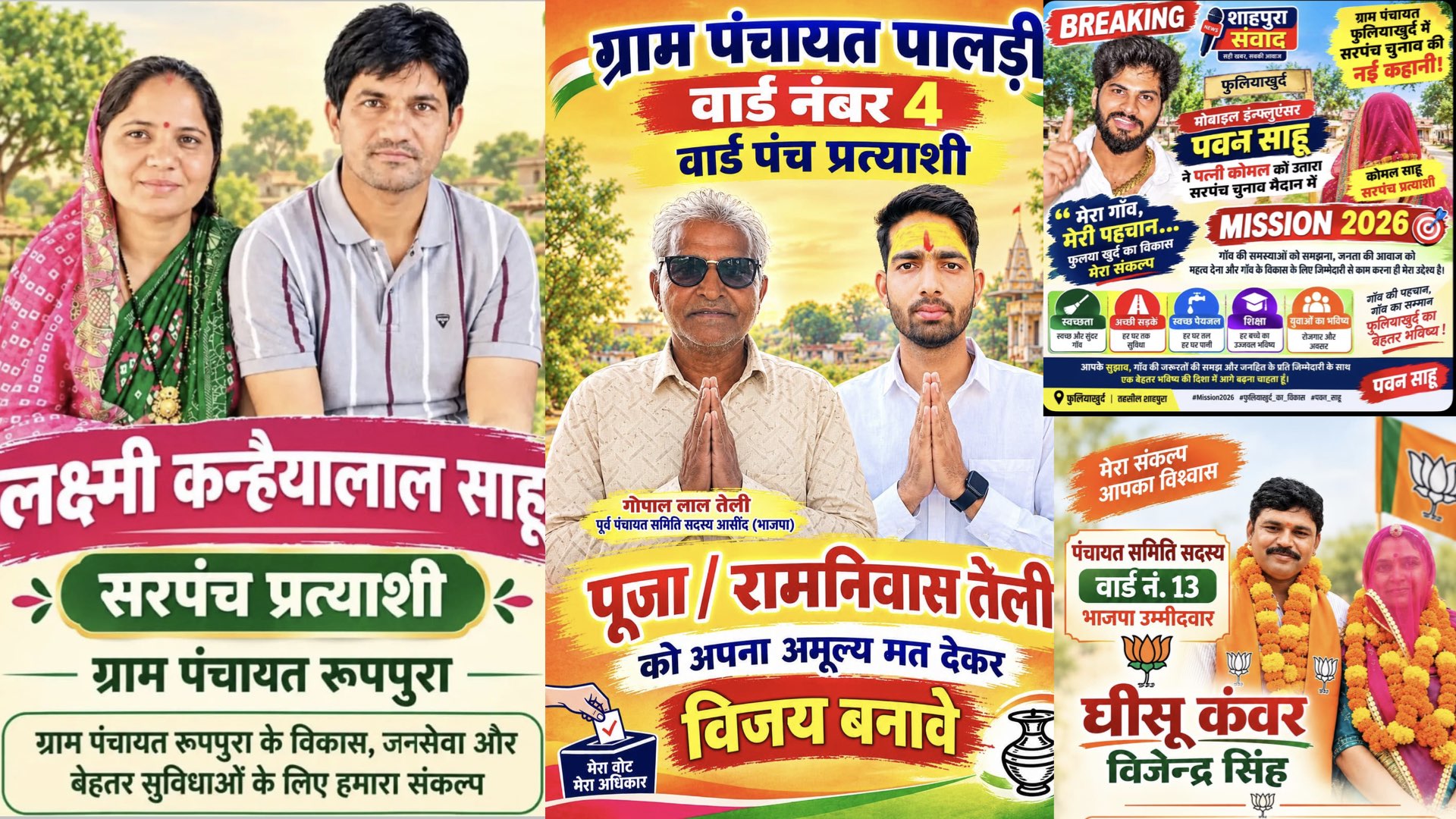
Currently, Rajasthan is in the middle of a four-phase panchayat election. Sarpanch and ward panch voting is scheduled for 25 October, 31 October, 6 November and 16 November, with results declared the same evening each time. The second phase has been completed. I have been watching campaigns in my own village and elsewhere in the state, and the pattern is hard to miss. The faces on election banners belong to husbands, sons, fathers-in-law and, occasionally, fathers. They lead door-to-door campaigns and ask for votes. The actual woman candidate for the positions reserved for women is either absent or, when present, veiled and lost in a group of women standing in the background. Supporters wear T-shirts bearing her male relative’s photograph.
The messaging is carefully constructed. Posters combine promises of development with images of men presented as educated, hardworking and committed to their villages. Reels, Bollywood music, Rajasthani songs and AI-generated imagery reinforce this male-centred political persona. The woman whose election is at stake becomes almost incidental to her own campaign.
A problem the state has named many times
None of this is news to the State Election Commission. In 2015 the prime minister publicly urged an end to the influence of husbands of women sarpanches, and in July 2023 an NGO, the Mundona Rural Development Foundation, brought the matter before the Supreme Court. The court chose not to take up the petition, observing that it offered no remedy of its own, and told the petitioner to approach the Union Ministry of Panchayati Raj.
The ministry went on to form an advisory committee, headed by a retired IAS officer, Sushil Kumar. It was set up to look at proxy participation and to find ways of making women representatives genuine leaders. The committee submitted its report in February 2025. As summarized in the press, the report recommended that states legislate heavy punishments, including disqualification of proven proxies and criminal complaints where fraud is involved. It also suggested ombudspersons for women representatives, complaint cells in every district, filming of swearing-in ceremonies, yearly social audits and a buddy system in which seasoned women leaders guide newcomers. The same report describes how proxies work in practice: turning up at meetings they have no right to attend, using a woman’s official seal, instructing officials by word of mouth and holding the Panchayat purse strings in the name of assisting the wife as she carries out her household duties.
The National Human Rights Commission has asked states to report on the practice, and in March 2026 the Union Ministry of Panchayati Raj ran an awareness drive titled “Say No to Proxy Sarpanch” that began on International Women’s Day. There is a catch, and it matters for Rajasthan. The Centre’s stated position is that questions about women representatives’ independence in decision-making fall under the purview of the states. So, the most important recommendations depend on state laws and the state’s election machinery. An awareness campaign in March counts for little if, in October, the rules and routines of the campaign allow a woman candidate to vanish from her own election. The scale is considerable. India has roughly 2.63 lakh panchayats and 32.29 lakh elected representatives, and 46.6 per cent of them are women. That is a vast number of women whose formal authority may in practice rest with someone else.
‘Are you joking? Where will she go?’
Reservation has changed who can contest these seats. It has not necessarily changed whose face they associate with the sarpanch in their minds. When I suggested to people in my village that the woman candidate should come forward, speak to voters and lead her own campaign, the response was often accompanied by a light laugh: “Are you joking? Where will she go?” That question has stayed with me. The objection was not necessarily about the woman’s ability to do the job. It was about her place in public life. The sarpanch is imagined as someone who moves freely, meets officials, addresses gatherings and deals with people outside the home. In this imagination, that person is a man. The husband is therefore not always seen as someone taking over his wife’s office. He is treated as the person who naturally belongs there. This is why calling the rule on proxies a loophole only goes so far. It is less a trick played on the rules, more a habit of mind that remains beyond the ambit of rules.
The educated proxy
What troubles me further is that this practice is not confined to men without formal education. Among those projecting themselves as the village’s next generation of leaders are educated young men who describe themselves as capable, committed and ready to bring change. Their entry into local politics might ordinarily be welcomed as a sign of generational change. Yet education does not necessarily unsettle the gender hierarchy that structures these campaigns. These men speak of equality, fraternity, development and giving their villages a distinct identity. But they struggle with a more immediate task: allowing their wives, mothers and daughters to participate in politics in their own right. They want to be recognized as agents of change while the women closest to them are denied the same recognition.
An arrangement that feeds off society
The problem is not simply that men have found a way around women’s reservation. It is that male authority remains so deeply embedded that even a policy designed to change local government can be absorbed into existing family hierarchies. A woman who does not appear prominently in campaign material, speak at public meetings or meet voters independently has fewer opportunities to establish her own political identity. Her limited public presence can then be used to justify her husband’s dominance. The rotation of reserved seats may reinforce this tendency when families treat a woman’s term as an opportunity to retain political influence rather than as the beginning of her independent political career. Political parties, local officials and voters also legitimize male proxies whenever they address them instead of the elected woman. The question is not merely whether a woman has won the election, but whether institutions recognize her as the person to whom the office belongs.
Why this is not a technicality
It is tempting to dismiss all this as a matter of optics. The evidence suggests otherwise. The best-known study of political reservation for women in India, by Raghabendra Chattopadhyay and Esther Duflo, looked at village councils in Birbhum in West Bengal and Udaipur in Rajasthan. Seats to be reserved for women are randomly selected, hence any difference in priorities of the councils is purely due to the presence of women ensured by reservation. Councils headed by women made investment choices based on what women said they needed. In Rajasthan, women’s complaints were mostly about drinking water, and councils reserved for women put more money into water supply and less into roads.
Those decisions and actions were courtesy of women who actually held and exercised their office. If the person who decides, negotiates and signs is the husband, villages may lose precisely what reservation was meant to deliver. That is why representation and power are not the same thing. The number of women elected tells us who holds the formal position. It does not tell us who makes decisions, negotiates with officials or speaks on behalf of the village. None of this is an argument against political reservation. Without it, many women would not have had the opportunity to enter local government. It is the first step towards empowering women.
Who has to change
Responsibility for change cannot rest on women alone. If families prevent women from appearing in public, officials routinely address their husbands, and voters assume that the man beside a candidate is the real authority, a reserved seat cannot deliver its full potential. First, parties and election authorities must recognize the distinction between voting for a woman candidate and presenting her male relative as the actual leader. At a minimum, the State Election Commission can mandate that candidates appear in their own campaign material and at nomination events, and insist that parties promote their women candidates in their own right.
Second, the State should act on what its own advisory committee proposed instead of stopping at awareness drives: independent complaint channels, social audits, penalties with teeth, and clear instructions that officials deal only with the elected woman. Third, training and mentoring must begin before polling day, not after it. The ministry’s Sashakt Panchayat-Netri Abhiyan (Campaign for Empowered Panchayat Leaders) had, according to one report, trained 64,863 women representatives by December 2025. That is a fraction of the more than 14 lakh women who sit in panchayats.
The poster and the voice
To sum up, the problem runs deeper than election rules. A law can reserve a seat, but it cannot by itself change what a family considers appropriate for a woman or what a village accepts as normal. That slower work will not be completed by any one election. Until the woman is the face on the poster, the voice at the meeting and the person officials turn to, the promise of representation stays incomplete. A political position does not guarantee voice. Electing a woman is not the same as creating a space in which she can lead.
Forward Press also publishes books on Bahujan issues. Forward Press Books sheds light on the widespread problems as well as the finer aspects of Bahujan (Dalit, OBC, Adivasi, Nomadic, Pasmanda) society, culture, literature and politics. Contact us for a list of FP Books’ titles and to order. Mobile: +917827427311, Email: info@forwardmagazine.in