We are told that legislature, judiciary and executive are the three organs (or pillars) of a parliamentary democracy like India. Our Constitution does not mention a fourth pillar. The fourth pillar is not a part of the Constitutional scheme of things. The Indian Constitution endeavours to strike a balance between the three organs of State. But what does this balance mean? And what is it meant for?
It is said that a right balance between the three organs still eludes India. And that the media, which is seen as the fourth pillar by the public, has struck an unholy alliance with the State. One of the measures of the efficiency of any system is how well it strikes a balance between its various components.
What exactly is meant by democracy’s fourth pillar? Relevant books tell us that it was Edmund Burke who first described an independent press as the fourth pillar of democracy. Burke (1730-1797) was a political theorist. With the rise of print media, he sought to underline how significant its relationship with the system of governance was. What needs to be understood in this context is that democracy is an abstract concept while parliamentary democracy is a system of governance based on the concept. Burke thought it prudent to add a fourth pillar to this system of governance.
Before him, John Locke (1632-1704) was of the view that without freedom of expression, democracy would just be a hollow concept. He even supported the right to rebellion. François-Marie Arouet, known by his pen name Voltaire, also stressed on freedom of expression being an inalienable component of democracy.
Thus, freedom of expression is integral to democracy and freedom of press is integral to parliamentary democracy.
The Indian Constitution gives to the people the right to freedom of expression. This right has been enunciated in Article 19(1) (a) of the Constitution. The Constitution does not refer to freedom of the press (or the media, as one would say these days). The right to freedom of expression is a fundamental right of the people.
The question that arises is whether in a democracy, the freedom of expression is good enough. Or, is the freedom of the press or media also important?
The Constitution guarantees the right to freedom of expression to the people. This freedom can be exercised by a citizen or a group of citizens, and this is the freedom that is sought in the business of mass communication. But means of mass communication are not a mandatory prerequisite for freedom of expression. They are just a facilitator. The Constitution is an ideological guide, aimed at building a system of governance for developing and sustaining the social order based on its chosen ideology. Thus, freedom of expression not only holds a great significance for democracy but is also associated with the Constitution achieving its objective.
Why do we say that the press or the media is the fourth pillar of a parliamentary democracy?
Advances in technology have taken mass communication to unforeseen levels in terms of reach. But the facility of reaching out to a large number of people at a time does not mean that the objectives of the right to freedom of expression have become redundant. The fourth pillar can inspire confidence only if it works towards achieving the Constitutional objectives. We need to remember that the right to freedom of expression is for the citizens. It enables the citizens to keep an eye on the three organs of the state, expose their acts of omission and commission, demand accountability from them and create conditions to prevent violation of the fundamental and human rights of the people. Only if the means of mass communication perform these functions can they be called the fourth pillar.
Indian media: Steady erosion of credibility
Freedom of expression is institutional in nature. It is a civic entity, bound by an informal structure. Just as the citizens as a body accept the system of governance based on three organs, they also create or allow development of formal institutions within its informal structure that can help achieve its objectives and fulfil its responsibilities and duties. Means of mass communication assist the citizens’ body. They are not the fourth pillar on their own.
But for the right to freedom of expression, the media could not have been the fourth pillar of democracy. Freedom of expression cannot be dependent on any particular institution. We all know that media institutions are controlled and run by private companies and groups which have their own interests to secure and serve. Doesn’t this imply that the economic, social and political interests of the company or the group that own the means of mass communication also become a part of the fourth pillar?
The companies and groups owning or controlling media houses have been working diligently and consistently to promote the idea that media is the fourth pillar of democracy. However, during British rule, the newspapers owned by big companies never fought for the right to freedom of expression. Their vested interests guided them, even as the common people were organizing themselves to free India from colonial rule.
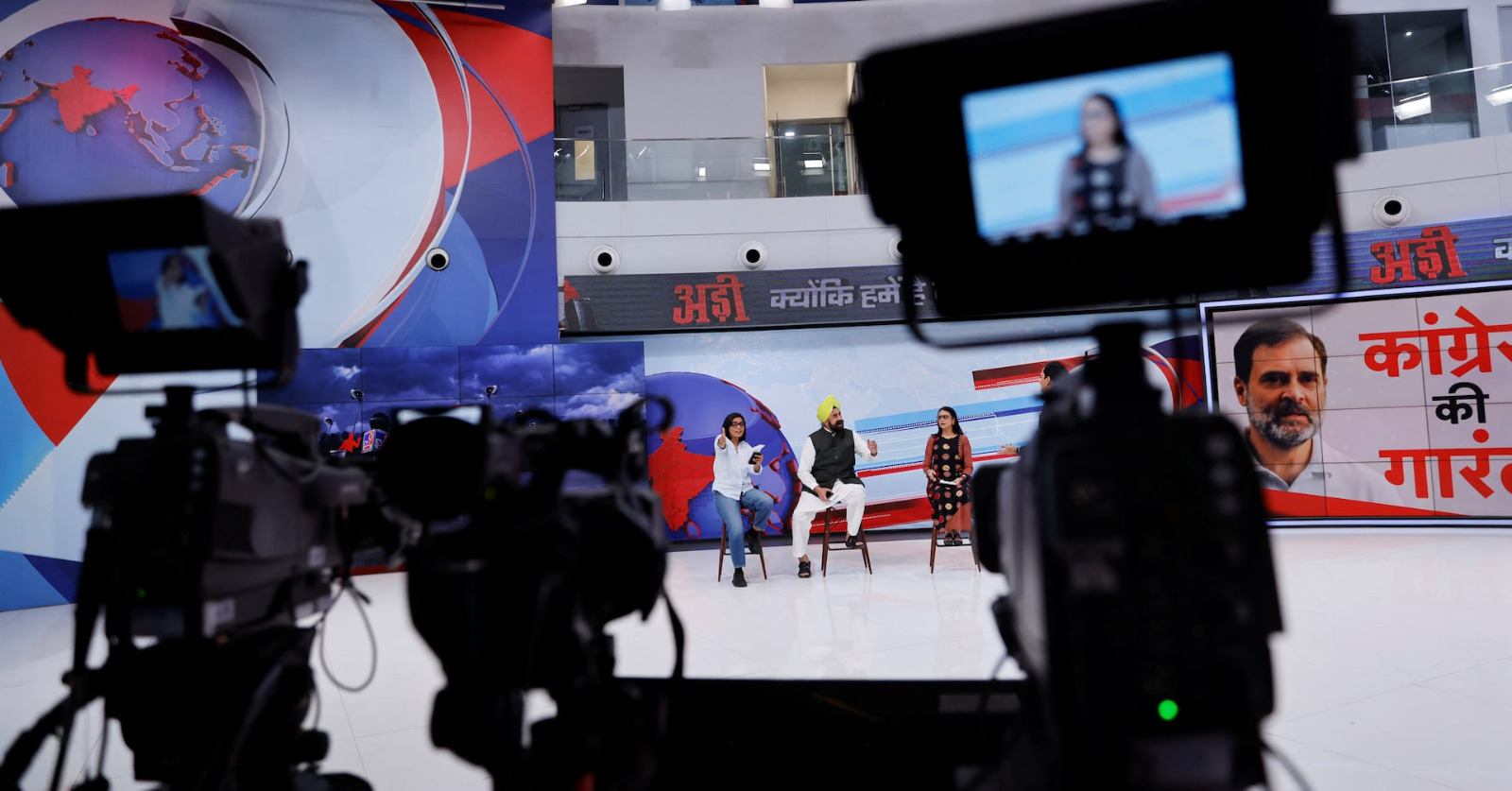
Post-Independence, the archives of Indian Parliament are replete with speeches by people’s representatives underlining how companies owning or controlling newspapers tried to curb the right of the people to express their views because they wanted to protect their own interests. They used their economic muscle and their right to freedom of expression to sow seeds of rancour and hostility among the people.
The more curious can go through the records of the proceedings of Parliament as it discussed the report of the First Press Commission of India in August 1955. It shows how, after Independence, different social, political and economic groupings were trying to establish their monopoly over the press.
Edmund Burke’s theory was aggressively publicized after Independence, the result being that the idea of the right to freedom of expression of the people at large as the fourth pillar of democracy took a backseat. Instead, companies running media houses were increasingly perceived as the fourth pillar. These companies steadily monopolized the media.
On the other hand, the consciousness of the need to create civic bodies faded gradually. Today around 50 companies control the entire media of the country. And the impression sought to be created is that the media outlets, or rather the companies that control them, are the sole custodians and flag bearers of the right to freedom of expression. The consciousness of freedom of expression being an individual right has been smothered. Independence is also about individual freedom. But the exercise of the right to freedom of expression – which is one of the foundations of individual freedom – has been outsourced to the media.
Basically, the fourth pillar is about keeping an eye on the institutional structure created to strengthen, develop and protect democracy, and reform and even more importantly, transform it. When the press is designated the fourth pillar, it is with reference to its role as a watchdog. But there is a basic difference between the general public acting as a watchdog and a private company playing that role. A people’s collective as a watchdog takes into account the interests and the expectations of the citizenry. But when a company acts as a watchdog, its own interests come into the play. Its vision is coloured by what would serve its interests or hurt them.
The people as a collective are the real fourth pillar, mandated with the responsibility of exercising the right to freedom of expression.
(Translated from the original Hindi by Amrish Herdenia)
Forward Press also publishes books on Bahujan issues. Forward Press Books sheds light on the widespread problems as well as the finer aspects of Bahujan (Dalit, OBC, Adivasi, Nomadic, Pasmanda) society, culture, literature and politics. Contact us for a list of FP Books’ titles and to order. Mobile: +917827427311, Email: info@forwardmagazine.in