Jawaharlal Nehru University (JNU) has long been known for its vibrant culture of student politics and a student community representative of diverse social backgrounds. However, in recent times, even JNU hasn’t been immune to a systematic dilution of the social-justice agenda of the Constitution. There has been a substantial shortfall in the number of seats reserved for Scheduled Tribe (ST) candidates in the PhD programmes.
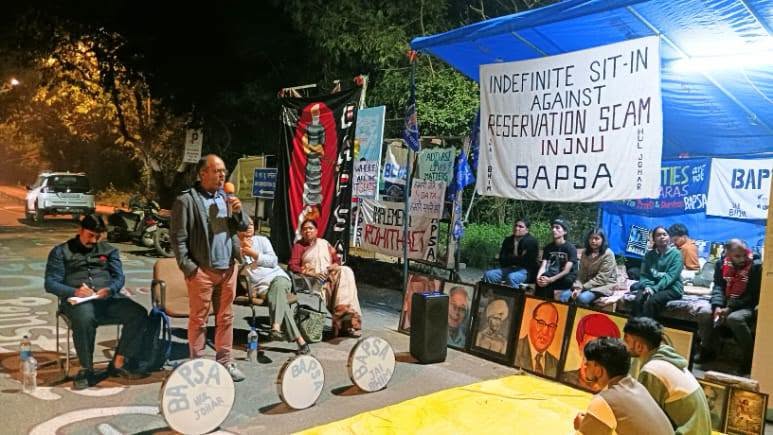
It was the Birsa-Ambedkar-Phule Student Association (BAPSA) that turned this issue into a discourse on the campus. Now, every progressive student organization active in JNU, including the JNUSU (the students’ union), has released a parcha (pamphlet), raising this issue. A look at the data on PhD seats reserved for STs over recent years is instructive.
An analysis of the last seven admission cycles from 2021 to 2026 reveals that a total of 5270 seats were advertised. Based on the prescribed reservation norm of 7.5 per cent, approximately 395 seats should have been allocated to Scheduled Tribe (ST) candidates. However, only 345 seats were assigned to the ST category, resulting in a shortfall of 50 seats.
The current 2026-27 cycle has the highest shortfall in ST seats at 28.7 per cent. It is a disturbing scenario. The PhD Prospectus of Jawaharlal Nehru University for 2026-27 promises 7.5 per cent of seats to Scheduled Tribe (ST) applicants, 15 per cent to Scheduled Caste (SC) applicants, 27 per cent to Other Backward Classes and 10 per cent to Economically Weaker Sections (EWS) (who are not eligible for SC, ST and OBC quotas). The published seat distribution, however, lists only 38 ST seats out of 711, about 5.3 per cent of the total. Based on the stipulated 7.5 per cent quota, the figure would be roughly 53, which means a shortfall of about 15 seats. SC seats are just shy of the 15 per cent mark, while OBC (27.99 per cent) and EWS (10.27 per cent) seats are in keeping with the stipulated quotas.
However, over the period 2021-2026, SCs have also been shortchanged. Against mandated approximately 790 seats, only 743 seats were allocated, resulting in a shortfall of 48 seats. Taken together, the SC and ST figures over the last seven admission cycles indicate a clear discrepancy between the prescribed reservation norms and the actual seat allocation as mentioned in the university’s admission prospectuses.
Table 1: SC-ST PhD seats and shortfall at JNU
| Admission round | ST share (%) against 7.5% quota | ST shortfall (%) | SC share (%) against 15% quota | SC shortfall (%) |
|---|---|---|---|---|
| 2021-22 | 6.8 | 9.0 | 14.3 | 5.0 |
| 2022-23 | 6.1 | 19.2 | 14.3 | 4.5 |
| 2023-24 | 6.2 | 17.5 | 14.2 | 5.5 |
| 2024-25 | 7.5 | 0.1 | 13.8 | 8.1 |
| 2025-26 | 7.2 | 4.6 | 14.1 | 5.9 |
| 2025-26 (Winter/ Phase II) | 5.6 | 25.2 | 12.9 | 4.2 |
| 2026-27 | 5.3 | 28.7 | 14.5 | 3.4 |
If we look at the figures over the last six years, the SC seats have never met the required quota and ST seats have amounted to the quota only in the 2024-25 cycle. Of the 5,270 seats, 743 were SC (about 14.1 per cent), and 345 were ST (about 6.55 per cent). This implies SCs and STs were denied roughly 47 and 50 seats, respectively.
STs face the brunt of fragmentation of reserved seats
There are several ways in which the reservation system is being undermined. It includes the under-advertisement of vacancies to avoid reserved-seat allocations; the distribution of vacancies across admission cycles, potentially weakening representation; and the fragmentation of JRF and Non-JRF seats, particularly given 100 per cent interview weightage under the JRF route.
The administration has yet to make public a roster for reservations but it claims that it considers the field of study as the unit for implementing reservation and allocates every seventh seat to Scheduled Tribe (ST) candidates. Interestingly, several centres (fields of study) have fewer than seven seats.
Furthermore, the administration has divided seats within the same field of study into two separate categories: NET (National Eligibility Test) and JRF (Junior Research Fellowship). For instance, the School of Sanskrit and Indic Studies offers a total of 12 seats in the year 2026-27, with six seats each under the NET and JRF categories, without allocating even a single seat to an ST candidate (see prospectus). Through this arbitrary division of seats, the JNU administration has systematically nullified the rightful claim of ST candidates to reservation in this centre. Several other centres have similar arbitrary divisions between the two categories.
In addition, from last year onwards, the administration has introduced a winter session for PhD admissions, thereby further fragmenting seat allocation and harming the chances of STs, the last category in the roster, making the cut.
As the school-wise table for 2026-27 shows, the School of International Studies, with 14 centres and 21 programmes, offers 4 ST seats against the expected 8. The School of Social Sciences offers 9 against 11. Several schools, including the Schools of Computational and Integrative Sciences, Biotechnology, and Sanskrit and Indic Studies, offer none. Of 13 schools, only four fulfill the expected ST quota.
Table 2: School-wise seats and shortfall of SC (15%) and ST (7.5%) PhD seats at JNU, 2026-27
| School | Total seats | SC notified | SC expected | SC shortfall (%) | ST notified | ST expected | ST shortfall (%) |
|---|---|---|---|---|---|---|---|
| ABV School of Management and Entrepreneurship | 18 | 3 | 3 | 0.0 | 1 | 1 | 0.0 |
| School of Arts and Aesthetics | 18 | 3 | 3 | 0.0 | 1 | 1 | 0.0 |
| School of Biotechnology | 12 | 1 | 2 | 50 | 0 | 1 | 100 |
| School of Computational and Integrative Sciences | 22 | 3 | 3 | 0.0 | 0 | 2 | 100.0 |
| School of Computer and Systems Sciences | 47 | 7 | 7 | 0.0 | 3 | 4 | 25.0 |
| School of Engineering | 32 | 3 | 5 | 40 | 3 | 2 | 0.0 |
| School of Environmental Sciences | 34 | 5 | 5 | 0.0 | 2 | 3 | 33.3 |
| School of International Studies | 105 | 16 | 16 | 0.0 | 4 | 8 | 50.0 |
| School of Language, Literature & Culture Studies | 122 | 18 | 18 | 0.0 | 6 | 9 | 33.3 |
| School of Life Sciences | 27 | 5 | 4 | 0.0 | 1 | 2 | 50.0 |
| School of Physical Sciences | 43 | 6 | 7 | 14.3 | 4 | 3 | 0.0 |
| School of Sanskrit and Indic Studies | 12 | 2 | 2 | 0.0 | 0 | 1 | 100 |
| School of Social Sciences | 140 | 18 | 21 | 14.3 | 9 | 11 | 18.1 |
| Special Centres | 79 | 13 | 12 | 0.0 | 4 | 6 | 33.3 |
| University Total | 711 | 103 | 107 | 3.7 | 38 | 53 | 28.3 |
This pattern also runs in individual programmes. Of 84 programmes listed for PhD intake in 2026-27, 56 have no ST seat, and 24 of those 56 do have seats for EWS. Over the last four admission rounds, 30 programmes offering a combined 351 seats never assigned a single seat to STs.
Comparison of EWS and ST Seats Allocation
The 1992 Indra Sawhney vs. Union of India judgment rejected reservation based exclusively on economic criteria. Although 30 years later, in 2022, the Supreme Court upheld the constitutional validity of Economically Weaker Sections (EWS) reservation by a 3:2 majority, the policy raises serious concerns about social justice. Economic deprivation cannot be equated with historical caste-based discrimination and systemic exclusion.
JNU’s current pattern of PhD seat allocation further underscores these concerns. One can easily raise a question: How does the administration manage to nearly fulfil the 10 per cent EWS quota while ST representation continues to decline sharply? This is clearly illustrated in Table No. 3.
Table 3: EWS seat but no ST seat in JNU PhD programmes, 2021-22 to 2026-27
| Admission round | Programmes offered seats | Programmes with no ST seat | Programmes with EWS seat but no ST seat |
|---|---|---|---|
| 2021-22 | 84 | 35 | 11 |
| 2022-23 | 80 | 45 | 18 |
| 2023-24 | 78 | 46 | 17 |
| 2024-25 | 80 | 32 | 7 |
| 2025-26 | 84 | 40 | 13 |
| 2025-26 (Winter) | 39 | 29 | 6 |
| 2026-27 | 84 | 56 | 24 |
In 2026-27, EWS has been offered 2.7% more than its 10% share
In 2026-27, ST has been deprived of 28.7% of its 7.5% share
What is the real intention behind such a reduction in ST seats and an increase in EWS seats? Our argument is not that seats reserved for ST and SC candidates have been directly diverted to the EWS category. Rather, we seek to question the reservation roster being followed, given that EWS candidates appear to be receiving more than their mandated share of seats, while SC and ST candidates are facing reductions in their respective categories.
Several centres have failed to fill the reserved seats and subsequently converted those seats into the Unreserved Category (UC) in the following admission cycle. For instance, in 2025, the Centre of Spanish, Portuguese, Italian and Latin American Studies (CSPILAS) – a centre at the School of Language, Literature and Culture Studies (SLL&CS) – advertised an ST seat against which no candidate was admitted, yet no ST seat appeared in the 2026-27 advertisement in an obvious violation of the carry-forward rules. Finally, 13 of 86 centres reportedly advertised no ST seats over five years, warranting scrutiny of roster implementation and admission practices.
Why this matters beyond the numbers
Sukumar, in his seminal work Caste Discrimination and Exclusion in Indian Universities: A Critical Reflection, illustrates how higher education institutions continue to reproduce caste hierarchies while presenting as neutral or objective. Drawing on his in-depth ethnographic research in several university settings across India, he argues that caste-based discrimination is often subtle rather than explicit, manifesting in routine academic and administrative practices, including student evaluation, research supervision, fellowship allocation, and institutional decision-making.
In addition, against the backdrop of widespread discrimination against SC/ST/OBC, several committees have reached this conclusion, including those led by Rajiv Bhatt (2012), Thorat (2013), and Nafey (2016).
At JNU, PhD selection weightage is 70 per cent for the written test and 30 per cent for the interview. To reiterate, Rajiv Bhatt report (2012) found SC/ST candidates receiving interview marks 19-20 per cent lower than Unreserved Category candidates, while OBC candidates were awarded 11 per cent lower marks. Hence Sukhdev Thorat (2013) and Nafey (2016) committees recommended restructuring or reducing interview weightage. Why does this happen? In this case, Pierre Bourdieu, a renowned French sociologist, through his concept of cultural capital, helps to explain why such an assessment method like the interview can be fertile ground for bias: judgments of ‘potential’ and ‘fit’ often reward familiarity with dominant styles of speech and bearing that are inherited capitals recognized as individual merit.
In addition, giving low scores to marginalized candidates in interviews is closely associated with the composition of the evaluation panel and the social composition of the respective department or university. The All India Survey on Higher Education (2018) states that there are still remarkably few faculty members from marginalized populations. Merely 8.6 per cent of teachers are from the Scheduled Castes, and just 2.27 per cent are from the Scheduled Tribes. Other Backward Classes fare better at 32 per cent, while 56.8 per cent fall in the Unreserved Category. Thus, there is still a shortage of academics from marginalized populations in higher education, despite affirmative action measures such as reservations.
Forward Press also publishes books on Bahujan issues. Forward Press Books sheds light on the widespread problems as well as the finer aspects of Bahujan (Dalit, OBC, Adivasi, Nomadic, Pasmanda) society, culture, literature and politics. Contact us for a list of FP Books’ titles and to order. Mobile: +917827427311, Email: info@forwardmagazine.in