Democratic India has witnessed three generations of Muslim leadership. Studying their trajectory is akin to studying the trajectory of Indian democracy. Immediately after Independence, the leadership of the community was in the hands of the old aristocratic class. The Congress party was in power. It nominated landlords, nawabs and the moneyed as its candidates and made them leaders. The politics of these worthies was based more on personal relations than on policies.
The influence of these classes extended to the Hindus and that was one of the reasons why they could ace electoral battles. Their decision not to migrate to Pakistan was enough to confer on them the title of nationalist. The current descendants of that generation proudly display the black-and-white photographs of their granddads posing with almost all top leaders of the time and relate tales of their ancestors’ close proximity to them with great relish. That generation, in a sense, was a continuation of the pre-partition Muslim elite class. They continued to wield power and influence till the 1980s. For most of them, politics was just a hobby, a pastime and that was why they never raised any meaningful issues for the good of the Muslims.
Towards the end of the 1980s, they were relegated to the margins, mainly due to the opening of the locks on the Babri Masjid and the implementation of the recommendations of the Mandal Commission, which was followed by the Muslims drifting away from the Congress and the Hindu OBC castes rising on the political horizon. They were replaced by politicians from the middle-class Muslims, who had only disdain for the Congress. This was the first generation of the Muslim leadership from the middle classes. Muslims developed a fear for the Bharatiya Janata Party (BJP) and began devising political equations to defeat it.
The rise of the Hindu backward castes in the political arena of the country in the 1980s was a novel phenomenon. Naturally, most of its leaders were from a new, younger generation. They brimmed with positive energy and vehemently staked their claim to power. But the morale of the Muslims was slipping. So, the alliance was an uneasy union of two classes – one upbeat and positive and the other pessimistic and cynical. That was also the time when the definition of secularism began changing. Until the 1970s, secularism was a fundamental and universal value. That was replaced by a new concept, in which secularism took up a small space in the battle between the forward and backward Hindu castes, where Muslims could survive with their identity intact.
Despite having a substantial population, Muslims were pushed behind many communities that were fewer in numbers. This generation of Muslims began working not to ensure the victory of a candidate, but to defeat one or the other candidate. They became “negative voters”. It was also the time when Muslims began being counted as opponents of the forward Hindus, for they were seen as supporters of the backward Hindu communities.
This generation of Muslim leadership busied itself in organizing Iftar parties, mushairas and functions for felicitating Dalit and Backward Hindu leaders. They left the task of drawing up strategies, working on electoral equations and even developing an ideology to the Hindu leaders.
That changed the texture of the politics of the Muslims. While other castes began mobilizing around issues of their interest – which made them politically conscious and aware – the Muslims opted for personality-oriented politics, ignoring issues and ideology. This approach turned Muslim leaders – right from the top ones to minor players – into agents of the administration and the police. A new band of Muslims leaders emerged who were just go-betweens to get your “work” done and who never fought for the political rights of their community. How commonplace these kinds of leaders were is evident by what a well-known Maulana from Lucknow told me over a personal conversation. He said that the Muslims don’t bother their leaders for anything except getting their impounded bikes released from police stations! But the leaders of the secular parties didn’t even do that.
In that period – and it was not too long ago – every town and village with a Muslim population had a bunch of youth who anchored events organized by anti-BJP parties. In their speeches, interspersed with poetry, they declared that the leaders of that particular party were among the protectors of the country’s “Ganga-Jamuni tehzeeb”. Then, there was a section that excelled in organizing Iftar parties and feasts. If a senior Hindu leader attended such parties, it was considered a great achievement. The success in persuading a heavyweight Hindu leader to attend an Iftar was flaunted as a great achievement right till the next Ramzan and then there used to be the talk of how the next time, this or that leader would be attending the feast. This was the pathetic picture of elite Muslims at the time when the sun was setting on post-Babri and post-Mandal politics.
Though this second generation remained active till 2017, it had begun losing steam much earlier. It had realized that these parties and their leaders had a selective approach, that they kept quiet on issues affecting the Muslims and that they were drifting towards the BJP, with their caste-based support base and their anti-Muslim narrative. The Muslim leaders of these parties were unable to take any stand. After the BJP assumed power in Uttar Pradesh, the leaders whose only qualification was that they could get your “work” done began vanishing – either of their own accord or because they were forced to.
As it became increasingly clear that Muslim votes were not enough to defeat the BJP, the relevance and importance of the Muslim vote bank began diminishing. The “secular” parties, which prospered on their votes, began distancing themselves from the Muslims. They still wanted their votes but were wary of associating publicly with them.
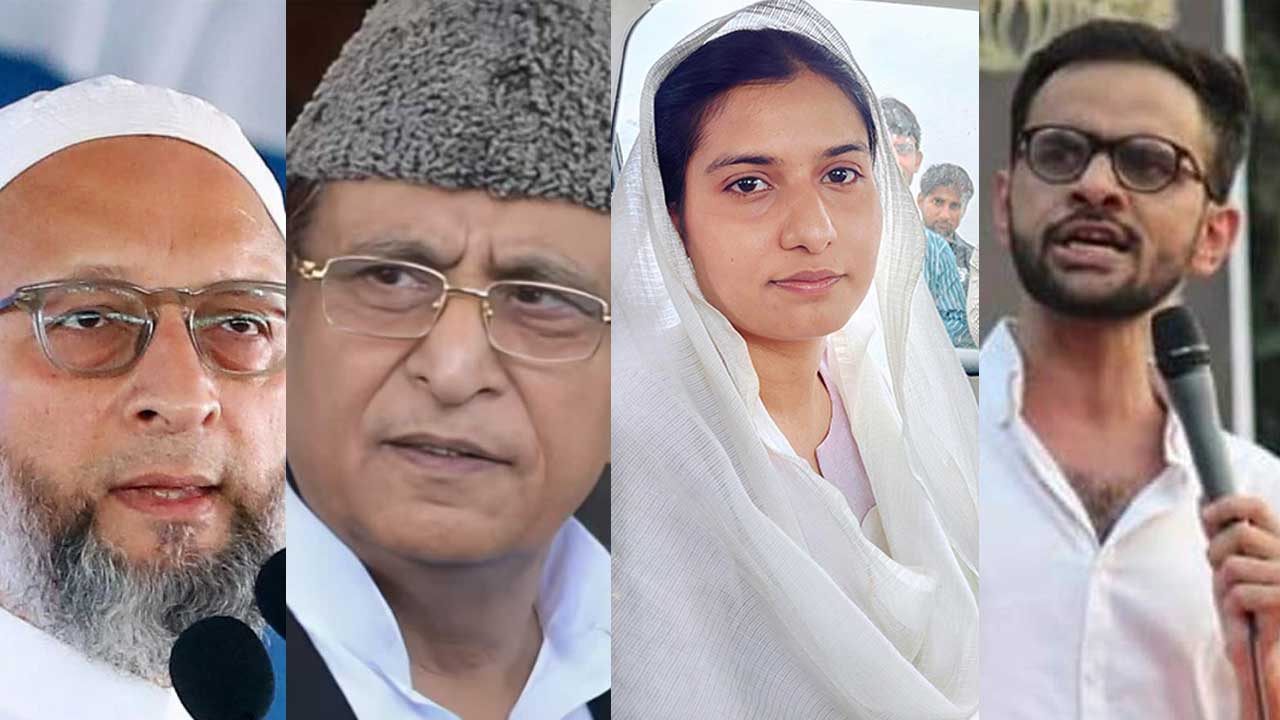
The second generation of the Muslim leadership is dead and now a third generation is rising, which wants to give a voice to the narrative within the community. This generation’s mindset was deeply affected by the framing of innocent Muslim young men in terrorism cases, beginning from 2005. Fake encounters and unwarranted arrests bought the issue of security centre stage. Alongside began attempts to turn the Indian State into a Hindutva outfit. Questions started being raised and one of them was that when the Indian democracy can accept the political mobilization of the Hindu OBCs and Dalits, why is it averse to political mobilization of the Muslims? Next came the judicial pronouncement in the Babri Masjid-Ram Janmabhoomi case, which was based on faith, rather than on facts. That shattered the illusion of the Muslims that were equals in the eyes of law.
The young Muslims were deeply perturbed by the silence or the opportunistic stand of the parties which benefited from Muslim votes in elections. Jamia university protests against Citizenship (Amendment) Act and National Register of Citizens (CAA-NRC) and the Special Intensive Revision (SIR) of the voter list were among other issues that birthed a new brand of political thinking, which is more progressive and unambiguous as compared to the stand of the leadership of the two previous generations.
A significant number of youths, who have new ideas and new stands, are behind bars. The Muslim community is concerned about them but the parties they vote for have abandoned these new heroes. Either intellectual dishonesty or the fear of Hindutva forces is the reason. Or maybe, the questions being posed by the Muslims make them uneasy. But not accepting this third generation of Muslim leadership will serve no one – neither the country, nor democracy, nor the Muslims.
(Translation from the original Hindi by Amrish Herdenia)
Forward Press also publishes books on Bahujan issues. Forward Press Books sheds light on the widespread problems as well as the finer aspects of Bahujan (Dalit, OBC, Adivasi, Nomadic, Pasmanda) society, culture, literature and politics. Contact us for a list of FP Books’ titles and to order. Mobile: +917827427311, Email: info@forwardmagazine.in