Meera and her society
Saanchee piyaaji ri goodadee, jaame nirmal rahai sarir.
Chhappan bhog buhaee de he, inn bhogin mein daag.
Lunn alunnon ho bhalo he, apnne piya jee ko saag.
…
Chhail virano lakh ko hey, apnne kaaj na koi.
Taake sang sidharataan hey, bhala na kahsee koi.
Var honnon apnnon bhalo hey, kodhee kushtee koi.
Jaake sang sidharataan hey, bhalo kahe sab koi.
Avinaasee soon baalvaan hey, jin soon saanchee preet.
Meera koon prabhu milya hey, ehee bhagati kee reet.[1]
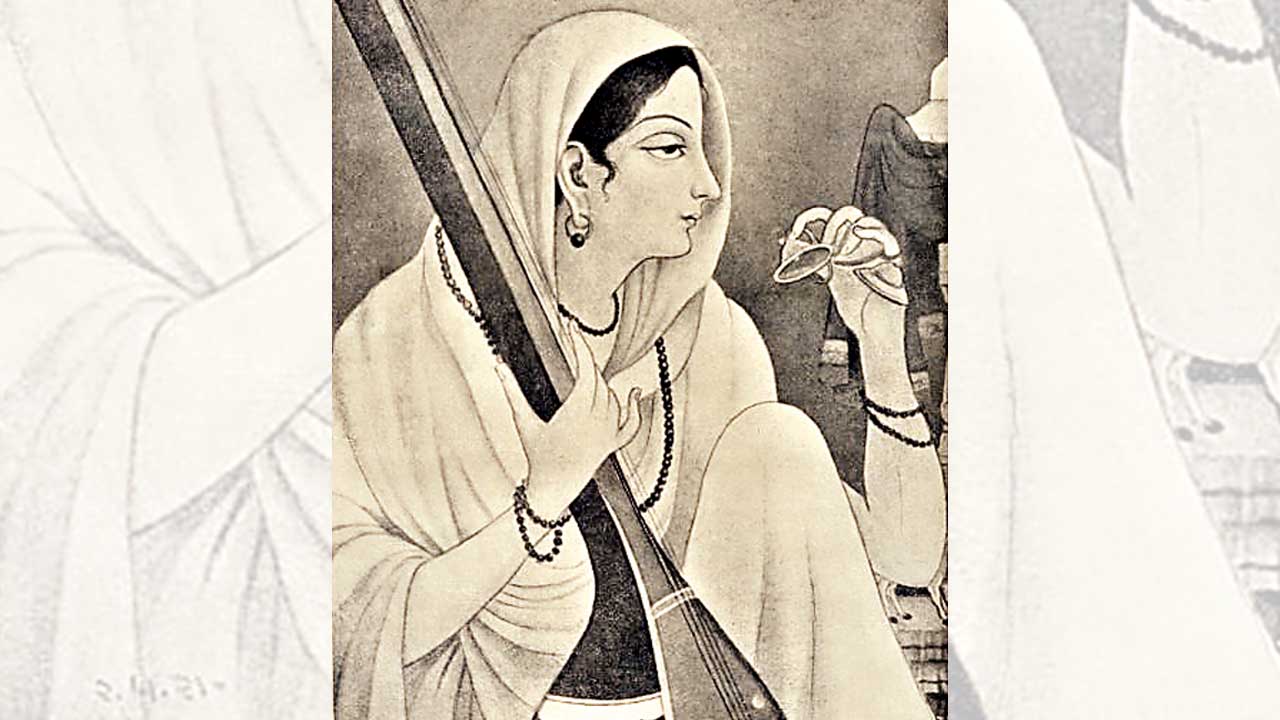
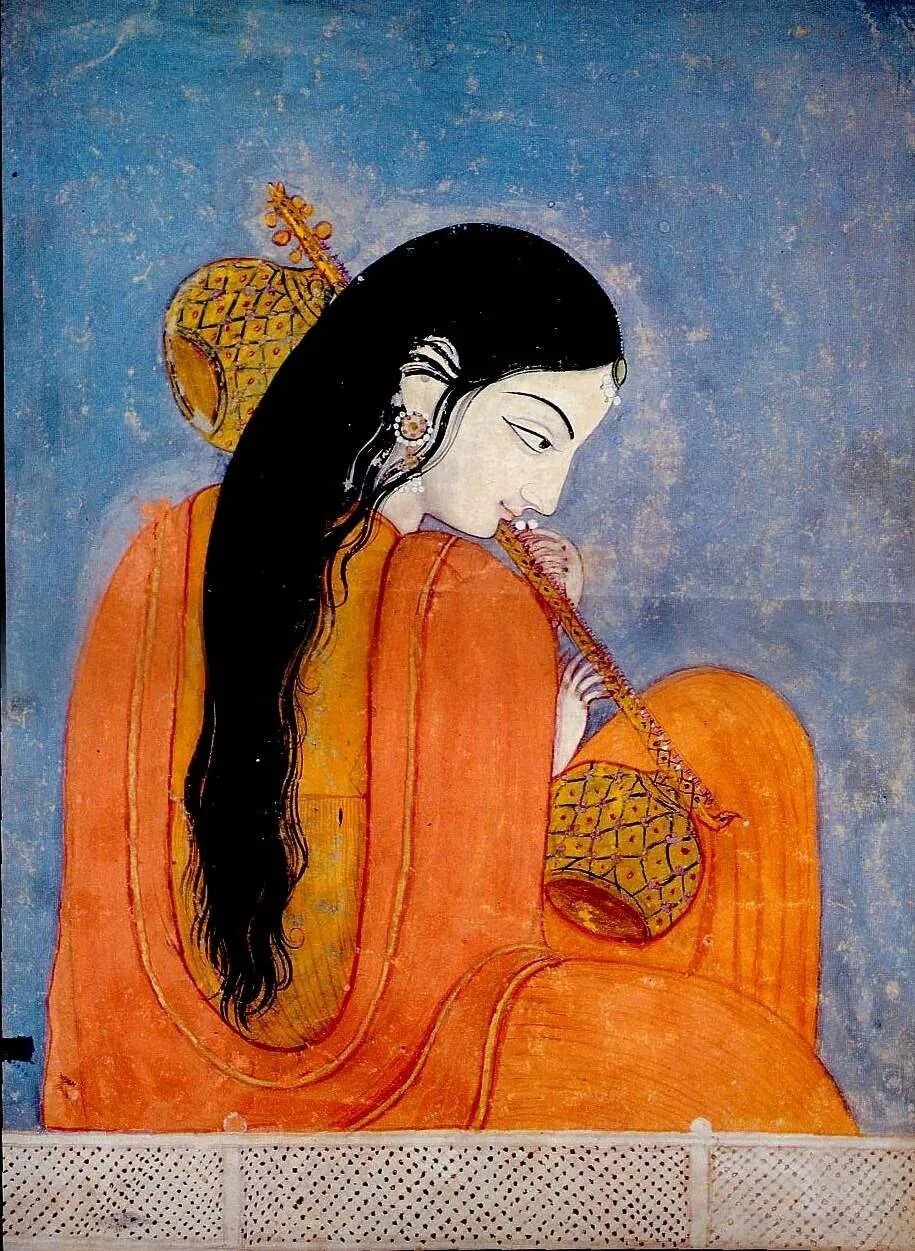
In this verse, Meera stresses on “pativrat dharma” (complete loyalty, devotion and commitment to husband). But her poetry is replete with expressions of her love for Krishna. Meera’s husband Bhojraj died a few years after their marriage. What explains Meera’s verses extolling “pativrat dharma” on the one hand and expressing love for Krishna on the other hand. At many places in her poetry, she says that she loves Krishna and had sacrificed family honour and prestige on the altar of that love. Before dwelling on whether she had really done that, let us try to understand Meera’s station in life. According to Madhav Hada, “Meera was not a sant [ascetic], bhakt [devotee] or jogan (mendicant). Love had not driven her insane. She was not crazy. She was not a deprived, oppressed, neglected or helpless woman. She was a feudal woman, who was self-dependent and self-conscious.”[2] If Meera was a feudal woman, it is highly unlikely that she would have sacrificed the honour and prestige of her family. Meera had enough wealth. She got temples built and made donations. Meera was the widow of a feudal lord and her status was that of a vassal. She had sources of income and was economically independent. Rather, she was rich – so rich that she used to make presents of ‘mohur’ (gold coins) to the sadhus and saints whom she hosted. The Varta texts of the Vallabh sect, which are considered authentic, have references to this effect.”[3]
Against this backdrop, it seems unlikely that she threw the norms of behaviour and conduct ordained by her social status to the winds. It is possible that Meera or her family members believed that her singing Bhajans at home were hurting the prestige and honour of the family. It is also possible that she, as a widow, harbouring feelings of love for Krishna was considered dishonourable. At the time, widows from upper-caste families were not allowed to remarry. So, it is just possible that Meera believed that her love for Krishna was not in keeping with the status of her family and that her family members held the same view. Meera suffered because of her birth in a conservative upper-caste family. Her remarriage was out of the question and she had to remain content with considering Krishna as her fictional husband. It is also said that she had great love for Krishna since her childhood – something she admits at numerous places in her verses:
Aao manmohanji, mitho thaaro bol
Balpana ki preet ramiyaji, kabay nahin aao thaaro tol [4]
She also says that her love goes back a long way:
Meri unkee preet puranni, Unn bin pal n rahaoon[5]
At another place, she says that her love was from an earlier birth:
Poorv janam ki preet purani, to kyon chhodee jaay.[6]
In these verses, “balpana” (childhood), “puranni” (long-held) and “poorva janam” (earlier birth) mean the same thing. Many of the ideas and beliefs which we acquire as a child stay with us all our lives. The same must have been the case with Meera. The childhood memories of an imaginary Krishna must have become a source of consolation and support for her, as she navigated the hard life of a widow. In many of her verses, she talks of dreaming of marriage to Krishna.
Maee mahane supnna maan paranya deenanath.
Chhappan kotan janna padharayan doolho siri brajanath.
Supnna maan torann bandyari supnna maan gahya haath.
Supnna maan mhare paran gaya paaya achal sohag.
Meera ri giradhar milya ree, porab janam ro bhaag.[7]
The memories of childhood turned into dreams. An imaginary Krishna became her source for fulfilling her desire for a husband. In this verse the word “supnna” (dream) has been used many times, showing that she is unwilling to believe that she doesn’t have a husband or a lover. “Achal sohag” (eternal married life) also exemplifies the same sentiment. She repeatedly asserts that she is no longer a widow. The stress on “suhag” indicates that Meera is in a state of denial, as far as her widowhood is concerned.
Madhav Hada, in his book Pachrang Chola Pahar Ri Sakhee, writes, “The society of Meera’s times was dynamic. It was not ideal but it was dynamic and dialectical. Though numerous hurdles were placed in her way, society gave Meera the leeway and the freedom to be a Meera.”[8] He also believes that widow remarriage was possible in that society. “Under the Varna system, theoretically, widow remarriage was prohibited for Brahmins but this prohibition was never an inviolable part of normal social conduct. In the medieval times and even earlier, widow remarriage was common among artisans and agriculturists, as also among the Shudras and Adivasis. And it was not completely prohibited even among castes placed on the higher rungs of the caste hierarchy.”[9] He goes on to argue, “Religion and scriptures might have ordained that a woman can marry only once in her life. But in Meera’s society, women did have the freedom to remarry. ‘Nata’, meaning remarriage, was common in 80 per cent of the populace, including the Jats, Gurjars, Malis and Bishnois.”[10]
Madhav Hada seems to have failed to appreciate that different behavioural and social norms dictated the conduct of the Shudras and the upper castes. There was social sanction for divorce and remarriage among the Shudras, Dalits and Adivasis from olden times. But the upper-caste women were never allowed to remarry. In fact, when, after Independence, Dr Ambedkar tried to legislate for the right of Hindu women to get divorce and remarry through the Hindu Code Bill, it was the upper-castes who vehemently opposed him. Ultimately, he had to quit as the law minister. Madhav Hada’s analysis is therefore a mishmash, which fails to appreciate the difference between upper castes and others.
Hada also argues that remarriage was possible even among upper castes. Does he not remember Meera? Was she not from a caste high up on the caste pyramid? Hada has also talked about other women from that era who were victims of the feudal social order. He writes, “Rambai, the daughter of Maharana Kumbha, did not have cordial relations with her husband, Mandalik, the ruler of Girnar. Her nephew Prithviraj, an army in tow, went to Girnar and brought her back to Mewar. She lived in Mewar for the rest of her life. Similarly, when Prithviraj’s sister Anandibai found it impossible to live with her husband, Rao Jagmal of Sirohi, Prithviraj went to Sirohi and forced his brother-in-law to touch the feet of his sister. When Meera could no longer live happily in Mewar, his uncle Viramdev brought her to Mewar.”[11] Why were Rambai, Anandibai and Meerabai forced to return to their parental homes?
On what basis does Madhav Hada conclude that the contemporary upper-caste society was dynamic? Did the women from feudal families return to their parental homes of their own accord? Had the upper-caste society been dynamic, these women would not have to endure these ordeals. And if, eventually, their marriages failed, they could have easily remarried and started a new life.
Madhav Hada describes the life of a widow as honourable. “The widowed sisters and daughters of rulers led a respectful life in their parental homes. Maharana Raimal of Mewar presented the pargana [a set of villages] of Jawar to his widow sister Rambai. She lived in Mewar till her death. She made donations, went on pilgrimages and got a temple built at Jawar.”[12] The author seems to be indicating that widows making donations for religious purposes more than made up for the right to remarry being denied to them. Meera also owned a jagir. She was also making donations. But did society allow her to lead a life of respect and dignity? Why did she spend the last days of her life in Mathura?
Mharon saanvaro brajavasi.
Jag suhaag mithya ree sajnee hovan ho mit jyasee.
Varan karyan avinasi mharon, kaal vyaal na khasi.
Mharon preetam hirdan bastanm daras lahya sukharasi.
Meeraan re prabhu abinasi, saran gahya then dasi.[13]
Every person internalizes the circumstances they face in life. This internalization involves both the personality as well as the social milieu in which he lives. The notion of “jag suhag mithya” (worldly relations are fleeting) was something Meera had internalized. It was probably Bhojraj’s death that made Meera say “jag suhag mithya” and “mharo pritam hirdam bastann” (my lover stays in my heart). After Bhojraj’s death, Meera gave him a place in her heart. But Meera had to face hard times only after her husband’s death. Hence, we can presume that these lines were written after Bhojraj’s death. The statement that worldly relations are fleeting and illusory expresses her pain. And “mharo pritam hirdam bastann” expresses it more forcefully. She cannot let go of her now-illusory husband, which is indicative of both her inability to overcome the loss and also her desire for a husband. That is the reason she repeatedly refers to Krishna as her true husband/lover.
Mharan to girdhar gopal doosra naan kuyaan.[14]
Another line goes like this:
Girdhar mharon sancho preetam, dekhat roop lubhaon.[15]
The emphasis on “sancho preetam” (true husband/lover) and “doosra naan kuyaan” (no one else) shows more love for one who isn’t present. Sometimes, poets describe what is important or primary as unimportant or secondary. This is a figure of speech. A line by poet Pash goes, “Police ki maar khatarnak nahin hoti” (Beatings by the police are not deadly). What he means is to the contrary – that the beatings are in fact deadly. Of course, there can be something deadlier than that. Meera’s approach is the same. By using expressions like “sancho preetam” and “doosra naan kuyaan” she depicts what is secondary and unimportant (husband) as primary and important. Meera said that worldly relations are fleeting, gave a place to her husband in her heart, emphasized his importance by describing him as unimportant and even more than that, waited for him. But she realized that her husband won’t come back and that her “suhag” (state of being married) was over. With no chance of remarriage, she began treating Krishna as her fictional husband.
Aankhayan tarshaan darsanm pyasi.
Mag jovaan dinn beetan sajni, rainn padaya dukhrashee.
Daran baithaya koyal bolya, bol soonya ree gaasee.
Kadava bol lok jag bolya, karasyaan mhari haansee.
Meeran hari re hath bikaanne, janam janam ki dasi.[16]
Two factors seem to have prompted Meera to consider Krishna as her fictional husband. The first, of course, is that Bhojraj was dead. Second, she had to endure bitter comments and ridicule about her widowhood. Meera began believing that Krishna was her husband. But there was no way he could meet him in person and there was no way Krishna could be a source of conjugal happiness to her. She knew that a union with Krishna was an impossibility, so she began singing verses depicting her separation.
Daari gayo manmohan pasee [phaansee]…
Virah ki mari mein ban dolon, pran tajon karvat lyun kasee.
Meeran se prabhu hari avinashi, tum mere thakur main teri daasee.[17]
Meera has clearly expressed her femininity. But the critics ignore this aspect of her poetry and emphasize her Bhakti (devotion to god). With her husband no more and remarriage appearing impossible, the woman in Meera became articulate. Before considering any other aspects of her, Meera should be treated as a woman whose desires could not be fulfilled in the contemporary feudal society. She gives expression to her desires unambiguously:
Ramaiya bin neend na aavai.
Neend na aavai virah satavai, prem kee aanch dhulavai.
Bin piya jot mandir andhiyaaro, deepkadaay na aavai.
Piya bina meree sej alunee, jagat rainn bihavai.
Piya kab re ghar aavai.[18]
Without her love, the empty bed seems like a snake to her. She can’t sleep:
Soonee sej vyaal bujhayan jaaga rainn bitavaan.
Neend nena na aavaan.[19]
In another verse, she says that without her lover, peace eludes her:
Jak nan parat man bahut udaasee.[20]
In her verses, Meera has also talked about her union with her lover. Scholars can always argue that with Bhojraj dead and Krishna being imaginary, how can there be a union? The answer is that Meera dreamt of marrying Krishna as she could not remarry. Meera has repeatedly referred to dreaming of marrying Krishna. This was, of course, imaginary, but it was society that forced her to fantasize. One such verse goes like this:
Sajann mhare ghar aaya ho.
Jugaan jugaan ri jovataan, virahan piv paaya ho.
Ratan karan nevachhaavaran, le aarat saajaan, ho
Preetam diya sanesada, mharon ghanon nevajaan ho.
Piya aaya mhaare sanvaraan, ang anand saajan ho.[21]
Due to the decadent societal norms, Meera, a widow, could neither live independently, nor remarry. Her society abuses her for being a widow. In these circumstances, memories of attraction towards Krishna as child provide her some succour. She dreams of Krishna. She marries him in her dreams. She dreams of union with her. She openly articulates her physical desires which can’t be fulfilled. Her society does not understand her desires. Her desires and aspirations represent the desires and aspirations of all the widowed women who are forbidden to remarry. The Bhakts of the medieval times and the scholars of the modern era could not grasp Meera’s pain. They interpreted her poetry in keeping with their own mindset. Saddened that no one could understand her pain, Meera was forced to say:
Heri mahaan darad deevaanee mhaara darad na jaanya koy.
Darad kee maraya dar-dar dolayaan baid milya nahin koy.[22]
References
[1] Parshuram Chaturvedi (ed), ‘Meera ki Padavali’, Hindi Sahitya Sammelan Prayag, 2002, Verse 26
[2] Madhav Haada, ‘Pachrang Chola Pahar Ri Sakhi’, Vani Prakashan, New Delhi, First Edition, p 9
[3] Ibid, p 13
[4] Parshuram Chaturvedi (ed), Meera Padavali, Verse 99
[5] Ibid, Verse 20
[6] Ibid, Verse 42
[7] Ibid, Verse 27
[8] Madhav Hada, ‘Pachrang Chola Pahar Ri Sakhee’, p 61
[9] Ibid, p 73
[10]Ibid, p 82
[11] Ibid, p 86
[12]Ibid, p 87
[13] Parshuram Chaturvedi (ed), ‘Meera ki Padavali’, Verse 193
[14] Ibid, Verse 18
[15] Ibid, Verse 20
[16]Ibid, Verse 45
[17]Ibid, Verse 65
[18] Ibid, Verse 74
[19] Ibid, Verse 78
[20]Ibid, Verse 125
[21] Ibid, Verse 149
[22] Ibid, Verse 70
(Translated from the original Hindi by Amrish Herdenia)
Forward Press also publishes books on Bahujan issues. Forward Press Books sheds light on the widespread problems as well as the finer aspects of Bahujan (Dalit, OBC, Adivasi, Nomadic, Pasmanda) society, culture, literature and politics. Contact us for a list of FP Books’ titles and to order. Mobile: +917827427311, Email: info@forwardmagazine.in