Jotirao Phule was three years younger to Swami Dayanand (born 1824) but had entered the field of social reform long before him. Jotirao set up his first school for girls in 1848, when he was just 20. On the other hand, as a young man, Swami Dayanand was obsessed with spiritualism and became a renunciant (sanyasi) at around the age of 23. He became a social reformer much later, after 1875. By then, Jotirao had already been a grassroots activist working for the upliftment of the Shudras-Atishudras for almost 27 years. According to J.T.F Jordens, the first attempt to constitute Arya Samaj was made on 16 January 1875 in Rajkot (Gujarat). Around 30 people turned up at the meeting convened for the purpose, and most of them were members of the local branch of the Prarthana Samaj. In a way, it was like taking over the Prarthana Samaj’s local branch. Dayanand drew up the constitution of the new organization and had it printed in Rajkot. However, due to differences of opinion over Niyoga (an ancient Hindu tradition which permitted widows or wives who had no child by their husband to procreate with another man) and the minimum age for marriage of girls, and some other issues, the organization did not last long. Gujarat was too conservative a place to attempt religious reforms of the kind Dayanand wanted to pursue. The Arya Samaj formally came into being on 10 April 1875 in Bombay.[1]
Arya Samaj is known as a reformist organization and Dayanand, as a social reformer. However, like Raja Ram Mohan Roy, Dayanand Saraswati was also a Hindu revivalist. To quote an instance, responding to a Bengali conservative’s assertion that “Before trying to know god, a man should immaculately perform all the customs, rituals and duties ordained by the Vedas and the Smritis”, Raja Ram Mohan Roy said, “We agree that it is the duty of people from every section of society to adhere to the rituals, traditions and duties ordained by the scriptures of their religion before acquiring divine knowledge.”[2] This statement exemplifies the casteist outlook of Brahmo Samaj – an organization founded by Raja Ram Mohan Roy in 1828 in Calcutta. Brahmo Samaj was an organization of the elite of Bengal, aimed at restoring India to her ancient glory – of which it had been robbed by rulers of other religions.
Ideologically, Jotirao and Dayanand were poles apart. For Dayanand, Vedas were the ultimate source of knowledge. He believed that India’s past had a golden period of knowledge, intellect and wisdom. The Indus Valley Civilization was yet to be discovered and Dayanand considered all inhabitants of the Indian subcontinent as descendants of the Aryans. His definition of Aryan was based on the Ashthadyayi, which says that Brahmacharis and Brahmins are Aryans.[3] He believed that the varna system was based on deeds, not birth. But it would be erroneous to believe that he had a soft corner for the so-called Shudras or that he wanted the end of socio-cultural inequalities. His was a practical approach, prompted by the crisis looming over Brahmanical Hinduism. By then, the British had begun involving Indian representatives in governance and as such, keeping the fourth Varna – comprising a majority of the Hindus – segregated would have translated into Brahmanism becoming a minority religion. He described the varna system as a key attribute of Indian society and was for giving Shudras limited access to education and Vedas. In short, he wanted to restore the hegemony of the Brahmins in the name of Vedic religion. Accordingly, he championed social reforms only to the extent that would help re-establish the golden era of Brahmanism.
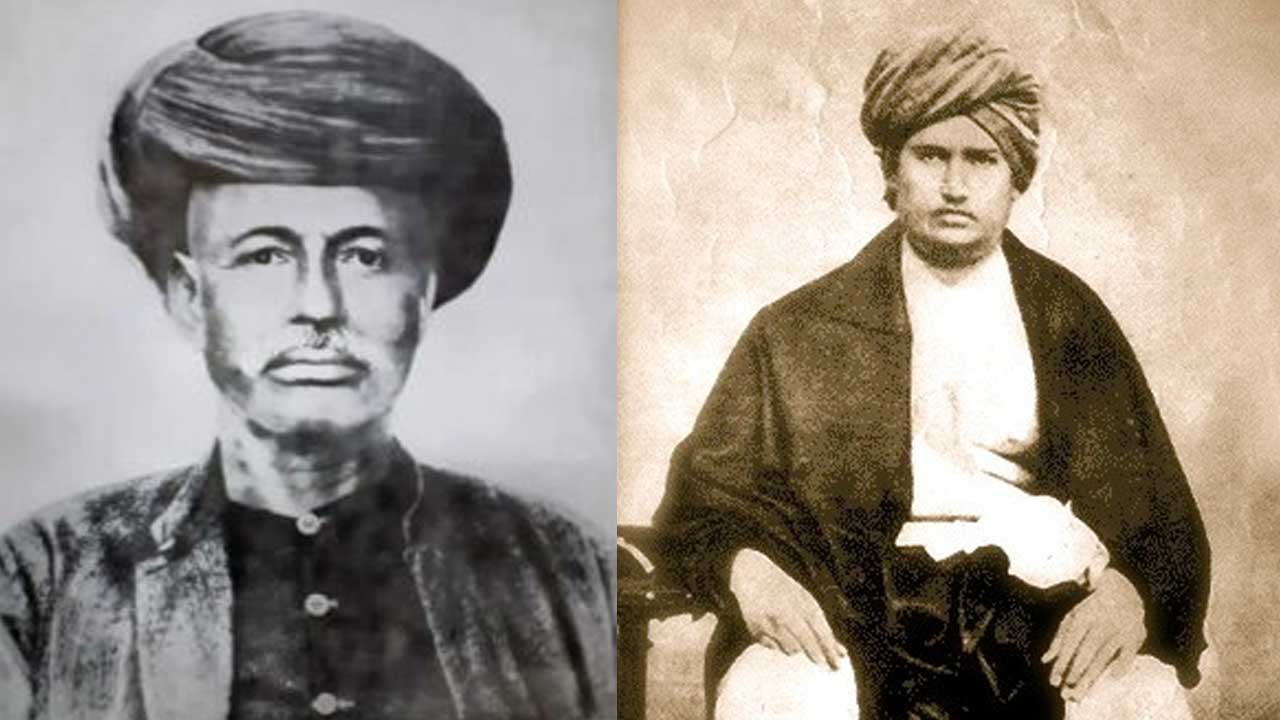
As for Jotirao, religion wasn’t a priority at all. He wanted an end to the hegemony of the Brahmins. He wanted the Shudra-Atishudras to get the right to education, to think independently, to engage in the profession of their choice and to be entitled to the fruits of their labour. Jotirao also believed that India had a golden past, but his ancient India was very different from what the Brahmins imagined. He outrightly rejected the Brahmanical varna theory and believed that the Shudras-Atishudras were the original inhabitants of India. In Gulamgiri he explained how the alien Aryans conspired against the Shudra-Atishudra rulers, subjugated them through deceit, distorted their culture and began ruling over this land. Jotirao began his campaign for transforming society by promoting women’s education. Dayanand Saraswati also supported education and equal property rights for women but he was firmly against allowing women to study the Vedas:
Around 1886, he [Dayanand] was in Ajmer and was sitting in an orchard. Some women called on him. They asked, “Can we attend your public meetings?”
“What do you have to do with me?” Dayanand queried.
“We want to listen to your sermons,” the women said.
Dayanand turned them back saying that he doesn’t give sermons to women, but they are free to send their husbands (to attend his sermons).[4]
Dayanand might have been a bit more liberal than obscurantists like Tilak as far as women’s education was concerned. But no compromise with the mandates of the varna system was acceptable to him. Manusmriti denied the right to education to the Shudras. Dayanand was willing to let them acquire an education but in keeping with the Varna system, so that they could serve the higher Varnas better.
He said that the Brahmin women were entitled to learning all kinds of skills; besides other skills, the Kshatriya women could learn archery, too; the Vaishya women should only learn accounting; and the Shudra women should only learn cooking.[5]
Thus, Dayanand was a supporter of women’s education only to the extent that it was compatible with the varna system and they could help their fathers or husbands in their work. In contrast, Jotirao fought for full autonomy for women to learn whatever they wanted to.
Gender divide was very apparent in the rule book of the Arya Samaj. It said that in the main and regional bodies of the organization, women cannot be appointed to the top (president) or the second-in-command (secretary) posts. They could only be members. Similarly, while Dayanand supported education of both boys and girls, he was against co-education. The Arya Samaj’s rules stipulated that girls’ schools should employ only women as teachers and that boys’ schools should employ only boys as teachers. The rules did not mention the varna system but stated that the “only Vedas would be considered self-evident”. This was clearly a call for maintaining the status quo.[6]
Destiny brought these travellers on different paths together momentarily. The biographers of Dayanand haven’t given much importance to this crossing of paths – perhaps because the Arya Samaj could not strike as deep roots in Maharashtra, as it did in Haryana, western Uttar Pradesh and some other areas. The Peshwai Brahmins were as conservative as the Namboodris of south India. After Arya Samaj came into being, the key challenge before Dayanand was to expand its footprint. In Bombay, he got the support of established industrialists and businessmen like Moolji Thakarshi, Lakhmidas Kheemji, Mathuradas Lavji and Chhabilas Lallubhai. They all helped in promoting Dayanand’s movement in their own ways. Bombay was the commercial capital of Maharashtra and Pune was its cultural hub. Without getting a foothold in Pune it was not possible to influence Maharashtra. Social workers like Jotirao Phule, Mahadev Govind Ranade and Ramkrishna Gopal Bhandarkar were already active in Pune. Jotirao Phule, by calling for keeping Brahmin priests away from all religious and social rituals, had emerged as a potent challenge for the entire Brahmin community. It was Ranade who invited Dayanand to Maharashtra. At his request, Dayanand arrived in Pune in July 1875, where Ranade not only accorded him a hearty welcome but also went on to arrange for the publication of Dayanand’s 15 speeches in the city in the form of a book.[7]
According to Jordens, Ranade inviting Dayanand to Pune and joining his brigade was just an act of courtesy extended by one social reformer to another. Was it?
Jotirao had been spearheading a reform movement in Pune for almost three decades. Ranade was impressed with his work, but he never joined forces with him. Needless to say, inviting Dayanand to Pune and helping him expand his footprint in Maharashtra was a pragmatic move on the part of Ranade and other Brahmin reformers. They were not enamoured of Dayanand’s Veda-centric spiritualism but they were concerned about Brahmanism coming under incessant attack from Jotirao.
Dayanand was a new arrival in the field of social reform and his Arya Samaj supported the idea of a golden past of Brahmanism. That was what drew Brahmin reformers to him. Defending his decision to invite Dayanand to Pune, Ranade said, “Dayanand considers Vedas supreme. He believes that emancipation is possible only by treading the path shown by the Vedas. Except this, there is nothing in his beliefs that contradicts our principles.”[8]
Satyashodhak Samaj was not an atheist organization. Like members of the Brahmo Samaj and Prarthna Samaj, Satyshodaks, too, had developed a monotheist belief system. But while reformers like Ranade wanted Brahmin priests to continue to have a role in religious rituals Jotirao was fighting to oust them from the socio-religious life of the masses. He believed that Brahmin priesthood was the source of umpteen evils afflicting society and that the worshipper didn’t need a middleman to connect to his deity. In fact, Jotirao urged the Shudra-Atishudras to boycott anything that validated the monopoly of the Brahmins or any other kind of hegemony.
Both Prarthana Samaj and Brahmo Samaj were theist organizations and so was Satyashodhak Samaj. All the three believed that there is one god and all humans are his children. The worshipper can directly connect with the object of his worship. No middleman like a priest or a guru is needed to perform any kind of worship or religious ritual. All the three organized weekly prayer meetings … Prarthana Samaj and Brahmo Samaj believed in the power of prayer. They prayed for the spiritual wellbeing of the people. Jotirao hardly had any interest in spiritual wellbeing and never laid much emphasis on it. He kept away from an intoxicating pursuit of god.[9]
According to Pandit Lekhram, Dayanand arrived in Pune in June 1875 and stayed at Shankar Sheth’s house in Vitthalpeth. He published a pamphlet containing a list of six books, which, he said, were the only authoritative texts in the Vedic tradition. All the books not on the list, he opined, could not be relied upon. Two venues were chosen for his speeches in Pune. The first was the Bhide Wada in Buddhavar Peth and the second, Marathi school in the cantonment area. He gave his first speech on 4 July at Bhide Wada. Subsequently, he also constituted the Pune branch of Arya Samaj. But somehow, the Arya Samaj and its ideology failed to enthuse the residents of Pune. The Shudra-Atishudras showed little interest in Dayanand’s reform movement as they already had a dependable and credible guide in Jotirao, whom they had tried and tested for the past three decades. Besides the conservatives, the reformists, too, did not agree with Dayanand’s nostalgia for the ancient past, his past-oriented ideology and reform movement. Reformists and celebrated scholars like Professor Ramkrishna Gopal Bhandarkar and Vishnushastri Pandit were among his critics. In his magazine Induprakash Vishnushastri blamed the orthodox elements for the failure of Dayanand’s Pune visit:
The reception Swami ji received was unpalatable to the gluttonous, foolish, mindless, selfish, spiteful and the mischief makers in the city and they did everything they should not have done … Pune is a highly civilized city and we should not have treated a widely revered gentleman like this. But the crooked, selfish and envious people not only disgraced themselves but also this city. We may well draw consolation from the saying that Chandals also have homes in places inhabited by the good people. But still, whatever happened was wrong.[10]
Anyone who advocated change; who stood for embracing new knowledge and reforms; who criticized untouchability and wanted to end it; who championed social justice, equality and rights – all such people were viewed as enemies by the orthodox elements, who launched a smear campaign against them. Critics of Hinduism being branded as its enemy was common enough. In his speeches, Dayanand raised issues such as minimum age for marriage, right to study the Vedas, untouchability, women’s education, yagnas and ritualistic animal sacrifice in yagnas. The reformists had long been pleading for reforms with regard to all these issues. But Dayanand was not only calling for reforms but was also quoting from the Vedas and other scriptures to back his demand. That incensed the conservatives of Pune. He gave a total of 15 speeches between 4 July 1875 and 4 August 1875. These were later compiled and published as a book titled Updesh Manjari. While Dayanand’s speeches were music to the ears of the reformists, the anger of the fanatics knew no bounds. The conservative Brahmins convened a meeting at Vishnu Mandir on 15 August 1875, where Dayanand’s ideas and his speeches were ridiculed and scorned. After the meeting, Pandit Ramdixit Apte and Pandit Narayan Shastri Godbole issued a statement saying that they were ready for a “shastrarth” (debate) with Dayanand. Induprakash’s editorial comment on this said:
After reaching Pune, Maharshi Dayanand had issued a statement listing which texts are authoritative and which aren’t. At that time, no pandit came forward for a shastrarth with him. That is because the pandits of Pune know nothing about the Vedas. They could not read or understand the other books which Dayanand called authoritative. Now, they are feeling that if they still keep quiet, people will start taking them for a bunch of fools. So, they are trying to salvage their reputation in the eyes of the common man by declaring that they are ready for a shastrarth with Swami ji. But they have appended such conditions to their challenge, which they know would hardly be acceptable to Dayanand.[11]
Writing in his newspaper Hitechchhu, Gopal Hari Desmukh was quite blunt: “The conservative Brahmins of Pune lack the courage to engage in a shastrarth with Swami Dayanand. That’s why, they are indulging in all kinds of shenanigans to avoid it.”[12] Eventually, the day for the shastrarth was fixed. It was the Vedic scholar Swami Dayanand versus the traditionalists of Pune. The traditionalists were angered by Dayanand’s assertions that both men and women were entitled to an education, that caste and varna were not linked to birth and that idol worship had no place in the Vedas, among others. Jotirao has been saying these things for three decades. That was the key message of his follower Tatya Padwal’s book Jatibhed Viveksar (1861). Kabir and Raidas had said the same thing centuries earlier. But few, if any, took notice of them because it was easy to ignore the ‘kshudra’ (trivial) ideas of the Shudras. But Dayanand was a Brahmin and was quoting from Vedic literature to back his claim. Clearly, it was not easy for the Brahmins to ignore him. Narayan Bhikhaji Joglekar, a joint commissioner of Pune, led the contingent of the conservatives at the shastrarth. He was also one of the organizers of the debate but was wary of facing the Swami.
Dayanand’s opposition to idol worship was well known. So, some orthodox elements hatched a conspiracy to defame him. A couple of idols of Ganapati were dumped outside a temple. They didn’t stop at that. To disturb law and order in the city, they threw some idols of Ahilya into a drain. As a result, tension gripped the city. Some people claimed that all this was done at the behest of Dayanand, who, it was alleged, hated idols and their worship. Some idols were found lying in a drain not far from the Balwantrao Temple. Rumours were spread that Dayanand himself had smashed some idols in front of the famous Vithoba Temple at Pandharpur. Some began spreading the rumour that Dayananda in his speech had used filthy words for Lord Rama. The local newspapers did their utmost to give currency to these rumours. The government feared that Dayanand’s attacks on popular Hindu beliefs may create a situation similar to the one that had led to the 1857 rebellion. So, the government was also unhappy with him.[13] In view of this situation, Dayanand decided to leave Poona. And it was amid these circumstances that a shastrarth was held between him and his opponents that comprised a contingent of around forty pandits of Poona.[14]
To ensure a decent farewell to Dayanand, the social reformers decided to take out a procession. The day appointed for the event was 5 September 1875. The conservatives of Poona decided to disrupt the event at any cost. Fearing violence, the reformists approached Jotirao for help, just a day prior to the event. Dayanand was a supporter of the varna system. The lower castes had little interest in his sermons. But Jotirao decided to help them because some of the reformist ideas of Dayanand were in sync with his own mission. The organizers had arranged a decorated elephant for the event. Dayanand was riding the elephant and the Vedas and other scriptures were being carried in a palanquin. The procession was led by a band. Conch shells were being sounded. Jotirao was a part of the procession. He was walking alongside Ranade and other social reformers. Jotirao’s supporters were there in strength to protect the procession from any attack. They included wrestlers trained by Lahuji and young Satyashodhak workers including Dhondiba Salve and Gyanoba Krishnaji Sasane.[15] Their presence was enough to deter the opponents, who decided that discretion was the better part of valour, and backed off.
Some chroniclers say that when the decorated elephant was brought before him, Swami Dayanand refused to mount it. He said that only Vedas should be placed on the elephant’s back. In Santsevak Balaji Kavde’s words:
Swami’s speeches had awakened the entire Pune city. Whatever he said was backed by the Vedas. On the other hand, the Brahmins of Pune had only memorized the Vedas. So none of them could gather the courage to argue with him directly. With the help of Jotirao, Justice Ranade decided to take out a procession with Dayanand riding an elephant. But the Swami said, “Place the Vedas on the elephant. I will walk.” The conservatives of Pune attacked the procession but Jotirao’s Satyashodhaks hit back, forcing the attackers to flee.[16]
The organizers of the procession thought that the trouble was over. But the Sanatanis were not ready to give up. How could they have allowed any reformist campaign to succeed? When they couldn’t disrupt the procession, they vented their frustration by catching hold of a donkey, decorating it, and placing on it a pagdi (headgear) similar to the one Swami Dayanand wore. They named the donkey Gardhabhanand and began marching behind it in a procession. Soon after the procession of the reformists reached its destination, the Gardhabhanand procession also arrived there.
That sparked a physical confrontation between the groups. Ranade had anticipated it and had arranged for police protection in advance. Police resorted to lathicharge to disperse the troublemakers.[17]
According to Dr Kushaldev Shastri, the author of Maharshi Dayanand: Kaal Aur Krititva, Dayanand addressed more than fifty meetings in Pune and Jotirao attended most of them. He also claims that Jotirao had invited Dayanand to deliver a sermon at a school located in Mominpura and that Dayanand spoke on the Vedas at the venue on 16 July 1875. This claim doesn’t seem very credible. Dayanand had travelled to Pune at the request of Ranande and right from his arrival to his departure, Ranade was Dayanand’s constant companion. Ranade also got a compilation of 15 lectures of Dayanand published. It is true that Dayanand spent more than two months in Pune. Many chroniclers say that reformist leaders, including Ranade, making preparations for Swami Dayanand’s farewell, had only sought Jotirao’s help a day before the procession. Jotirao agreed to help them, his rationale being that whatever may have been the spiritual outlook of Dayanand, all said and done, he, too, was a reformer. If Jotirao was really interested in Swami Dayanand’s Pune sojourn, he would surely have been aware of the conspiracies being hatched by the Brahmins opposed to Dayanand and he himself would have ensured that no hurdle was placed on the path of the procession. It is possible that Jotirao was in touch with Dayanand but it doesn’t seem plausible that he invited the latter to speak on Vedas at a school for the Shudras. This is also clear from what Jotirao wrote back in response to the letters from Arya Samaj leaders on the issue of scriptures. Jotirao wrote:
We don’t need scriptures. Our mind should be open to all kinds of knowledge and wisdom and intellectual curiosity should be encouraged.[18]
Jotirao Phule stood for logical and rational knowledge, and that set him apart from other contemporary social reformers.
References:
[1] Joseph Teresa Florent Jordens. Dayananda Sarasvati: His Life and Ideas. (1960: 133-134)
[2] Shivnath Shastri. History of Brahmo Samaj – I (1911 : 68-69)
[3] Swami Dayanand. ‘Aryo Brahmankumaroyoh’. Ashthadyayi (6.2.58). Updesh Manjari. (2005 : 69)
[4] Pandit Lekhram. Jeevancharitra: Maharshi Swami Dayanand (1960 : 67)
[5] Swami Dayanand. Satyarthprakash. Chapter 3 (2008 : 68)
[6] Pandit Lekhram. Jeevancharitra: Maharshi Swami Dayanand (1960 : 255-256)
[7] Dhananjay Keer. Mahatma Jotirao Phule (1960 : 138); Jordens. Dayananda Sarasvati: His Life and Ideas. [1960 : 136]
[8] Joseph Teresa Florent Jordens. Dayananda Sarasvati: His Life and Ideas. (1960 : 136)
[9] Dhananjay Keer. Mahatma Jotirao Phule (1960 : 129)
[10] Pandit Lekhram. Jeevancharitra: Maharshi Swami Dayanand (1960 : 268-270)
[11] Harvilas Sharda, Life of Dayanand Saraswati [1946 : 145-146]
[12] Ibid. [146]
[13] Ibid [146-147]
[14] Pandit Lekhram. Jeevancharitra: Maharshi Swami Dayanand [1960 : 265-266]
[15] Dhananjay Keer. Mahatma Jotirao Phule [1960 : 139]; Shriram Gundekar. Satyashodhak Mahatma Jotiba Phule [2004 : 57]
[16] Santsevak Pandurang Balaji Kavade. Mahatma Jotirao Phule Hyanche Charitra [1968 : 144]
स्वामींस पुण्यास आणण्यासाठी न्यायमूर्ती रानडे यांनी पुढाकर घेतला होता। स्वामींच्या व्याख्यानाने सारे पुणे शहर खडबडून जागे झाले। स्वामींच्या प्रत्येक तत्त्वास वेदांचा आधार असे। पुण्यातील ब्राह्मणांचे वेदांचे ज्ञान फक्त पाठांतरात होते! त्यामुळे स्वामींशी प्रत्यक्ष वादविवाद करण्यास कोणी धजले नाहीत। न्यायमूर्ती रानडे यांनी जोतीरावांच्या मदतीने स्वामींची हत्तीवरून मिरवणूक काढण्याचे ठरविले। परंतु स्वामींनी सांगितले, हत्तीवर फक्त वेद ग्रंथ ठेवणे, मी स्वतः पायी चालेन! मिरवणुकीवर पुण्यातील कर्मठांनी हल्ला केला पण जोतीरावांच्या सत्यशोधकांनी तो परत फिरवून उलट त्यांचीच फटफजिती केली।
[17] Santsevak Pandurang Balaji Kavade. Mahatma Jotirao Phule Hyanche Charitra [1968 : 144] and Dhananjay Keer. Mahatma Jotirao Phule [1960 : 139]
स्वामी बांधीत असलेल्या फेट्याप्रमाणेच सनातन्यांनी एक फेटा गाढवाच्या डोक्यास बांधला व गाढवाची मिरवणूक काढून आपले सत्यधर्मद्रोही हृदय प्रगट केले।
[18] Deenmitra, 31 January 1912. Quoted in M. Bhavyansh. Jotiba Phule and the Art of Dissent. 2019. Delhi University
(Translated from the original Hindi by Amrish Herdenia)
Forward Press also publishes books on Bahujan issues. Forward Press Books sheds light on the widespread problems as well as the finer aspects of Bahujan (Dalit, OBC, Adivasi, Nomadic, Pasmanda) society, culture, literature and politics. Contact us for a list of FP Books’ titles and to order. Mobile: +917827427311, Email: info@forwardmagazine.in