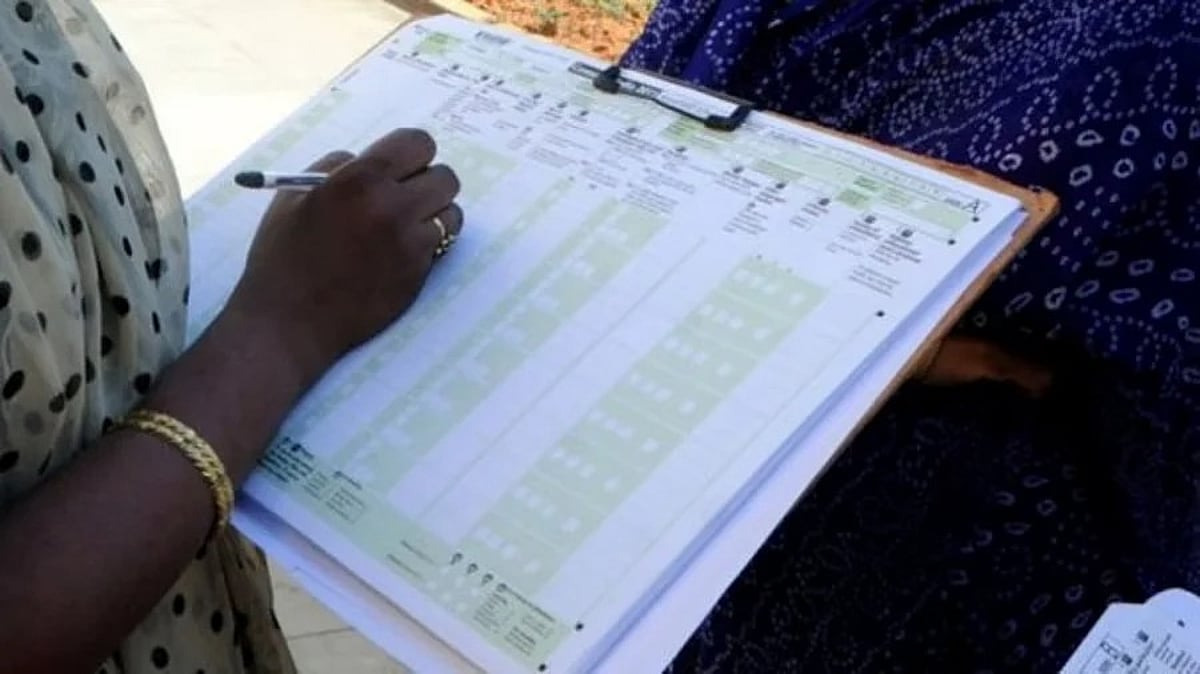
Today, Indian democracy is on the cusp of its largest ideological struggle grounded in reason. Even four decades after Independence, the reservation regime – the lynchpin of social justice – is handicapped by the absence of data to justify it. The proposed caste census, especially the methodology of filling in the castes of citizens who have been categorized as OBC (Other Backward Classes), is in the eye of an administrative and political storm. One section wants the enumerator, or the enumerated themselves, to enter the name of the OBC caste in the enumeration form. This is what is called an open-ended format. Practical, technical, ground experience strongly suggests that this may be a well-thought-out conspiracy to weaken the OBCs by messing up data. On the other hand, a drop-down menu, listing the names of the castes identified as OBCs at the Central level and in the state concerned, would serve the purpose excellently and produce transparent and accurate data.
In India, the backward classes of castes have not been plucked out of thin air. The Mandal Commission (Second Backward Classes Commission) as well as the backward classes commissions of different states possess authoritative lists of backward castes, which have been identified through painstaking research and have been duly notified in gazettes. All the socially and educationally backward castes and sub-castes in the country have been named and assigned distinct codes. When the government and the backward classes commissions are already in possession of a database of OBC castes and sub-castes, classified and coded scientifically, how the idea of an open-ended format cropped up is a mystery.
Pitfalls of open-ended format
At first glance, an open-ended format may appear to be liberal, transparent and “open”, but data science and administrative experience suggest otherwise. If the enumerator, or the enumerated, is allowed to fill in the name of caste in the form, it will open floodgates of errors and mismatches. Caste names and surnames (like Chaudhary, Verma, Sharma or Singh) are pronounced and spelt in different ways in different parts of the country. If the enumerated are allowed to write the name of their caste themselves, some will name their caste, others their sub-caste, still others their gotra, surname or even their local title. A careless enumerator and the unaware enumerated both will be prone to committing such mistakes.
The open-ended format was used in the 2011 Socio Economic and Caste Census (SECC). The result was an utterly confusing mishmash of 46 lakh different castes, sub-castes and surnames. Spelling mistakes and different spellings of the same names added to the confusion – so much so that the government decided not to make the data public.
Advocates of the open-ended format argue that AI can be used to clean up the data. However, if millions of people write the names of their castes and sub-castes a thousand different ways, no intelligence – artificial or otherwise – will be able to make any sense of it. It will be next to impossible to determine the class a citizen belongs to because scores of surnames are shared by General, OBC and SC categories. The Census Act does not empower the officials to merge similar or similar-sounding names for the purpose of categorizing them. Any such attempt would be treated as tampering with the data and the courts may well go ahead and nix the entire exercise. That’s why the correct code must be selected at the time of the enumeration.
If, on the other hand, digital forms with drop-down menus listing the names of castes and sub-castes and the codes assigned to them are used, the enumerator or the enumerated will only have to click on the right choice.
Caste surveys conducted by the governments of Bihar, Karnataka and Telangana have proved that using drop-down menus with codes can produce error-free and accurate data within a couple of weeks. And even if there is an apprehension that a few castes may be missing from the authorized list, an “other” option can be provided at the bottom of the list. This will ensure that castes of 99 per cent of the people are recorded correctly, along with their codes. The Supreme Court has repeatedly stressed the need for quantitative data to justify reservations and for policy-making. Only properly classified data, collected using drop-down menus, will meet the standards set by the top court.
The saboteurs: Who are they?
An obvious question is this: Which are the forces rooting for the open-ended format to ensure that the collected data is unintelligible, complicated and unreliable?
The Rashtriya Swayamsevak Sangh (RSS) and the ruling Bharatiya Janata Party (BJP) have an old habit of using myriad ploys to derail social justice initiatives. They know quite well that once scientific and credible data on OBC population and castes becomes available, the slogan of “Jiski jitni sankhya bhari, utni uski hissedari” (Representation in keeping with the numbers) would be difficult to brush aside. It would become an irrefutable argument. The ruling party fears such a scenario. It would instead prefer disparate and confusing data fracturing the OBC community into lakhs of castes, sub-castes and gotras, triggering internecine identity battles within the community. Divided among themselves, the OBCs will have no statistics to back their claims. That would make it easy to deprive them of reservation and institutional representation or undermine their rights using criteria like “creamy layer”. This is a conspiracy to create artificial divisions among the backward classes.
Inequality runs deep
The result of ignoring – or not collecting – accurate data on castes is for all to see. Reports compiled by Oxfam India and World Inequality Lab show that India’s national wealth and resources are concentrated in the hands of a few, while the hardworking backward Bahujan castes struggle to meet their basic needs. They mostly work in the unorganized sector.
According to different international and national reports, the top five per cent of India’s population in terms of income is sitting on 55 per cent to 62 per cent of the nation’s total wealth. Oxfam India’s report “Survival of the Richest: The India Story” says that the richest five per cent own over 60 per cent of the total wealth. According to the World Inequality Lab’s 2026 Report, India has a high concentration of wealth. The top one per cent own 40 per cent and the top 10 per cent own 65 per cent of the national wealth. The top five per cent, thus, can be said to be the owners of 55 -58 per cent of the nation’s total wealth. According to the World Inequality Lab’s 2024 Report, upper castes have 89 per cent of the country’s wealth.
Question of adequate representation
Despite the Constitution providing for reservations, OBC-Bahujan form a miniscule section of the faculty at Indian Institutes of Technology (IITs) and other top technical education institutions.
The data supplied to Dr Panav Jeevan P., an alumnus of IIT Bombay and IIT Kanpur, in reply to his query under the Right to Information Act, paints a sorry picture. The responses by 17 of the 23 IITs show that the upper castes have almost a complete monopoly on the teaching positions of these institutions. As high as 83.7 per cent of the faculty members in the 17 IITs come from the general (unreserved) category, when their share is statutorily capped at 50.5 per cent. These institutions have 928 more upper caste teachers than they should have. As many as 2,631 posts reserved for SCs, STs and OBCs in these institutions are vacant; the share of Adivasis (STs) is a measly 1.1 per cent.
An institution-wise breakup reveals blatant flouting of reservation norms. According to The Wire report, of the 781 teachers at IIT Kharagpur, 712 (around 91 per cent) are from the unreserved category and 710 reserved posts (378 for OBCs, 216 for SCs and 116 for OBCs) are lying vacant. Of the 45 departments in the institution, 43 do not have even a single ST teacher and 32 do not have even one SC faculty member. Similarly, 254 of the 257 professors at IIT Kanpur are from the general category. No professor at the institution comes from the SC or ST communities. Of the 412 professors at IIT Kanpur, just five are SCs and six are OBCs. IIT Kanpur has no ST professor. The situation is no different in other key institutions. At IIT Dhanbad (Indian School of Mines), 248 reserved posts are vacant. The corresponding figures for IIT Roorkee, IIT BHU, Varanasi and IIT Hyderabad are 248, 236 and 201, respectively. At IIT Patna, 120 of the 149 reserved teaching posts (around 80 per cent) have not been filled.
The IITs have long been arguing that they do not get worthy candidates from the reserved categories. But the RTI response knocks the bottom out of this argument. SC, ST and OBC candidates formed 48-50 per cent of the applicants received in response to announcements of vacancies in these IITs after 2025. In IIT Guwahati, the figure was more than 80 per cent. But despite getting an adequate number of applications, the posts were left vacant. For instance, IIT Jodhpur received 3,043 applications from reserved-category candidates but only 75 appointments were made and 126 posts were left vacant. IIT Kharagpur received 2,798 and IIT Hyderabad 2,359 applications. But despite that, hundreds of posts were not filled. Even among the Bahujan teachers, few have been allowed to rise to the levels of associate professor and professor from the entry-level assistant professor.
“Not found suitable” is a weapon frequently used to keep reserved posts vacant and thus maintain the hegemony of the upper castes. This is ample proof that the Bahujan are being denied their due for want of credible data and administrative apathy.
The RSS-BJP government doesn’t want the actual numbers of Bahujan to be made public, for that would make it difficult to whip up communal frenzy against Non-Hindus and keep the Bahujan divided on the basis of their caste. Once the data is public, it would forge a Bahujan unity and the forces advocating for social justice would launch a decisive struggle.
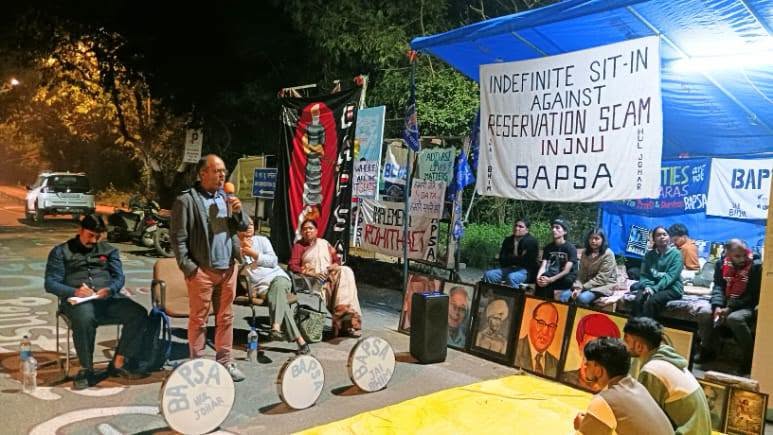
Supporting the use of an open-ended format for enumeration of OBCs is tantamount to sabotaging an exercise that may well secure justice to the Backward Classes. Whether it is carelessness on the part of the enumerators or spelling mistakes by the enumerated, the entire process is doomed from the start. When the different backward class commissions have already verified lists of OBC castes along with their specific codes, a drop-down menu is the only scientific, legal and transparent option. The massive rally planned at Delhi’s Ramleela Maidan on 28 November is proof enough that the Bahujan have realized that behind this technical imbroglio is a political conspiracy. The rally is not just another protest, but an expression of the well-considered view that only a drop-down menu can enable an accurate and transparent counting of the OBCs – to ensure that those in power can’t play sordid games with the rights of the Backward Classes.
(Translated from the original Hindi by Amrish Herdenia)
Forward Press also publishes books on Bahujan issues. Forward Press Books sheds light on the widespread problems as well as the finer aspects of Bahujan (Dalit, OBC, Adivasi, Nomadic, Pasmanda) society, culture, literature and politics. Contact us for a list of FP Books’ titles and to order. Mobile: +917827427311, Email: info@forwardmagazine.in