Village Pali, Tehsil Phulpur, District Prayagraj, Uttar Pradesh. White and grey clouds scattered in the sky. It is about to rain, at least so it seems. A clutch of women is transplanting paddy seedlings in a puddled field. But instead of breaking into folk songs traditionally sung during sowing, or gossiping and joking, they are discussing a current politico-religious issue.
One of them says, “What a Kaliyug we are living in! Ram’s wealth, his ornaments, cash – everything has been looted in Ayodhya.”
“But who told you that?”, another woman asks.
“No one needs to tell me anything. The mobile tells me everything.”
“Did they break into the temple at night, or did they commit dacoity in broad daylight?”
“Sister, the thieves were not outsiders. Those who looted Ram’s wealth were the very people responsible for protecting it.”
“And Modi-Yogi are doing nothing?”
“What can they do? The thieves are from their own party.”
A middle-aged woman joins the conversation, recounting a gist of Ram’s life. “Poor Ram! So unlucky he was. He could never be happy – neither in life nor in death. He could neither enjoy the company of his wife nor of his children. Watching their children grow is something that gives immense pleasure to fathers. But he was deprived of it. His idol was first kept in a mosque, and then in a tent. And when finally he did get a grand temple, his wealth was looted.”
This account of a conversation between Dalitbahujan women in a village in Uttar Pradesh is evidence enough that Ayodhya’s Ram Temple is back as a talking point. This time, though, the issue is the loot of the offerings made by the devotees at the temple. The Dalitbahujan were enthusiastic partners in the Ram Temple movement – right from karsewa to the demolition of the Babri Masjid to the lighting of lamps in homes after the construction was over. But now they find that from jewellery to cash – everything is being looted from the temple.
Ghanshyam Thateri, who runs a kitchenware shop in the Babuganj Market of Prayagraj, had collected donations for the construction of the Ram Temple. He had gone around riding a bicycle, with an attached trolley carrying a pair of khadau (wooden footwear associated with Ram). He recalls how people turned emotional and even began crying. “Moved by their faith in the Lord, some women even donated their ornaments. Widows gave their mangalsutras. In some villages, for want of anything valuable to give, people donated their brass utensils.” He describes how all this was done secretively, because in the eyes of the government and the police, it was a crime. But they did it for the sake of Ram. Now that they have come to know that the offerings made to the Lord were siphoned off and that the purchase of land for the temple was a big scam, it has been a real slap in the face. They are feeling cheated and betrayed. “The situation now is that everyone who sought donations for the temple is being seen as a thief. People may not say anything to your face, but they do feel that we all are crooks,” Ghanshyam says.
Gobbling up temple offerings has a long history
Amit Nishad of Katka Jhoonsi has given up his traditional occupation (boatman) and now earns a livelihood by fixing floor tiles. He has involved two boys from the neighbourhood in his work. Amit belongs to Gen Z. He was born after the Ram Temple Movement and the destruction of the Babri mosque in the early 1990s. But he has seen the temple coming up in Ayodhya. He was witness to the frenzy that marked the temple’s inauguration, which, incidentally, was timed to draw maximum electoral advantage. He had lit five earthen lamps at his home on 22 January 2024. Ram’s association with a member of his (Nishad) community is something he feels very proud about. “To whom do the offerings made at temples go? If it is a small temple, the pujari who looks after its affairs and performs puja keeps it. It is the source of his livelihood. Donations are sought for maintenance of the temple and for annual festivals held on its premises. Whatever is offered at Ayodhya’s temple, does it go to Ram? No, not at all. If the temple had one pujari, he alone would have gobbled up everything. Now since it has a 15-member – unofficially 17-member – trust and hundreds of staff, all of them were apparently together devouring the offerings,” he says.
Amit says, “Had the offerings been small, there would have been no problem. All the staff would have made merry and no one would have noticed. But the problem was that the offerings were huge, very huge. Now, since the offerings were huge, these people devoured huge amounts of money. And when you devour too much – whether it is food, or money – you are bound to get indigestion. These people stole tons of money and divided it among themselves. For example, Lavkush Mishra, Avinash Shukla. Then there is Tinnu Yadav, working at the temple for a long time. A man drawing a salary of Rs 15,000 per month turns wealthy in just two years. So wealthy that he buys land in prime locations priced between Rs 25 lakh and Rs one crore. He pays lakhs just as registration charges. He builds a huge two-storied lavish house and purchases expensive cars. His clothes are expensive, his mobile phone is costly, even his shoes cost a lot. People around you notice this. But more importantly, your language changes, your attitude, your behaviour changes. And then you become an eyesore. The revelations have come about because of new entrants. One doesn’t know for how long the old scoundrels had been stealing.”
As I hear what Amit has to say, a verse written by Raidas centuries back comes to mind.
Mandir bheetar murati baithee, pujari bahar chela re,
Laddu bhog chadhawati janta, murati ke dhing kela re
Pathhar murti kachhu nahin khati, khate bambhan chela re,
Janata lutati bambhan saare, prbahu ji dete na dhela re
Punya paap punarjanm ka, Bambhan dinha khela re
Swargm nark baikunth padharo, guru shisya ya chela re
Jitna daan devge jaise, waisa nikre tela re
(Inside the temple sits an idol and outside are the priest’s disciples. The people make offerings, but the idol doesn’t even get a banana. The stone idol eats nothing; it is the priest and his disciples who consume everything. The priests loot the public, yet the Lord doesn’t punish them. Sin, virtue, and rebirth all are illusions created by the Brahmins. They sell passes to heaven, hell, or Vaikuntha. Whatever you offer as a donation, you will reap a commensurate reward, they tell you)
Why the land scam was ignored
Deepti Patel, who is pursuing her graduation, asks why no action was taken when the land purchase scam was uncovered. “Had the land scam been probed seriously and action been taken against the accused Champat Rai and Anil Mishra, they could have not stayed on at the top positions in the trust and devoured the offerings for years,” she says.
It might be mentioned here that in 2021, the land purchase scam had become the talk of the town. It was alleged that a nexus of senior administrative officers posted in Ayodhya, ruling party leaders and local builders made benami land purchases (concealing the real owners) for a song, and then sold it to the temple trust at prices that were multiple times higher. The Aam Aadmi Party was at the forefront in demanding action in the matter. At that time, too, the issue was brushed under the carpet by forming an SIT.
Investigations by the SIT constituted for probing the offerings theft have revealed that employees drawing very low salaries owned lands worth crores. It is alleged that senior politicians, powerful bureaucrats and land mafia are the real owners of these properties. They have made benami purchases to evade taxes and dodge the law. The SIT is also examining the bainamas (sale deeds) of these properties to find out whether revenue officials and property dealers were in cahoots.
Loot of money, land began in early days of Ram Mandir Movement
Social worker Ram Kripal Yadav, who has been keeping a close eye on the Ram Temple movement since the 1980s, says that “theft is nothing new to the movement”. Even in the 1990s, siphoning off the donations collected by invoking the Ram Temple was common enough. Disputes over sharing of the spoils had even led to murders. It was not that voices were not raised against the rampant malpractices. But the dissenting voices were suppressed. Mahant Lal Das was the first chief priest of the makeshift Ram Temple at the disputed structure. He had opposed seeking donations in the name of the temple, alleging that the Vishwa Hindu Parishad (VHP) had collected hundreds of crores of rupees by exploiting popular sentiments and used the money to construct huge buildings. He was removed as chief priest on the charge that he had usurped Rs 10 from the offerings made at the temple and was replaced by Satyendra Das. Mahant Lal Das was shot dead in 1993. His murderers are still at large.
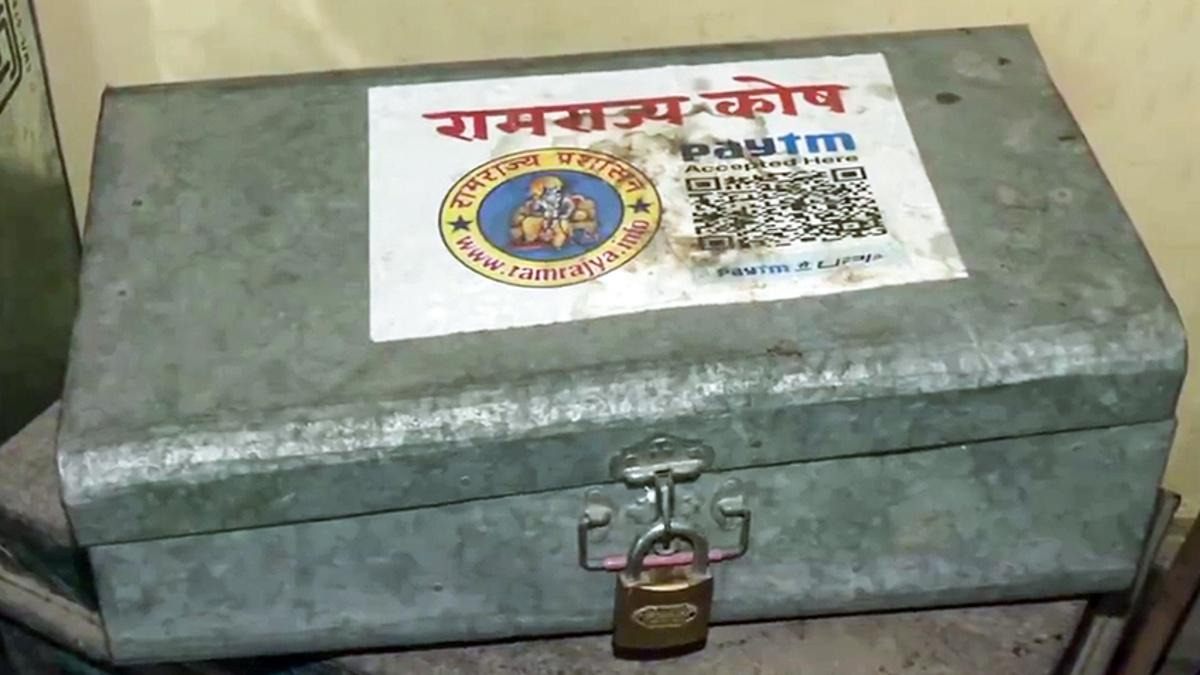
More than half a dozen serious allegations of corruption and embezzlement related to the Ram Temple Movement have been levelled over the past 30-40 years. The Nirmohi Akhada was the first to allege misappropriation of funds, accusing the VHP and its associates of siphoning off more than Rs 1,400 crore. It was also alleged that the cash which the people donated, along with Ram Shilas (bricks with “Ram” etched on them], was not accounted for and was misused. Another allegation was that some VHP leaders usurped donations from the people in Ayodhya as well as the offerings made at the temple. In 2021, a scam in the land purchase came to light. Yet another allegation was that land belonging to the temple was illegally sold. There were also allegations of a prasad (food offered to idols) scam running into crores of rupees.
Temple integration programme
A Dalitbahujan professor at Allahabad University, who preferred anonymity out of fear for his job, said that besides financial irregularities, a wider conspiracy is also being hatched. He says, “Just see how many old temples have been demolished in Gujarat, Varanasi and Ayodhya. The Fakire Ram Temple, Sita Rasoi Temple and dozens of such historical temples were bulldozed in Ayodhya. The decentralized structure of temples in ancient cities was systematically destroyed and was replaced with integrated temple complexes. Then, these integrated temple complexes were handed over to trusts, controlled by their own men. This was done in Badrinath, Kashi, Ayodhya, Dwarka and numerous other places. Clusters of temples were replaced with single temple complexes. With small temples gone, all the offerings and donations began flowing into the integrated temples complexes. Besides Ram Mandir, many other integrated temple complexes have witnessed a big jump in the offerings. The offerings which normally were distributed among many temples became concentrated in integrated temple complexes.”
Extortion in the name of VIP darshan
A VIP Darshan programme on payment of a convenience fee was launched at the Ram Mandir. SIT probe revealed that Rs 25,000 was charged for VIP darshan. At the Vishwanath Temple in Kashi, an extra payment needs to be made for witnessing aarti. There are different charges for different time slots. At Badrinath Temple, a Mahindra Thar SUV is available to ferry you if you are ready to pay the charges. At this temple, too, a VIP darshan costs Rs 1,100. Those who can’t pay are denied access. Some time ago, a video shot in front of the Kedarnath Temple went viral on social media. The video shows a sobbing woman relating that she had reached Kedarnath covering a distance of 23 km on foot. But those who had come on foot were not being allowed to have a darshan. Those buying VIP tickets were being allowed inside – and also those who arrived on a helicopter. Those coming on foot could not hope for a darshan. The woman in the video could not have a proper darshan because she hadn’t used a chopper to get there and hadn’t paid the extra fee for darshan.
Just recall what happened at the Kumbh 2024-25 in Allahabad. A tent city was set up on the Arail Ghat. Those staying there were allowed to perform yagnas and pujas on the Arail VIP ghats even on the day of Mauni Amawasya (Black Moon, considered inauspicious). But the ordinary people could not even take a dip in the river (to wash off the inauspiciousness). They were forced to approach the ghats packed like sardines, and some even lost their lives. Many videos depicting this state of affairs had gone viral.
All major centres of pilgrimage are coming under the control of a particular organization and a particular ideology. The poor, and especially the Dalitbahujan, are being denied access to temples. This is a political conspiracy aimed at making these people feel inferior by keeping them away from their gods. In short, the RSS-BJP combine is not only depriving people of their places of worship but is also deciding who can enter temples and who can’t.
Donations usurped in Vaishno Devi, Badrinath, Gujarat, Rajasthan temples, too
Even as the theft of offerings at Ram Mandir became public, a string of similar revelations came to the fore. It is being said that 20 tonnes of silver, costing around Rs 550 crore, offered at the Vaishno Devi shrine in Jammu was found to be fake. The offerings of silver made over several years were sent to a government mint for melting. However, it was found that only 5-6 per cent of the stock was real silver. It is a moot point whether the shopkeepers cheated the devotees by selling fake silver to them or they offered real silver but it was replaced with faux silver at the temple.
A similar case has been uncovered at the Badrinath temple. On 12 July 2026, a person called Pramod Nautiyal was arrested. He is the personal secretary to Hemant Dwivedi, the chairperson of the Badrinath-Kedarnath Temple Committee. He was arrested on the basis of a complaint made by Yuddhaveer Pushpvaan, an official at the temple, who was entrusted with the task of compiling a record of the offerings made at Badrinath. The Badrinath-Kedarnath Temple Committee, under the Uttarakhand government, manages and runs the Badrinath Temple.
It has also been revealed that Rs 22 crore was usurped from the offerings made at Rajasthan’s Butati Mandir Dham. Records of gold and silver offerings made at the temple have disappeared, too. Also, CCTV footage showing theft of the offerings from Gujarat’s Ambaji Temple has also emerged.
(Translated from the original Hindi by Amrish Herdenia)