Travelling to Dangawas, about 3 km from Merta town in Rajasthan, one cannot miss the District and Sessions Court building. It was a Special SC-ST Court housed in this building that, on 5 August 2026, pronounced its judgment in the 11-year-old Dangawas Dalit massacre case. The court acquitted all the 40 accused giving them the benefit of doubt. The judgment was more disappointing than shocking. Caste-centric social set-up, violent predisposition of a supposedly progressive caste, political considerations, and the love of people occupying positions of authority for their respective castes were responsible for turning a land dispute into a barbaric massacre, perpetrated just for asserting the superiority of a caste.
Massacre rooted in casteist frenzy
Dangawas made news in 2015 when a blood-thirsty mob of a particular caste killed five members of a Dalit family and left 10 others seriously injured. A land dispute was at the root of the violence. In 1964, Bastaram Meghwal, a Dalit from the village, mortgaged his 23 bigha 5 biswa (14.4-acre) land to Chimnaram Jat in return for a loan of Rs 1,500. A few years later, Chimnaram Jat took physical possession of the land. The Rajasthan Kashtkari Act 1955 prohibits the sale of land owned by a Dalit to a non-Dalit. Purchasing such land is a crime. The law’s objective is to protect land owned by Dalits from the capricious powerful castes. Bastaram repaid the loan but Chimnaram Jat did not vacate the land. This was clearly a crime in the eyes of the law. But in this “Jatland” it is not at all uncommon. The biased system and the fact that Bastaram didn’t have any children convinced Chimanram Jat that the land had become his for good. But Bastaram’s adopted son Ratnaram Meghwal did not think so. He began asserting his right to the mortgaged land. In revenue records, he was the owner of the land. The sub-divisional officer issued an order saying that Ratnaram should be given physical possession of the land.
Following the order, in April 2015, Ratnaram built a house on the land. Chimnaram’s sons Omaram and Kanaram could not digest this development. Having lost in the revenue court, they turned to the Panchayat of their village. Remember, this was not the official Gram Panchayat or Gram Sabha, but an informal, social assembly of narrow-minded, obscurantist and biased men. Meanwhile, Ratnaram’s family began getting threats, which they duly reported to the local police. But the police didn’t take them seriously.
On 11 May 2015, a Panchayat of the supporters of Chimnaram’s family was convened. Some participants went to Ratnaram’s house to ask him to join the sham Panchayat. He was not at home. His brother Khemaram and son Munnaram agreed to act as his representatives. But they were turned back midway, saying that as the matter concerned Ratnaram, their presence would serve no purpose. Clearly, the members of a particular caste harboured enmity towards Ratnaram. The same day, a mob submitted a memorandum to the district collector, who counselled restraint and suggested that they take legal recourse. Ratnaram, who was visiting his relatives, urged the police to ensure his security. But nothing was done. With the collector’s refusal to intervene and Ratnaram’s case appearing legally sound, the caste Panchayat now turned to using the land dispute to assert their dominance and show Dalits their place.
Another mob assembled on 14 May 2015, which, early in the morning, launched a fatal attack on 16 members of Ratnaram’s family present on the land. Attempts were made to outrage the modesty of the women. The ferocious attack left five people dead. The remaining 11, including six women, sustained serious injuries. Some of them were bedridden for years. Rampal, a resident of the village, also died for which a case was registered against 16 members of the Dalit family. Cases were even registered against the Dalits who were killed in the May 14 attack.
The supporters of the perpetrators went to great lengths to portray this massacre of Dalits as a dispute between two families. But the anger, resentment among the Dalits and the pressure of social justice organizations and civil society, forced the government to hand over the case to the CBI. A total of 40 people were named as accused by the CBI. Some absconded during the trial and 11 years later, a special court exonerated all of them.
Dalit victims of Dangwas
For the victim Dalit family residing in the Meghwal locality of Dangwas, the court’s judgment was hard to accept. Five members of the family were slain mercilessly 11 years ago. The family fought a long legal battle even amid socio-economic problems. And now the court has acquitted the accused. Only the family could tell us how perturbed they were. My associate and I were enquiring about the way to the house of Govind Meghwal (the closest kin of Ratnaram Meghwal) on the Ramdev Mandir lane in Dangawas, when a lanky man riding a bike stopped and turned towards us. He introduced himself as Arjunram, the son of Ratnaram Meghwal. A manual labourer, he was returning home after work. All members of the family work as manual labourers to put food on the table.
Kishnaram, the other son of Rantaram, told us, “What else can we do? We have to toil to feed ourselves and our children. No one in our family has a government job or any ancestral property. We just do manual labour.” The court’s judgment has come as a shock for the family which has been fighting for justice for their loved ones. But their faith in the judiciary and the Constitution remains intact.
Govind Meghwal appears tired. He has not been able to sleep since the court delivered its judgment on 5 August. Govind is educated and was the one in the family who has been in touch with the lawyers and the media. He says, “I have been charged with the murder of Rampal. But on that day I was not at home. I had completed my degree in nursing and was to appear in an examination for recruitment of nursing staff in Patna on 5 June 2015.” Neither could Govind write that exam, nor could he continue his studies and prepare for other competitive examinations. He devoted the prime of his life to fighting for justice for his murdered family members. He, in consultation with his family, has decided to file an appeal in the High Court against the decision of the Special SC-ST court. He says, “We respect the judiciary but this judgment is disappointing. We will knock on the doors of the High Court for justice. We are confident that the High Court will take up this case promptly and ensure that the accused are punished.”
Narendra, a young member of the family, says, “Since this judgment, we haven’t been able to sleep properly. We have faith in the judiciary but this judgment is beyond us.” This is not an emotional reaction either. It is based on solid reasoning. Ashish Bijaria, the presiding officer of the special court, has acquitted all the accused giving them the benefit of doubt. The 245-page judgment admits that the incident had taken place but finds complete lack of unimpeachable evidence of the involvement of the accused. The judgment says that the prosecution could not specify which accused attacked which deceased or injured person. The judgment also highlights the contradictions in the depositions of the eyewitnesses.
But the question that needs to be asked is what level of specificity and accuracy can be expected from the witnesses who were clamouring to save their lives from a blood-thirsty mob. In a village of 7,000 residents, how can the six women witnesses, who rarely ventured out of their localities, and the injured young men, who used to work in other villages, be expected to remember the names of the assailants? Govind Meghwal, an accused in the murder of Rampal, was subjected to a polygraph test. But none of the 40 accused were put through the test. And if they had refused the test, what does it indicate about their culpability? The judgment also points out that the witnesses changed their statements. If that was so, why the witnesses were not asked about it and why the investigating agency was not questioned on this issue. Even as I grapple with these arguments, Govind’s question continues to torment me: “Had the murderers killed all the 16 family members, who would have testified, and how would the court have reached a verdict?”
This statement cannot be dismissed as the comment arising from resentment and disappointment. It finds corroboration in an important judgment of the Supreme Court. In its December 2018 judgment on Farida Begum versus State of Uttarakhand, the apex court said, “Unless the contradictions are such material contradictions which may destroy the case of the prosecution, the benefit of such contradictions cannot be given to the accused.” In the context of the Dangawas case, it can well be presumed that this ruling of the Supreme Court can help overturn the judgment.
The judgment also refers to another contradiction – whether Paancharam Meghwal died after he was crushed by the tractor of Manaram Jat or he was buried in the debris of the house. Paancharam Meghwal’s brother Khemaram, who sustained serious injuries in the incident, still shudders while recalling the incident that day. He says, “A mob suddenly attacked us. We did not realize what was happening. Ratnaram was surrounded by a crowd. I, Kishnaram and Pokarram climbed atop the house. Manaram brought the house down by driving his tractor into it. Meanwhile, Kishnaram jumped off the roof of the house and ran away to save his life. Pokarram fell down from the roof straight into the hands of the assailants. The brutal manner in which he was done to death would leave anybody shaken. I fell on the other side and the tractor was driven over my legs. Meanwhile, repeated ramming by the tractor brought the house down. Pancharam was buried under the rubble and died.”
According to the judgment, one witness deposed that Paancharam died due to being hit by a stone. Khemaram, whose limbs have inserted metal rods, says, “Even if a stone killed him, the question is who threw the stones and who brought the house down. We have told the court all about them.” Khemaram Meghwal was a mason. After the attack, he was confined to bed for two years and he has been told that he cannot do any work involving physical labour for the rest of his life.
The judgment repeatedly refers to the witnesses talking about a “mob” and stresses that they could not identify the accused by name. At the end, it says that it is proved that the incident did take place, but the identity of the perpetrators remains unproved and goes on to acquit all the accused. The pain is palpable in the voice of deceased Paancharam’s wife Sonki Devi, who sustained serious injuries. “If they did not kill our men, who did?” she asks. Whether the court took this profound question into consideration is not known. But what we know is that the Supreme Court, in its 1989 judgment on Lalji and Others versus State of Uttar Pradesh, had said, “Once an unlawful assembly and its common goal are proven, the prosecution does not need to prove a specific overt act or active strike for every individual member.” If the witnesses could not identify the accused, this ruling could have come into effect.
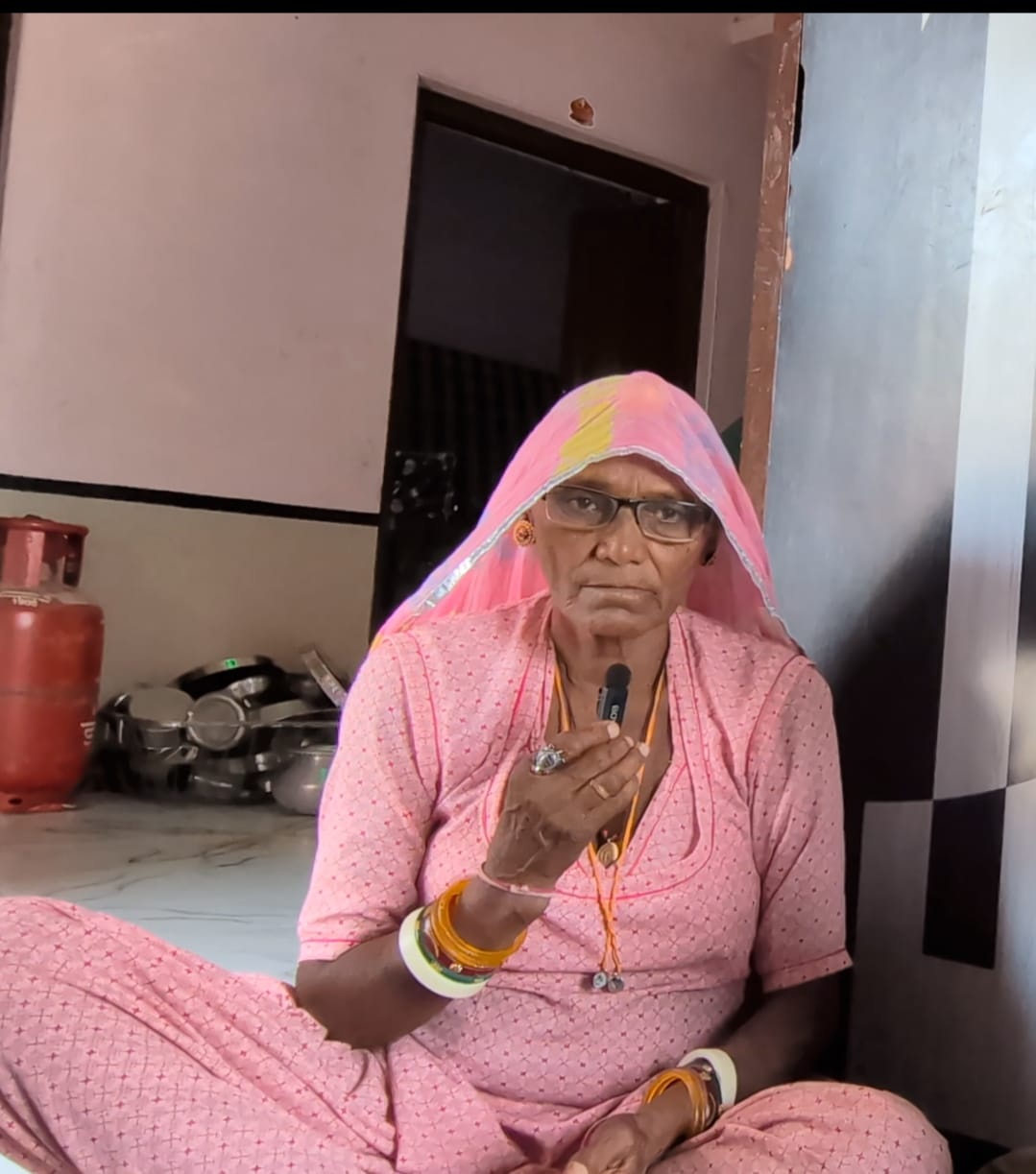
Be that as it may, the pain and distress that Sonki Devi and five other women present in the house underwent is enough to move any sensitive person. An attempt was made to molest them and filthy pejoratives like “Dhedhni” and “Chamarin” were hurled at them. Sonki Devi, the wife of Paancharam, had never ever ventured into her village without her face covered and head down. Little did she know that the supposedly powerful, dominant caste of the village would one day reward her with widowhood, serious physical injuries, and a trauma from which she would never recover. Her vision has become hazy. She wears glasses. But the hope for justice lingers in her eyes.
(Translation from the original Hindi by Amrish Herdenia)
Forward Press also publishes books on Bahujan issues. Forward Press Books sheds light on the widespread problems as well as the finer aspects of Bahujan (Dalit, OBC, Adivasi, Nomadic, Pasmanda) society, culture, literature and politics. Contact us for a list of FP Books’ titles and to order. Mobile: +917827427311, Email: info@forwardmagazine.in