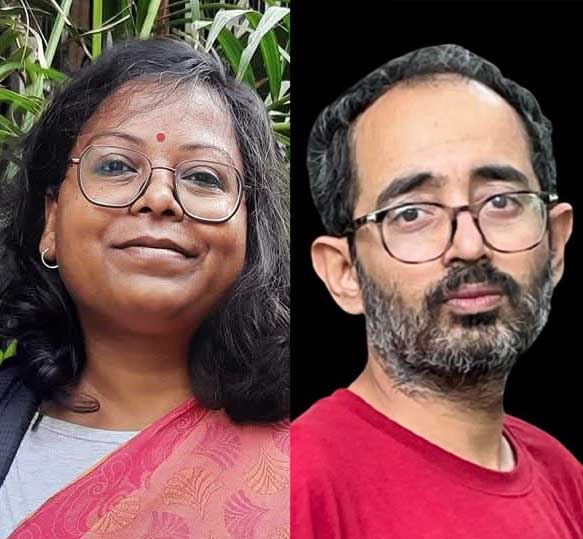
Hansda Sowvendra Shekhar is a Jharkhand-based medical officer, who has earned his fame by writing stories about the struggles of the Adivasi community, particularly the Santhals of Jharkhand and the adjoining areas. Among his books, The Adivasi Will Not Dance has perhaps created the greatest buzz. First published in 2017, the book is a collection of ten stories, most of them about the lives of the Santhals. The author deserves appreciation for trying to educate the non-Adivasis about the everyday struggles of Adivasi communities, which are largely ignored by elite authors and journalists. Barring a few exceptions, most writers and journalists with upper-caste and upper-class social locations fail to understand the issues that matter to the Adivasis. Their prejudices make them see Adivasis as either “backward Hindus” or as “left-wing militants” opposing development. While the political domain has representation from Dalit and Adivasi communities due to Constitutional compulsions, the cultural and economic domains continue to be dominated by a small section of the upper castes. Despite rampant caste-based discrimination in academia and the publishing industry, Dr Shekhar has carved out a niche for himself, which is commendable.
Among the ten stories that make up the book under review, the last one, ‘The Adivasi Will Not Dance’, which is also the title of the book, is the most powerful. The State, market, and political economy are missing from the other stories and so are the problems faced by Adivasis due to broader structural issues. But the last story raises fundamental questions about the model of development that our ruling classes have imposed on the country.
However, we disagree with the author on some issues, particularly his portrayal of Muslims. His views on Christians and their religious and educational institutions are also controversial. As an Adivasi, the author is justified in highlighting the distinct traditions and values of the Adivasi community, but progressive politics places on him the responsibility of trying to forge the unity of the oppressed rather than emphasizing the differences.
Besides, his views on sexuality and the agency of Adivasi women need a closer examination. While the author deserves the credit for addressing the problems faced by the Santhals, the exercise would have been more fruitful had he explored the linkage between the problems of the Adivasis and the wider social, economic, and political structure (‘The Adivasi Will Not Dance’ being the exception).
Adivasi
The first story, entitled “They Eat Meat!”, is about a Santhal family. Panmunijhi’s husband, Biram Soren, a government officer, is transferred from Bhubaneswar to Vadodara in Gujarat at the time when Gujarat is witnessing massive anti-Muslim violence. The Adivasi family experiences discrimination right from the moment it lands in Vadodara. While the mainstream media and corporate lobby praise the cities of Gujarat for their advancement, the author brilliantly shows how the so-called advanced urban spaces are sites of cultural hegemony of the upper-caste Hindus. m The Santhal family is not only advised to suppress their Adivasi identity but also keep away from jill-haku (meat and fish) and eggs. Mr Rao, the landlord, introduces his new tenant to the cultural practices of the city, “Vadodara is a strong Hindu city … People here believed in purity … People here don’t eat non-veg. You know? Meat, fish, chicken, eggs. Nor do they approve of people who eat non-veg.” (p 6)
Mr Rao’s introduction does not only reveal the brahmanical cultural practices but also the exclusion of those who do not follow those practices. Mr Rao’s comment that people do not “approve of” those “who eat non-veg”, is a manifestation of a mechanism to ‘control’ Dalits, Adivasis, OBCs and religious minorities. “Muslims and Christians, they don’t stand a chance here. They have separate areas where they live. Cities within a city. Separate bastis for Muslims, for Christians,” says Mr Rao. (p 6)
Once he is done with the instructions, the landlord asks the Adivasi tenant to take a vow not to cook non-vegetarian dishes in the kitchen even though he is required to pay a huge amount as rent every month. Look at the coercive language of the landlord, “Can you assure me that you won’t cook any non-veg in my kitchen? No meat-mutton-egg-chicken-fish. Nothing?”(p 8)
The Soren family is not ready to accept these diktats. But their way of life is unwelcome in the city. The urban areas were perceived as a place where ascriptive identities and conservative practices would matter little, where migrants could enjoy freedom. But that’s no longer the case.
But the tenant is not ready to accept the restrictions. The Santhal family scouts for ways to enjoy non-vegetarian dishes. Occasionally, they visit their relatives in the city to have the food of their choice. They devise ways to prepare eggs in their kitchen. “If buying eggs was a difficult task, cooking one was a mission in itself.” Panmuni-jhi has to make sure that ‘the odour of the eggs’ does not waft out and that egg shells are disposed of discreetly. The author does a fine job of exposing the conservatism of urban spaces and their exclusionary character. Food culture is just a part of the problem. A single Dalit, Muslim or Adivasi woman stands little chance of even getting an accommodation in the city.
However, the author contradicts his own radical tone by depicting that the Santhal family is beginning to feel at home in the city.

One of the limitations of the stories in the collection is that the author has not made efforts to show how the sufferings of Adivasis are more or less shared by other marginalized sections and how there can be solidarity between them.
Internal critique
Let us now examine how the author has dealt with social ills within his own community. For example, the second story (‘Sons’) is about Kalpana-di, whose husband is a corrupt bank manager. Their spoilt son, Suraj, smokes and drinks. This story could unsettle those who romanticize Adivasi life as “idyllic happiness”, uncorrupted by the shrewd and exploitative mainstream society.
Similarly, the seventh story (‘Baso-jhi’) offers another critique of Adivasi society, which oppresses its own people on the pretext of rooting out witchcraft. Baso-jhi, or Basanti, is a “shy, naïve Santhal girl, unschooled and illiterate”. After marriage, she gives birth to two sons. Her husband dies and later, when her younger son’s child dies of diarrhoea, her daughter-in-law accuses her of being a dahni, a witch. Later, the author gives a very painful description of how Baso-jhi’s own son abuses her, beats her and throws her out of their home.
While the author foregrounds the suffering of Adivasi women, he misses locating the social and economic reasons behind the “witch-hunt”. Adivasi women are usually accused of witchcraft and attacked to evict them from their property and facilitate landgrabbing.
A section of the so-called rationalists and progressives often deride the superstitious practices among the Adivasis as practices of a backward people, yet they never care to delve into the social, economic and political structure that supports and promotes such social ills. Eminent sociologist C. Wright Mills (The Sociological Imagination, 1959) has shown how individual problems are linked to the larger societal structure. He has cited the example of women turning widows and children orphans during wars, arguing that individual tragedy is linked to the social, economic and political structure of society. Some Adivasis may be involved in embezzlement, but the author should have traced the social reasons that push them into such malpractices.
Gender and Sexuality
While the author has focused on the plight of Adivasi women, some aspects of his storytelling are questionable. For example, the third story (‘November Is the Month of Migration’) is based on the migration of Santhals to the nearby Bardhaman district in West Bengal. The migrant Adivasis seek various forms of employment, including as labourers in the paddy fields. This story is about Talamai Kisku, a 20-year-old migrant Adivasi woman. Talamai takes to prostitution to feed her family. The author makes a sweeping statement that “on their way to Namal, Santhal women do this work for food and money at the railway station, too”(p 40). Talamai agrees to have sex with “young, fair, a Diku, and a Jawan of the Railway Protection Force” in exchange for “bread pakora” and fifty rupees. This creates an impression that Adivasi Santhali women have no agency and have no qualms about involving themselves in such a trade. The author has taken an individual case and used it to make a broader claim about Adivasi women.
In the sixth story (‘Blue Baby’), a woman occupies the central theme. The woman protagonist is depicted as cheating on her husband for the sake of her boyfriend. The story revolves around Gita, who is in love with Dilip but is going to be married to Suren. A day before her marriage, Gita meets Dilip and has sex with him in the hope that she gets pregnant and Dilip returns to her. However, Dilip never comes back. Here again, the portrayal of the woman protagonist raises serious questions.
The eighth story (‘Merely a Whore’) revolves around a sex worker, Sona. She is so beautiful that she has become the pick of all those who visit the brothel. Among Sona’s regular customers is a young transporter, Nirmal. His macho personality and display of wealth attract Sona, and both begin to spend time together. Sona falls in love with Nirmal and begins to dream of marrying him. However, Nirmal has no such plans and he eventually ditches Sona.
The story is a poignant description of the life of a prostitute – even those who are dying to spend time with her would never accept her in public. However, the author has overindulged in describing the sexual act.
The eighth story, titled ‘Desire, Divination, Death’, is also about an Adivasi woman who works in a rice mill. This is the story of the dire poverty in Adivasi society and the everyday struggle of its women, who are both homemakers and workers. Subhashini, a Santhal widow who is a mother of two girls and a boy, has no choice but to go to work leaving behind her son running a high fever. The boy asks her to bring jalebi when she returns from work. But on her return she discovers that her son has died. This is a moving description of the exploitation of workers and their day-to-day struggles.
Caste
The fifth story of the book (‘Eating with the Enemy’) deals with the theme of sexuality and agency of women. Here, the protagonists are not Adivasis but Dalits. However, the author uses the term ‘Harijan’ for Dalits, which is problematic; it is a term that Gandhiji gave to Dalits and it was strongly opposed by sections of the community. Sulochona Behra is a Dalit woman belonging to the Ghasi caste. Her husband, Dinanath Behera, has an affair with a liquor-seller Mohini from the milkman caste (Gaund) and brings her home as his “mistress”. Dinanath dies and Mohini starts living with a wealthy Telugu man, Babu. In return for shelter and food, he secures sexual favours from Mohini. Later, when Sulochona Behra meets Mohini and comes to know of her prosperous life, she sends her young daughter Mathabhangi with Mohini to Babu’s place. Babu, a sexual predator, tries to molest Mathabhangi but she somehow escapes. At one point, Sulochona Behra, Mohini and Babu drink together despite what Babu has done to her daughter. This story depicts a Dalit mother as greedy and insensitive to her daughter’s traumatic experience. The author appears to fall for the upper-caste writers’ trope in which Dalits are depicted as passive and their women as easy prey for sexual predators.
Religious minorities
The portrayal of religious minorities is even more problematic. For example, the fourth story (‘Getting Even’) is based on unsubstantiated charges against the Christians. This story unfolds at a Sadar Hospital in Santhal Pargana, where a ten-year-old boy accused of rape is brought in by the police to examine whether he he has attained puberty. This story has an engrossing beginning, and as the plot unfolds, the heartbeat of the readers increases, showing the capacity of the author to write lucid, engaging prose.
After examining the boy, the doctor concludes that the boy is too young to commit the act. Later, the weeping parents of the boy narrate what really happened: their vengeful Christian relatives were trying to frame their child. The mother of the boy is a Santhal woman who married a barber-caste Hindu. The Christian relatives had sold her daughter in Delhi. She tells the doctor, “Those people are taking revenge on us because they sold our daughter in Delhi and we rescued her and brought her back” (p 54).
The Santhal woman says that her relatives did not approve of her marriage to a non-Christian Thakur. She tells the doctor, “They are Santhals, sir. Kiristans… And this is what they do. They bring Santhal girls from villages on the pretext of giving them education and training and work, and sell them …” (p 54)
This story thus appears to promote and strengthen the right-wing narrative that Adivasis are lured into Christianity. There is no substantive evidence to prove that Christian religious, social or educational organisations are involved in human trafficking.
The third story also puts the Christian missionaries in the dock. Talamai, a young Christian Adivasi girl, could not get access to educational institutions run by Christian missionaries. Consequently, she ends up working in the fields and coal mines.
We agree with the author that the Church or Christian missionary institutions are run by people who may have their own biases. We are also aware of the Dalit Christians’ critique that Christian religious or educational institutions are not free from caste or regional prejudices. But the author should also not expect Christian missionaries to take responsibility for the education of all Adivasis in general or Christian Adivasis in particular. The author must have been aware of the communal polarization in Jharkhand and other Adivasi areas. The right-wing forces have been trying to cause division between Adivasis who have converted to Christianity and those who haven’t. Given these sensitive issues, the author should have been much more nuanced in his formulation.
While the author is justified in raising the issue of educational deprivation among Adivasis, he fails to show the root cause of the problem. In a welfare democracy like India, where educational deprivation is a consequence of a rigid social hierarchy, the State cannot run away from its responsibility of educating the masses, particularly the downtrodden.
In the last story too, the author makes a generalization about the Muslim community of Jharkhand – that they are encroaching upon the villages of Santhals and “sleeping with” their women. Here is an excerpt: “A decade earlier, when the Santhals of Matiajore were beginning their annual journey to sharecrop in the farms of Namal, four Jolha families turned up from nowhere and asked us for shelter. A poor lot, they looked as impoverished as us. Perhaps worse. In return, they offered us their services. They told us that they would look after our fields in our absence and farm them for a share of the produce. We trusted them. They started working on our fields and built four huts in a distant corner of Matiajore. Today that small cluster of four huts has grown into a tola of more than a hundred houses. Houses, not huts. While we Santhals, in our own village, still live in our mud houses, each Jolha house has at least one brick wall and a cemented yard. This tola is now called the Jolha tola of Matiajore. Matiajore used to be an exclusive Santhal village. Today, it has a Santhal tola and a Jolha tola, with the latter being the bigger. Sometimes I wonder who the olposonkhyok [minority] is here.” (pp 175-176)
It is sheer exaggeration that the four families of the weaver community would become hundreds of people in a decade and their four huts would expand into a tola. If the Muslims have built their pucca houses, they can only be blamed if they have resorted to unfair means or have exploited the Adivasi community. If they have not indulged in any such practices, how could they be blamed for the plight of the Adivasi community?
This is the same narrative that was used by the Hindu Right in the 2024 Assembly Elections in Jharkhand – that (Bangladeshi) Muslims are not only marrying Adivasi women but also usurping their land and changing the demography of the state. While it is true that the population growth rate of Muslims is a bit higher than that of other communities, this has not changed the demography of the state significantly. And the reason for the higher population growth among Muslims is social, educational and economic, rather than religious.
It is also not appropriate to use the term “Jolha” for the weaver-caste Muslims. One should be sensitive to the fact that the community prefers not to be addressed as such and many among them consider the term derogatory.
Displacement
The last and the tenth story (‘The Adivasi Will Not Dance’) is the pick of the collection. This is a serious critique of what is wrong with India’s development model. The author succeeds in highlighting how the so-called development and progress takes place at the cost of Adivasis. The plot of the story is beautifully woven, and till the last moment, the author is able to keep the reader riveted.
The story begins with a description of the Birbhum areas where Rabindra Nath Tagore established his Santiniketan. However, what has been almost forgotten now is that Santiniketan and its adjoining areas were once the habitat of the Santhals, who fought against the British Raj and opposed their native agents. They have been the victims of the process of the building of the nation-state and its profit-based economic models.
At the centre of the story is Mangal Murmu, a Santhal musician who, along with his troupe, composes music and leads musical performances. However, changes in the political, social and economic conditions have ruined the lives of Santhals in the area. Development works have destroyed the ecology and mining has defaced the beautiful landscape. Be it for mining, construction of roads, thermal plants, or factories, the Santhals have been uprooted from their habitats, their lands have been snatched from them, and those who resisted have been beaten up or put behind bars.
Mangal Murmu, who is from Pakur district, narrates the tale of this destruction. Santhal farmlands were “acquired by a mining company” and those who fought against the “acquisition” were framed and put in jail. Mangal Murmu is critical of the so-called leaders and civil society actors who “apparently come to support us [Adivasis] but when the land is snatched, they too leave the Adivasi to suffer alone”.
Murmu also says that the media, instead of reporting the truth, presents the facts from the perspective of the rich and the powerful. The coal and stone merchants are also involved in exploiting the Adivasis. The Adivasi protagonist is right in observing that while the Dikus exploit the Adivasis and build big houses, the Adivasis live in dire poverty.
The protagonist Murmu not only shows the contrast between the lives of Diku exploiters and the indigenous Santhal community but also describes how the mining and plundering of Adivasi resources is polluting the environment, putting human lives in peril and endangering wildlife.
While the lands of Santhals have been taken away from them, their dance and music have been turned into exotic items to entertain and showcase India’s diversity. Murmu is invited by senior government officers to perform at a cultural programme to be attended by the President of India, who is on a tour of Jharkhand to lay the foundation stone for a thermal plant in Godda district. Murmu is critical of the attitude of the Dikus, who control the resources in the state of Jharkhand and dominate educational and administrative institutions as well, while the exploited Santhals are supposed to showcase Jharkhandi culture.
While Murmu is preparing for the musical show before the President of India, he hears the news that the police have forced the Adivasis from eleven villages in Godda district to vacate their lands for the setting up of the thermal power plant. The laws like the Tenancy Act, bring them no relief. When the villagers refuse to leave their villages and fight for their rights, the district administration uses brute force, bulldozes their houses and throws the protesters behind bars.
Among those who were displaced are Mangal Murmu’s daughter and her family. Worse still, Murmu’s son-in-law is jailed and, with nowhere else to go, his daughter, along with her children, comes to his home. Distracted and pained by these events, the musician struggles to arrange the dance and music show for the President of India.
Through the protagonist Mangal, the author exposes the failure of the media to cover people’s issues. While the journalists are busy covering the official functions, what the Adivasis have had to endure for the building of the power plant is blacked out.
Those speaking from the stage at the cultural programme are insensitive to the plight of the Adivasis and are busy praising the businessman who will own the thermal plant. Clearly, the sole motive of the businessman is to make money, but his “generosity” to set up the plant to light up the state is lauded. During the function, patriotic Hindi songs are played, and slogans of “Bharat Mahan” are raised from the stage. These displays of sycophancy and patriotism are placed in sharp contrast to the plight of the Adivasis displaced as a result of the power plant. Patriotic symbolism has been used by the ruling classes to justify their reign of corruption and exploitation.
As Magal holds the microphone to speak, he asks himself: How can Adivasis dance on a stage that is celebrating the displacement of Adivasis? Delegates, leaders and officers are expecting him to start the performance but he speaks truth to power instead and refuses to perform until the land grab is stopped.
The author hits the bull’s eye in this final story, especially in its last paragraph. We sensed a radical voice of resistance against the wrongs being done to the Adivasi community in the name of development and nation-building. The book, notwithstanding its limitations, is unique in the way it compels the reader to see Adivasi society through their own lens, distinct from the elite culture of looking at Adivasis as distant, exotic peoples.
(Edited by Amrish Herdenia/Anil)
Forward Press also publishes books on Bahujan issues. Forward Press Books sheds light on the widespread problems as well as the finer aspects of Bahujan (Dalit, OBC, Adivasi, Nomadic, Pasmanda) society, culture, literature and politics. Contact us for a list of FP Books’ titles and to order. Mobile: +917827427311, Email: info@forwardmagazine.in