When we Indians talk of development, we often see forests, hills and rivers as resources. For the Adivasis, nature is not a resource, but part of the extended family. The Sal tree (known locally as Sakhua or Sarayi) is central to the celebration of the Sarhul festival. Celebrated in Jharkhand, Chhattisgarh, Odisha and Bihar, Sarhul is a festival in keeping with the Advasi philosophy of life.
Celebrated with the flowers of Sal tree, Sarhul is not just a religious ritual, but a symbol of Adivasis’ coexistence with nature for centuries. The Adivasis consider Sal tree a symbol of Singbonga (the supreme deity of Munda, Santhal and a few other tribes) and Dharmesh (the supreme deity of Oraon tribe).
Sarhul is celebrated by Munda, Oraon, Ho, Santhal and a few other tribes with great gusto. The word Sarhul is a combination of two words “Sar” (Sarai flower) and “hul” (revolution or blossoming). The festival’s literal meaning conveys its essence. Sarhul is known by some other names as well. Mundas call it “Ba Parab” (festival of flowers), Oraons call it “Khaddi” (flowers and leaves) or “Khekhel Benja” and Santhals call it “Baha” (flower). Among Kharias, the name “Jankor” is popular where “Jang” means seeds and “Ekor” means process – the process of the making of seeds.
Sarhul celebrates the blossoming of Sal trees. While the rest of the world looks to a calendar to determine the beginning of a new year, Adivasis seek cues from the forests. When Sal trees cover themselves with new leaves and flowers, it is time for Adivasis to welcome the new year. Nature, not the calendar, decides their festivals.
Sarhul is also about respecting nature, protecting the environment and preserving Adivasi culture. It is not just celebrated, it is lived. It symbolizes the philosophy of evolution with its emphatic message that humans are not masters of nature, but just a small part of it.
Humans tap into nature year round to survive. Sarhul symbolizes expression of gratitude to nature and the wishing of a good crop in the new year. Fields are given a break during Sarhul and ploughing is strictly prohibited. This is in sharp contrast with the modern consumerist culture, which views land just as a resource. Sarhul embodies the idea that before growing crops, we need to seek permission from Mother Earth and learn to respect and value her fertility.
Sarhul is also a celebration of the marriage of Earth and Singbonga (Sun). This wedding symbolizes respect for the process of creation. Starting a few days before Sarhul, Adivasis don’t hunt or pluck fruits from trees in the forests. It is believed that the period around Sarhul is the breeding season for many species inhabiting the jungles. A ban on hunting during this period demonstrates how sensitive the Adivasis are to the reproduction cycle of nature. When animals give birth, it is considered sinful to come in the way of perpetuation of life.
Sarna religion and Sarhul
Sarhul also has a close association with the religious beliefs of the Adivasis. The religion of the Adivasis inhabiting Jharkhand and surrounding areas is often called Sarna. This religion is founded on the belief that nature is the supreme power. Deep inside the jungles is a sacred place called Sarna Sthal – which is the central place of worship. These days, Sarna Sthals have sprouted in villages as well as in towns and cities.
Around Sarhul, the village priest, known as “Pahaan”, goes to the Sarna Sthal and performs a puja with Sal flowers and other things of traditionally symbolic value obtained from nature. In return for fulfilling their religious obligations, the community donates some land to the Pahaan, which is called “pahnaayi” land. It is remuneration for his work but the land still does not become his personal property. Normally, pahnaayi land can’t be sold.
Pahaan prays for prosperity and safety of the community and for good rain. Starting farming after the puja is considered auspicious.
Cultural significance of Sal tree
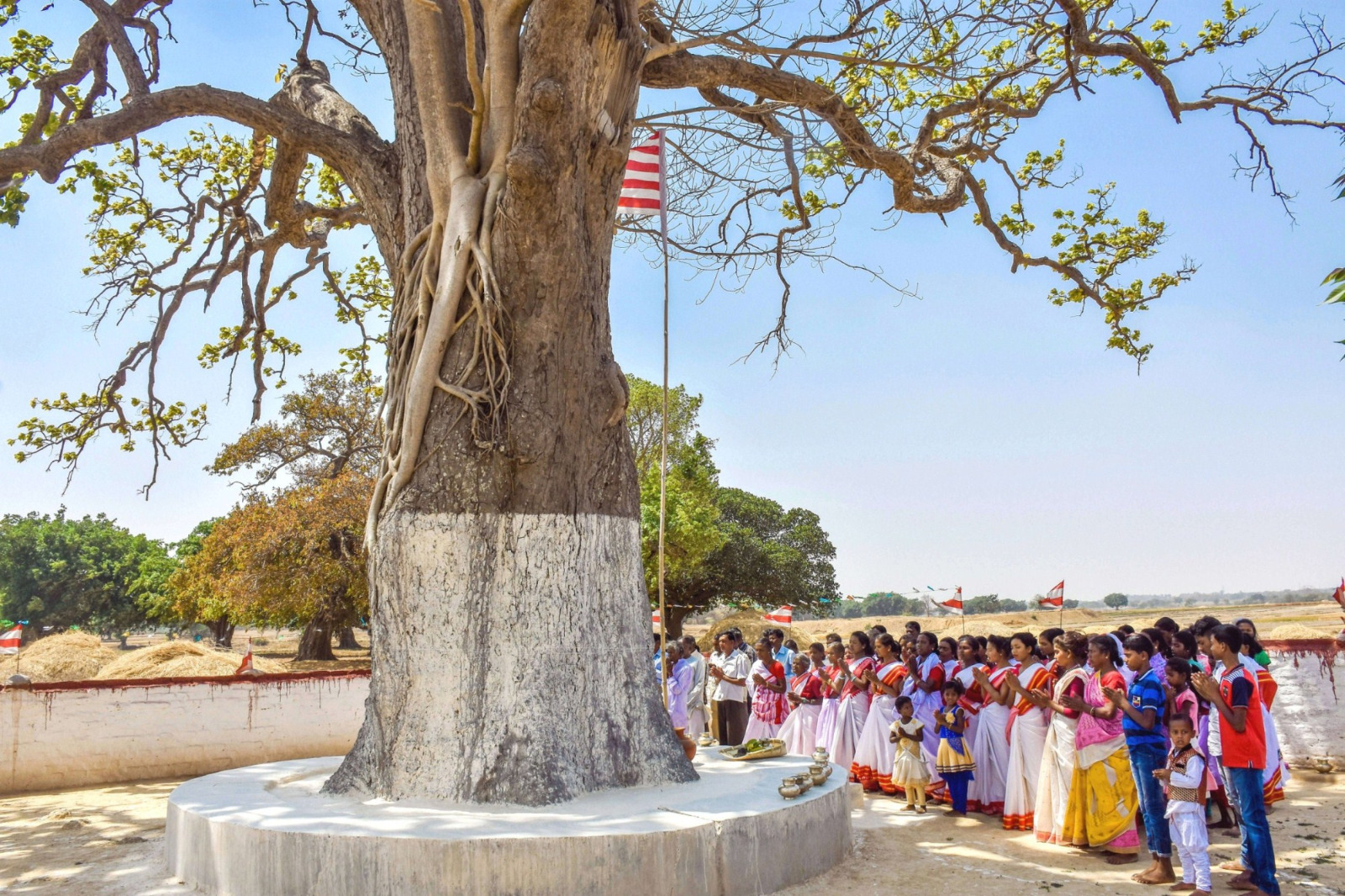
Sal tree is central to Sarhul. Sal is also the “state tree” of Jharkhand and Chhattisgarh. For Adivasis, Sal is not just a tree. It symbolizes life. Folk tales have it that in the olden times, the ancestors of the present-day Adivasis were nomads. They moved from one forest to another and were completely dependent on nature. They survived on wild roots, fruits, and hunting, and stayed wherever darkness fell.
Then, one day, they encountered a mighty Sal (Sakhua) tree. Its thick and strong trunk could save them from the creatures in the wild. Its canopy of dense branches and leaves gave them a sense of security – much more than any other tree could. Their ancestors felt that Sal was not just a tree but their guardian, their protector. Every part of the tree – wood, leaves and seeds – was useful for them. This made them accord a sacred status to the tree. That’s why the Sal tree is a permanent fixture in all Sarna Sthals.
The flowers of Sal trees are considered sacred. During Sarhul, the Pahaan brings these flowers from the Sarna Sthal and distributes them among the villagers, who reverently keep them in their homes. The Sal flowers symbolize the bounty of nature and prosperity.
Sarhul rituals
Sarhul is celebrated for three days. In Ranchi and the adjoining urban areas, Sarhul celebrations begin on the third day of the Shukla Paksha of the month of Chait, which is a government holiday. However, in the rural areas, the festival is celebrated on different dates in different villages. Sarhul’s association with farming manifests itself in different ways in different areas. This diversity is not of religious origin. It is the consequence of the local terrain and climate.
Pre-monsoon showers set in relatively earlier in the southern plateau of Jharkhand, including Ranchi and around. Sal trees blossom in the month of Chait and it is the time to begin preliminary preparations for the next sowing season. Hence, Sarhul is celebrated in Chait in this area and it is also known as “Phool Sarhul”.
In the northern areas, however, the seasonal change takes place a little later and so do the preparations for farming. Here, Sal trees blossom in the month of Vaishakh and that is the time when Sarhul (Phool Sarhul) is celebrated here.
Thus, Sarhul is not tied to a particular date, but is linked to nature and the farming cycle. That is why it is celebrated on different dates in different parts of Jharkhand. At some places, the celebrations last a month.
Generally, people fast on the first day of the festival and the young boys go out to catch fish and crabs. Adivasis believe that crab and fish are ancestors of the Earth and consider them auspicious. On Sarhul, alongside ancestors, crabs are also worshipped. The crab is hung by sacred thread (arva) to dry above the hearth in the kitchen. A few months later, when sowing begins, the crab is ground and mixed with water. This water is used to wash seeds. At some places, seeds are mixed with crab powder before sowing. As crabs lay a large number of eggs at one time, it is believed that mixing crab powder and seeds will lead to plentiful harvest. Water is ritualistically poured over fish and that water is sprinkled in the house.
On the Day One itself, the Pahaan ceremonially fills two clay pots with water from a lake or well and places them at the Sarna Sthal. On the second day, men from the village carry the Pahaan on their shoulders to the Sarna Sthal, where he is given a ritual bath. The Pahaan then performs the puja using Sal flowers, rice, hadia (a traditional drink made from rice) and other items. Then three cocks are sacrificed – a red one for the village deity, a white one for Singbonga and a black or spotted one for the ancestors. The chicken meat is cooked with arva rice and is eaten as “prasad”. It is called “sudi bhaat”. During the puja, the participants pray to Maa Sarna, Singhbonga, the village deity and ancestors.
This puja is an offering of reverence and gratitude for the forces of nature. It also involves seeking blessings for the prosperity of the community. After the puja, the Pahaan minutely observes the water in the two pots and makes a forecast about rains. People believe that rain clouds will come from the direction where the outside of the pot appears moist. If there is a small drop in the water level, rainfall will be adequate. But if it drops below the halfway mark, a drought or a famine is predicted. All this cannot be dismissed as mere superstition. It is the essence of the wisdom that the Adivasis have acquired by living in communion with nature for thousands of years.
After the puja, the entire village gets out on the streets. They take out a procession, dressed up in their traditional attire and dancing to the tune of madar, nagara and dhol. The dance performed on the occasion is called “jhoomar”. In Jharkhand – and especially around Ranchi – the processions from different tolas culminate at the main Sarna Sthal called “Siram Toli”.
The third day is devoted to the rituals of the marriage of the Earth and the Sun. It is called “Khekhel Benja” in the Oraon dialect. The Pahaan plays the role of the Sun while his wife, the Pahnaayin plays the Earth. This wedding symbolizes creation and prosperity, and is believed to bring about a good crop. The union demonstrates the fact that crops can’t be grown on the Earth without sunlight.
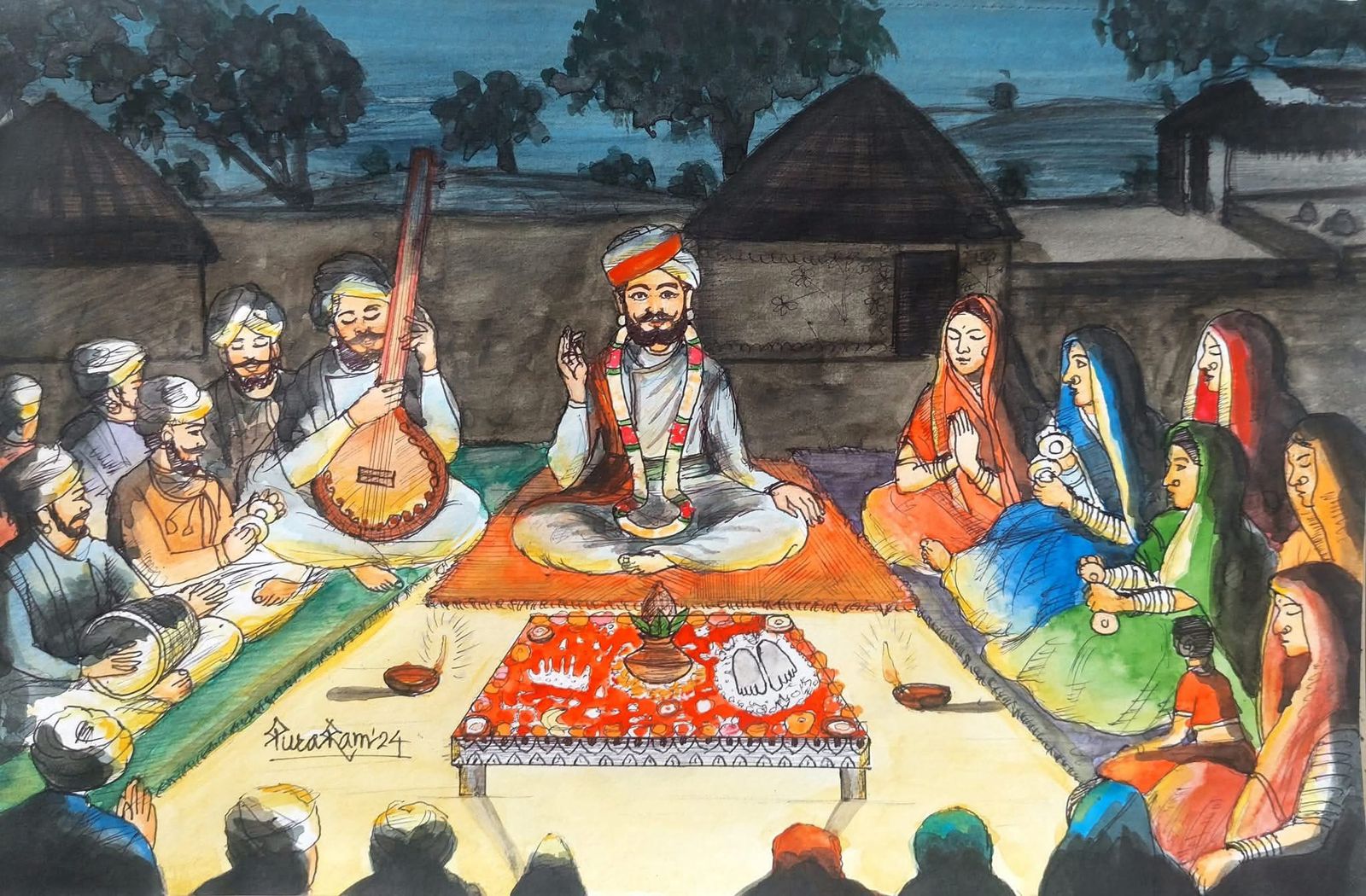
After “Khekhel Benja”, the Pahaan goes from house to house in the village or the town carrying the Sarai flowers in a “soop” (winnowing basket) as part of a ritual called “Phoolkhaunsi”. Residents of the village, singing and dancing, accompany him. The Pahaan is received with great respect in every home. He is seated on a mat and his feet are washed and that water is then sprinkled on the roof of the house.
Then the Pahaan inserts the flowers in the crevices in the outer wall or the cracks in the main door of the house. The family members tuck these flowers behind their ears. This is not just for looks, but is also seen as a blessing from the ancestors for happiness and peace.
Sarhul songs and dances, and launch of Shobhayatra
According to the Kendriya Sarna Samiti (Central Sarna Committee), it was in 1967 that the tradition of taking out a Sarhul Shobhayatra (parade or pageant) began under the leadership of Kartik Oraon. The parade begins from the Hatma Sarna Sthal at Ranchi College after the puja there and is accompanied by bands and traditional musical instruments. It was launched as a means for the Adivasis to assert their right on their land. The idea was to showcase the culture, traditions and lifestyle of Adivasis for the wider world.
Music and dance are integral to Sarhul. For the Adivasis, dance is not merely a means of entertainment but also a means to keep collective memory and cultural traditions alive. Young girls and boys, donning traditional attires, dance at the akhda (village common space) to Sarhul songs, accompanied by mandars, dhols and nagaras. Women wear saris with white and red borders and traditional ornaments and adorn their hair with Sal flowers. Men wear dhoti-kurta and traditional headgear.
Sarhul songs celebrate nature, love, community and life. They are a poetic expression of the connection of humanity with forests, rivers, hills and land. The songs and dances showcase the shared identity of the community. They are also meant to equip the coming generations with knowledge about the culture of the Adivasis.
Farming cycle and Sarhul
Sarhul is not only about religious beliefs. It is connected with the New Stone Age, which marked an important turn in human civilization. That was the time when humans gave up a nomadic existence and began farming. It would not be wrong to surmise that festivals like Sarhul – which celebrate nature – must have been born in the era when the primitive man began understanding the significance of seeds and the seasonal cycle.
Sarhul’s global message
At a time when the world is obsessed with “Paris Accord” and “carbon footprint”, the philosophy underlying Sarhul offers a simple yet infallible solution to the environmental crisis facing humanity. “Nature worship” doesn’t only mean bowing before trees. It also means acknowledging that nature is our master. The tradition of not using the plough and of first offering fruits and flowers to nature is a primitive form of sustainable development. Sarhul teaches us to take from nature only what is necessary and allow it to blossom and grow.
Here we also need to dwell on the developments that are depriving festivals like Sarhul of their sheen. The Sal trees and the Sarna Sthals are being sacrificed on the altar of industrial projects. Not only people but also the “cultural geography” that sustains festivities like Sarhul are being displaced.
A recent example is the protest against the construction of a flyover near the Sarna Sthal at Sirma Toli in Ranchi. The Adivasis see it as an encroachment on their beliefs, identity and cultural rights. This protest signifies that the modern concept of development marginalizes sacred places and the traditions that are central to the life of Adivasis.
(Translated from the original Hindi by Amrish Herdenia)
Forward Press also publishes books on Bahujan issues. Forward Press Books sheds light on the widespread problems as well as the finer aspects of Bahujan (Dalit, OBC, Adivasi, Nomadic, Pasmanda) society, culture, literature and politics. Contact us for a list of FP Books’ titles and to order. Mobile: +917827427311, Email: info@forwardmagazine.in